How Do Some Devices Have Dual Input Voltage Ratings?
Why and How Do Some Electrical Devices Support Two Different Voltage Ratings as an Input Power?
Dual Voltage Operated Devices
Different countries use different standard voltages for their power grids, commercial and residential applications. For instance, USA and Canada use 120V/240V, while Europe, UK, Asia and Africa use 230V/415V. Surprisingly, Japan uses 100/200V system which is totally different from others.
Dual-voltage devices allow manufacturers to create a single product that can be sold and used in multiple regions without needing separate models. Many modern electronics (like laptops, smartphones, and chargers) use switch-mode power supplies (SMPS) that can handle a wide range of voltages (typically 100–240V). Hence, the multiple or universal voltage operated device avoid the need for external transformers or voltage converters. This feature is especially helpful for travelers who frequently visit different regions having different voltage standards around the world.
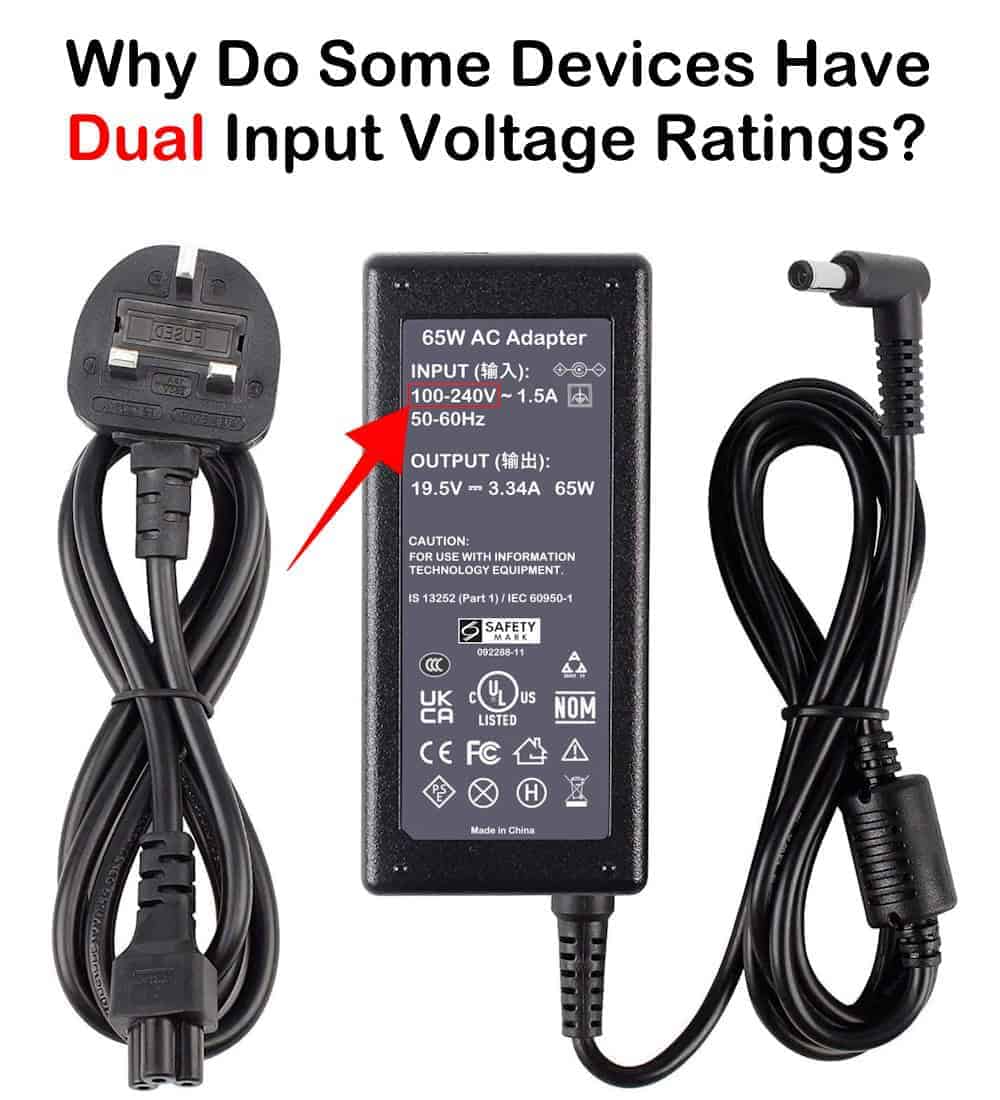
A “dual voltage” device can operate with two different input voltage levels, typically found in different countries or regions. This means the device is designed to function correctly with both a lower voltage (e.g., 110-120V) and a higher voltage (e.g., 220-240V). Devices with a dual voltage rating often have a range of acceptable input voltages printed on them (e.g., “90-240V”). In these devices, switching power supplies and SMPS regulate voltage internally, converting AC to DC efficiently regardless of input voltage within the rated range.
For this reason, some electrical devices are designed with dual-voltage input ratings to accommodate varying power standards in different regions. This allows the same device to operate safely on both low (e.g., 100-120V) and high (e.g., 220-240V) voltage systems.
- Related Post: Can an AC Device Operate on DC Supply, and Vice Versa?
Can Universal Voltage Operated Devices Work with Any Voltage?
Not exactly! they can work within a specified range. For example:
A label that says “100-240V, 50/60Hz” means, the device accepts any voltage between 100V and 240V. Similarly, it works on both 50Hz and 60Hz AC frequency (important for motors and timers).
Devices with Universal Power Supplies: Many modern electronics (e.g., laptops, phone chargers, cameras) have power adapters labeled for a wide voltage range (e.g., 100-240V, 50/60 Hz). These devices can work with virtually any standard household voltage worldwide. This is because dual-voltage devices automatically adjust to the input voltage and frequency. You may only need a plug adapter to match the outlet type in different countries. Some dual-voltage outlets are NEMA 6-15 and 6-20 rated for 125/250V can be wired for both 120V and 240V systems.
Devices with Manual Voltage Selection: Some devices require you to manually switch between voltage settings (e.g., 120V or 240V). If the wrong setting is used, the device may not work properly or could be damaged For instance, using a 120V setting on a 240V supply can overload and damage the device. Similarly, using a 240V setting on a 120V supply may result in insufficient power, causing the device to malfunction or not work at all.
Single-Voltage Devices: Devices designed for a single voltage (e.g., only 120V) will not work with other voltages unless used with a voltage converter or transformer to adjust the input voltage. For instance, NEMA 5-15 and 5-20 outlets rated for 125V can only be wired to 120V single phase supply.
Devices that Don’t Support Multiple Voltages
Heating appliances (e.g., hair dryers, heaters, electric stoves) often have fixed voltage ratings because they rely on direct resistance heating.
Single-voltage equipment, motors and some older electronics may only work at one voltage. This is because these appliances are designed for a single voltage (e.g., 110V) will not work safely with a higher voltage (e.g., 220V) and vice versa without a voltage converter or transformer.
Devices operate on low voltage systems like doorbells, garage door openers, battery charging and some security systems operate on lower voltages (e.g., 12V or 24V) and are not designed for standard household voltages.
Precautions and Consideration
- Always check the label or marking on the device nameplate for voltage, current and power ratings. It usually stamped on the device or its power adapter. Confirm its voltage compatibility before plugging in the outlet.
- Most devices that support dual voltages also handle both 50 Hz and 60 Hz frequencies, but some (e.g., clocks or motors) may be sensitive to frequency differences.
- When traveling, always check the voltage requirements of your devices and the voltage of the electrical outlets in your destination.
- Using a device with a voltage higher than its rating can cause damage, while using it with a lower voltage may result in improper functioning or failure.
Related Posts:
- Can you use 15A Breaker on 20A Circuit and Vice Versa?
- Can You use a 15A Outlet on a 20A Circuit and Vice Versa?
If the voltages are shown with a hyphen (–) e.g. 90-250V, it means the device can work anywhere within that range i.e. from 90V up to 250V. If they’re separated by a slash (/), i.e. 120V/240V, it means you need to change a switch or plug to use the correct voltage. In both cases, the device can usually handle a small difference of about 6% to 10% from the rated voltage.
Related Posts:
- Can We Use AC Circuit Breaker for DC Circuit & Vice Versa?
- How Do Some Devices Operate on Both AC and DC Supplies?
- Why is AC Commonly Used in Households Instead of DC?
- What Happens When an AC Line Touches a DC Line?
- What Happens if a Power Line Falls into the Ocean Water?
- When and Why Did the U.S. Transition from 110V to 120V Supply?
- Why are High-Power Devices Not Designed to Run on DC Voltage?
- Why Do Doorbells Use Low Voltage of 12V-24V AC Instead of DC?
- What Will Happen If You Connect a Male-to-Male Plug Between Outlets
- What Happens if a Battery is Connected to the AC Supply?
- Why is the Neutral Prong or Slot Wider on a Plug or Outlet?
- Why Doesn’t a Standard Breaker Protract Against Ground Faults?
- How Do GFCI and Standard Breakers Respond to Ground Faults?
- Why Can’t a 12V Car Battery Electrocute You?
- Difference Between 120V and 240V/230V AC Power Supply
- Which One is More Dangerous? 120V or 230V and Why?
- Which One is More Dangerous? 50Hz or 60Hz in 120V/230V & Why?
- Which One Kills? Current or Voltage and Why? Amps vs Volts
- Which One is More Dangerous? 120V or 230V and Why?
- AC or DC ? Which One is More Dangerous And Why
- Can I Run 1-Phase Load on 3-Phase Supply and Vice Versa?
- Can I Use a 1-Phase Breaker on a 3-Phase Supply & Vice Versa?