Three Phase Induction Motors MCQs with Explanatory Answers
3-Phase Induction Motors – Objective Multiple Choice Questions with Explanatory Answers
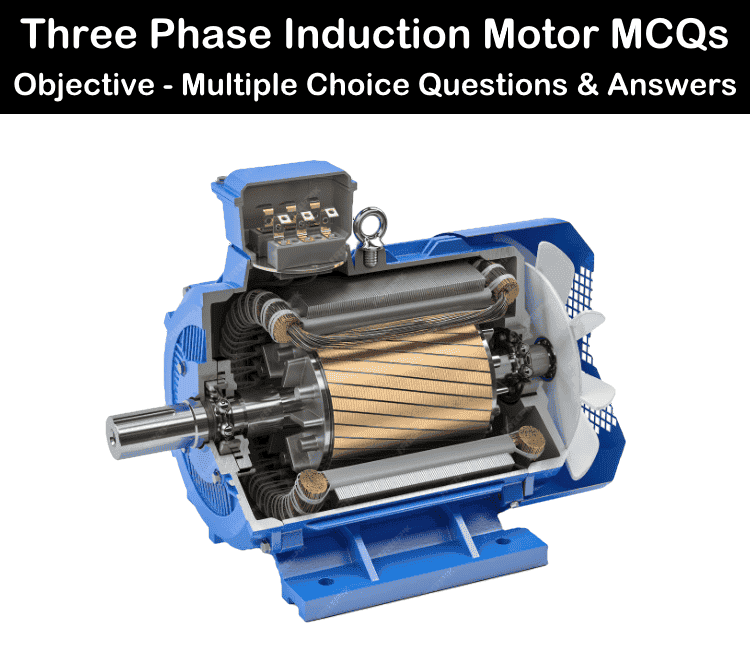
1. The induction motor is also known as ________.
- Asynchronous motor
- Synchronous motor
- DC motor
- Servo motor
Explanation: Rotor never reaches synchronous speed.
Show Explanatory Answer
2. If the frequency of 3-phase supply to the stator of 3-phase induction motor is increased, then synchronous speed is ________?
- Increased
- Decreased
- Remain unchanged
- None of the above
Show Explanatory Answer
Explanation: As we know that; f = (NSP) / 120
It is clear that f ∝ NS i.e., frequency (f) is directly proportional to the Synchronous speed (NS).
In more clear words, when frequency increases, Speed also increases.
3. The rotating magnetic field in a three-phase induction motor is produced by ________.
- Rotor current
- Stator current
- Exciter
- Permanent magnets
Show Explanatory Answer
Explanation: The 3-phase AC supply to stator windings produces a rotating magnetic field that induces current in the rotor.
4. The speed of a three-phase induction motor depends on ________.
- Rotor resistance
- Stator voltage
- Supply frequency and number of poles
- Rotor reactance
Show Explanatory Answer
Explanation: Synchronous speed
NS = 120f / P
5. Slip in an induction motor is defined as ________.
- Difference between rotor and stator current
- Ratio of rotor speed to synchronous speed
- Difference between synchronous and rotor speed divided by synchronous speed
- Ratio of stator to rotor voltage
Show Explanatory Answer
Explanation: Slip = s = (NS − Nr) / NS
6. At synchronous speed, the slip of an induction motor is ________.
- 0
- 1
- Between 0 and 1
- Infinity
Explanation: At synchronous speed, Nr = 0, hence s = 1
Show Explanatory Answer
7. At no-load, the slip of an induction motor is typically ________.
- 0.1 to 0.5
- 0.001 to 0.03
- 0.2 to 0.4
- 1
Explanation: At light load, slip is very small but non-zero.
Show Explanatory Answer
8. The rotor frequency in an induction motor is given by ________.
- Supply frequency
- Slip × Supply frequency
- Rotor speed / Supply frequency
- Constant always
Explanation: Rotor frequency = fr = s⋅f
Show Explanatory Answer
9. If slip is zero, the rotor induced EMF is ________.
- Maximum
- Zero
- Equal to supply voltage
- Infinite
Explanation: Induced EMF depends on relative speed; if slip = 0, no relative motion exists.
Show Explanatory Answer
10. The torque produced in an induction motor is proportional to ________.
- Slip
- Square of slip
- Frequency
- Synchronous speed
Explanation: At small slips, torque T ∝ s
Show Explanatory Answer
11. Maximum torque of an induction motor occurs when ________.
- Slip = 0
- Rotor resistance = Rotor reactance
- Rotor resistance = Stator resistance
- Slip = 1
Explanation: From torque equation, maximum torque when R2 = sX2.
Show Explanatory Answer
12. Which part of a squirrel cage induction motor resembles a “rotating transformer”?
- Stator
- Rotor
- Shaft
- Bearings
Explanation: Rotor bars act as secondary of a transformer.
Show Explanatory Answer
13. The starting current of a squirrel cage induction motor is ________.
- 1 to 2 times full-load current
- 5 to 7 times full-load current
- Equal to full-load current
- Zero
Explanation: No back EMF at standstill; hence high inrush current.
Show Explanatory Answer
14. In slip ring induction motors, external resistance is added to ________.
- Stator winding
- Rotor winding
- Shaft
- Air gap
Explanation: Improves starting torque and reduces starting current.
Show Explanatory Answer
15. The power transferred across the air gap is called ________.
- Input power
- Rotor copper loss
- Air-gap power
- Mechanical power
Explanation: Power crossing the air gap is called air-gap power.
Show Explanatory Answer
16. Mechanical power developed in rotor = ________.
- Air-gap power – Rotor copper loss
- Air-gap power + Stator copper loss
- Rotor copper loss only
- None
Explanation: Pm = Pg − Pcu.
Show Explanatory Answer
17. If supply frequency increases, synchronous speed ________.
- Increases
- Decreases
- Remains constant
- Becomes zero
Explanation: Ns ∝ f.
Show Explanatory Answer
18. Which of the following is NOT a starting method for squirrel cage induction motors?
- Direct-on-line (DOL)
- Star-delta starter
- Rotor resistance starter
- Autotransformer starter
Explanation: Rotor resistance starter is used for slip-ring motors.
Show Explanatory Answer
19. The efficiency of a three-phase induction motor is generally ________.
- 40–50%
- 60–70%
- 85–95%
- 99%
Explanation: Good efficiency, typically above 85%.
Show Explanatory Answer
20. The relation between rotor copper loss and slip is ________.
- Rotor copper loss = s × Rotor input
- Rotor copper loss = (1 – s) × Rotor input
- Rotor copper loss = s × Mechanical power
- None
Explanation: Pcu = sp⋅g
Show Explanatory Answer
21. At full load, slip is usually ________.
- 0–1%
- 2–6%
- 10–15%
- 50%
Explanation: For normal induction motors, slip is 2–6% at full load.
Show Explanatory Answer
22. The torque-speed characteristic of an induction motor is ________.
- Linear
- Parabolic
- Non-linear
- Constant
Show Explanatory Answer
Explanation: Torque vs. speed curve is non-linear with maximum torque at a certain slip.
23. If rotor resistance is increased, the maximum torque ________.
- Increases
- Decreases
- Remains same
- Becomes infinite
Show Explanatory Answer
Explanation: Maximum torque is independent of rotor resistance, but slip at which it occurs changes.
24.The no-load current of an induction motor is about ________.
- 1–2% of full-load current
- 5–10% of full-load current
- 25–40% of full-load current
- 50–60% of full-load current
Show Explanatory Answer
Explanation: Magnetizing current is large compared to transformers, typically 25–40%.
25. Which losses are present in the rotor at standstill?
- Only copper losses
- Only core losses
- Copper + core losses
- Mechanical losses
Show Explanatory Answer
Explanation: At standstill, rotor frequency = supply frequency → high core + copper losses.
26. The starting torque of a squirrel cage induction motor is usually ________.
- High
- Low
- Zero
- Infinite
Show Explanatory Answer
Explanation: Rotor resistance is low; hence poor starting torque.
27. The crawling phenomenon in induction motor occurs due to ________.
- Rotor resistance
- Harmonics in supply
- Improper rotor design
- Supply voltage unbalance
Show Explanatory Answer
Explanation: 7th harmonics create torque dips causing crawling at about 1/7th speed.
28. Cogging in induction motor is ________.
- Running at high speed
- Running at synchronous speed
- Failure to start due to magnetic locking
- Sudden stalling
Show Explanatory Answer
Explanation: Cogging is magnetic locking between stator and rotor teeth at standstill.
29. Which rotor has better starting torque?
- Squirrel cage
- Slip ring
- Permanent magnet rotor
- Salient pole rotor
Show Explanatory Answer
Explanation: Resistance can be added externally to improve starting torque.
30. The torque under blocked rotor test is proportional to ________.
- Supply voltage
- Square of supply voltage
- Slip
- Resistance
Show Explanatory Answer
Explanation: Torque T ∝ V2 at standstill.
31. Rotor copper loss is maximum when slip is ________.
- 0
- 0.5
- 1
- Between 0 – 1
Show Explanatory Answer
Explanation: At standstill, all air-gap power is lost in rotor resistance.
32. Which of the following is not a part of induction motor losses?
- Stator copper loss
- Rotor copper loss
- Stray losses
- Commutation losses
Show Explanatory Answer
Explanation: Induction motors don’t have commutators.
33. The frequency of rotor current at standstill is ________.
- Zero
- Equal to supply frequency
- Half of supply frequency
- Twice supply frequency
Show Explanatory Answer
Explanation: At standstill, slip = 1 → fr = f.
34. When the motor is running close to synchronous speed, rotor frequency is: ________.
- Zero
- High
- Very low
- Equal to stator frequency
Show Explanatory Answer
Explanation: Slip is very small near synchronous speed → rotor frequency also small.
35. Double cage induction motor is designed to improve ________.
- Speed regulation
- Efficiency
- Starting torque
- Power factor
Show Explanatory Answer
Explanation: Outer cage provides high resistance → improved starting torque.
36. Which starting method gives the lowest starting current for squirrel cage motors?
- DOL starter
- Star-delta starter
- Autotransformer starter
- None
Show Explanatory Answer
Explanation: It reduces supply voltage, lowering starting current.
37. Slip at maximum torque is directly proportional to ________.
- Stator resistance
- Rotor resistance
- Synchronous speed
- Stator leakage reactance
Show Explanatory Answer
Explanation: smax = (R2 / X2).
38. For constant torque load, the motor draws ________.
- Same current at all speeds
- More current at lower speeds
- More current at higher speeds
- Zero current
Show Explanatory Answer
Explanation: To maintain torque, current must increase as speed drops.
39. The induction motor operates in braking region when ________.
- Slip is positive and < 1
- Slip > 1
- Slip is negative
- Slip = 0
Show Explanatory Answer
Explanation: Negative slip → regenerative braking.
40. The rotor bars of a squirrel cage motor are usually made of ________.
- Copper or aluminum
- Brass
- Steel
- Silver
Show Explanatory Answer
Explanation: Copper or aluminum is used for conductivity and cost effectiveness.
41. The stator winding of a 3-phase induction motor is similar to ________.
- Armature of DC machine
- Primary of transformer
- Rotor winding
- Exciter
Show Explanatory Answer
Explanation: Stator acts like primary of a transformer.
42. Which factor mainly decides synchronous speed?
- Supply voltage
- Frequency and poles
- Stator current
- Rotor resistance
Show Explanatory Answer
Explanation: NS = 120f / P.
43. If supply frequency is halved, the synchronous speed will ________.
- Remain constant
- Be halved
- Double
- Zero
Show Explanatory Answer
Explanation: Speed directly proportional to frequency.
44. The main reason for using laminated cores in stator is ________.
- Reduce copper losses
- Reduce eddy current losses
- Reduce hysteresis losses
- Increase efficiency
Show Explanatory Answer
Explanation: Laminations increase resistance to eddy currents.
45. The type of bearing mostly used in induction motors is ________.
- Thrust bearing
- Ball/roller bearing
- Magnetic bearing
- Hydrostatic bearing
Explanation: Ball or roller bearings are standard.
Show Explanatory Answer
46. Induction motor torque decreases if ________.
- Supply voltage decreases
- Supply voltage increases
- Frequency decreases
- Poles increase
Show Explanatory Answer
Explanation: T ∝ V2.
47. The induced emf in the rotor is due to ________.
- Direct supply
- Relative speed between rotor and RMF
- External excitation
- Residual magnetism
Show Explanatory Answer
Explanation: Rotor emf is induced by relative motion with RMF.
48. If number of poles increases, synchronous speed ________.
- Increases
- Decreases
- Remains constant
- Becomes zero
Show Explanatory Answer
Explanation: NS ∝ 1/P
49. The main advantage of squirrel cage motor is ________.
- High starting torque
- Simple and rugged construction
- Variable speed operation
- Easy to add external resistance
Show Explanatory Answer
Explanation: It is maintenance-free, robust, and cheap.
50. The ratio of starting torque to full load torque is highest in ________.
- Squirrel cage motor
- Slip ring motor
- Double cage motor
- Star-delta starting
Show Explanatory Answer
Explanation: Outer cage provides high resistance at start → better torque.
51. Which of the following applications use slip-ring induction motors?
- Ceiling fans
- Pumps
- Cranes and hoists
- Mixers
Show Explanatory Answer
Explanation: They need high starting torque, which slip-ring motors provide.



Wow! In the end I got a weblog from where I be capable of genuinely get helpful information regarding my <br />study and knowledge.|<br /><br />My web blog <a href="http://pityprogramy.pl" rel="nofollow">druk PIT-28 wytworzysz gratis programem Pit 2014</a>
very nice
how i go next question
really good site ……………….
sir,pls more detaile about all type of motor.
sir please detail send about Signal phase and Three phase motor , Synchronous motor
sir,really good explained.