What Happens if You Use a 120V Device on 240V & Vice Versa?
Can We Operate a 120V Appliance on 240V Supply, or a 240V Equipment on 120V Supply?
It is always recommended to operate appliances, switches, and outlets at their rated voltage and current. Using a device on a voltage or current level different from its rated specification may violate electrical codes and can lead to serious hazards such as electric shock, fire, or equipment damage.
However, dual-voltage devices are designed to operate on both voltage levels. Examples include modern phone and laptop chargers, travel adapters (rated for 100 – 240V), and certain 20A outlets and receptacles such as NEMA 6-15 and NEMA 6-20, which can operate at both 125V and 250V.
Always check the nameplate rating, printed label, or marking on the device before connecting it to a dual-voltage power source before plugging in the receptacles.
But what happens if a single-voltage-rated device is connected to a voltage level that is either higher or lower than its rated value? Let’s see the consequences below:
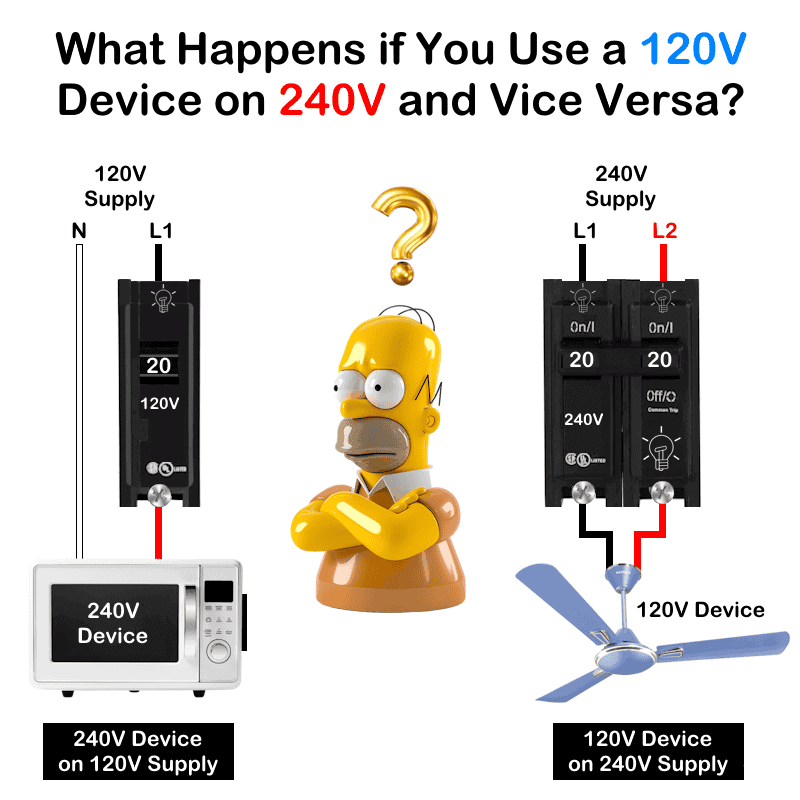
Using 120V Device on 240V Supply
Connecting a 120V device to a 240V power source will result in damage or destruction if there is no built-in fuse or protective device in the internal circuit. As the device receives double its rated voltage, where power is directly proportional to the voltage, resultantly, doubling the voltage double the power dissipation in the device.
Power = V2 ÷ R
Similarly, current is directly proportion to the applied voltage (Ohm’s law). Hence, doubling the applied voltage will double the amount of flowing current in the circuit.
V = I × R
In this case, the wire used for the device may overheat and burn as the OCPD’s won’t trip because they are used to handle 240V circuits and associated higher currents. Hence, no protection at all.
For instance, plugging a 120V hairdryer, blender, or toaster into a 240V outlet (common in the U.S. and Canada under NEC and CEC standards, or in countries following IEC standards such as the UK and Australia) will likely destroy the device instantly.
As stated before, a 120V device is designed to operate at 120 volts. Supplying 240V sends twice the intended voltage through the device, which can cause:
- Overheating: Internal components like circuits, resistors, capacitors, or motors may overheat, melt, or burn out due to excessive current.
- No Protection: As 240V breakers are used for high wattage appliances to handle higher current, the power cords and cables used with 120V device may melt and burn without tripping the breaker. Hence, no protection for branch circuit conductor beyond the plugs used with 120V device.
- Immediate Failure: The device may fail instantly, with sparks, smoke, or blown fuses.
- Shock and Fire Hazard: Overheating can lead to a fire, or or shock hazard especially in devices with poor or no overvoltage protection.
- Permanent Damage: Most 120V devices lack the ability to handle 240V, so the device is likely to be irreparably damaged. If the device has no internal protection (like a fuse), it may be destroyed beyond repair.
If you need to operate a 120V device on 240V supply, and the device is not rated for dual voltage, use a step-down transformer or voltage converter (240V to 120V) to safely power the device.
Always check the voltage rating on the device label or nameplate before plugging into any outlet or receptacle. If needed, use a step-down (240V → 120V) or step-up transformer (120V → 240V) designed for the voltage conversion.
Using 240V Device on 120V Supply
Connecting a 240V device to a 120V power source is not as dangerous as the opposite case; however, it will result in underperformance or the device may not operate at all. For instance, a 240V air conditioner on 120V may hum but not start, risking motor burnout. Similarly, A 240V appliance from Europe (e.g., a washing machine) plugged into a 120V US outlet may not work at all or may operate sluggishly.
A 240V device is designed to operate at 240 volts. Supplying only 120V provides insufficient power to the circuit which could lead to the following issues.
- Failure to Operate: The device may not turn on or function properly (e.g., inductive load i.e. 240V motor may hum but not spin, or stall immediately ), or operate very weakly due to the insufficient voltage known as undervoltage issues.
- Weak Performance: If the device does operate, it will likely perform poorly. For example, lights may appear dim, and motors may run at reduced speed and performance. Additionally, heating appliances such as kettles, toasters, water heaters, or ovens will not heat as expected. This is because the heating elements will not reach the required temperature quickly, due to the lower voltage being supplied compared to the device’s rated voltage.
- Potential Damage: Some devices, such as motors or compressors, may overheat or stall due to insufficient voltage. This happens because the device may draw excessive current during startup in an attempt to compensate for the low voltage. As a result, this can lead to long-term damage to the equipment.
- Glitch in the Circuit: If the electronic control circuitry depends on full voltage, it may misbehave or shut down. Similarly, relays or solenoids may not engage properly which may stuck the operation of control circuits.
If you need to operate a 240V device on 120V supply, and the device is not rated for dual voltage, use a step-up transformer or voltage converter (120V to 240V) to provide the correct voltage.
Related Posts:
- Can You use a 15A Outlet on a 20A Circuit and Vice Versa?
- Can you use 15A Breaker on 20A Circuit and Vice Versa?
| Scenario | Outcome | Risk |
| 120V Device on 240V Supply | Burnout, Fire Hazard, Destruction | 🔥 HIGH |
| 240V Device on 120V Supply | Won’t Work Properly, Weak Operation | ⚠️ LOW |
| Dual-Voltage Device (100–240V) | Safe to use worldwide | ✅ SAFE |
Precautions:
- Safety First: Always switch-off the power supply and unplug devices before troubleshooting. Never attempt to use a device with an incompatible voltage without proper equipment. If unsure, contact a licensed electrician.
- Device Rating: Check the device’s voltage rating and specification (usually on a label or in the manual). Some devices are dual-voltage (e.g., 100-250V) and can handle both 120V and 240V power supplies without issue, as they have built-in voltage regulation (common in phone chargers, laptops, etc.). Always use properly sized breaker with correct wire size and match with the device rating for overcurrent protection.
- Plug Type: Different countries use different plug types (e.g., US vs. UK plugs), so you may need an adapter in addition to a voltage converter. However, an adapter alone does not change voltage which is critical, it only ensures physical compatibility.
- Frequency Differences: In some cases, the frequency (e.g., 50Hz vs. 60Hz) may also differ between regions. Most modern electronics are unaffected, but some devices (e.g., clocks or motors) may malfunction if the frequency is incompatible.
Resources & Tutorials:
- Can We Use AC Circuit Breaker for DC Circuit & Vice Versa?
- Can an AC Device Operate on DC Supply, and Vice Versa?
- Can You Use a 2-Pole Breaker Instead of a 1-Pole Breaker
- What Will Happen If You Connect a Male-to-Male Plug Between Outlets
- What Happens When an AC Line Touches a DC Line?
- What Happens if a Battery is Connected to the AC Supply?
- Why Can’t a Transformer Be Operated on DC Supply?
- Difference Between 15-Amp and 20-Amp Outlet?
- Difference Between Socket, Outlet and Receptacle?
- Main Difference between Fuse and Circuit Breaker
- Why is the Neutral Prong or Slot Wider on a Plug or Outlet?
- What is the Right Wire Size for 15A Breaker and Outlet?
- What is the Suitable Wire Size for 20A Breaker and Outlet?
- How to Wire and Install an Electrical Outlet Receptacle?
- How Does a Standard Breaker Respond to Electrical Fault?
- Why Doesn’t a Standard Breaker Protract Against Ground Faults?
- How Do GFCI and Standard Breakers Respond to Ground Faults?
- Why Can’t a 12V Car Battery Electrocute You?
- Which One is More Dangerous? 120V or 230V and Why?
- Which One is More Dangerous? 50Hz or 60Hz in 120V/230V & Why?
- Which One Kills? Current or Voltage and Why? Amps vs Volts
- Which One is More Dangerous? 120V or 230V and Why?
- AC or DC ? Which One is More Dangerous And Why?
- How to Toggle Electric Water Heater Between 120V and 240V?


I’ve seen some 120v LED “strip” lights, the ones that come in a large roll like tape, and then you fasten them for accents around soffits, alcoves, etc., accidentally connected to 277v, and there was A LOT of fire and black smoke until the circuit tripped or was turned off.
Related – if 2-3 120v circuits are sharing a neutral (multi-wire branch circuit) and the neutral connection is lost at the panel or a splice, the resulting loop circuit will deliver up to 208-240v depending on the source and the resistance of the loads. Which could be fatal to a lot of equipment, especially electronics. The damage could happen instantaneously.
Well I may have hooked up a 120 ballast to a 277v circuit before. It was really bright until it wasn’t. Lol
I put a 120v skillsaw on a 220v circuit once. The torque and speed was about 2x the original and it ran for about an hour solid before burning up
You will probably hear a quick pop when you turn that fan on. Some of the smoke might escape the housing. As for the microwave, that hot pocket isn’t going to be ready any time soon.
Explosions if you run a 120v appliance on 220 and . Half braindead performance of the appliance if vice versa