Motor Capacitor Calculator – Calculate Fan Capacitor Value
How to Size a Fan Capacitor – Starting and Running Capacitors for Single Phase Motors
Capacitor-start, capacitor-run motors use two capacitors viz a starting capacitor and a running capacitor. However, in most single-phase AC motors used in fans (ceiling, wall-mounted, exhaust, and window fans), the capacitor that commonly requires replacement is the running capacitor, which helps improve the motor’s speed, efficiency, and torque.
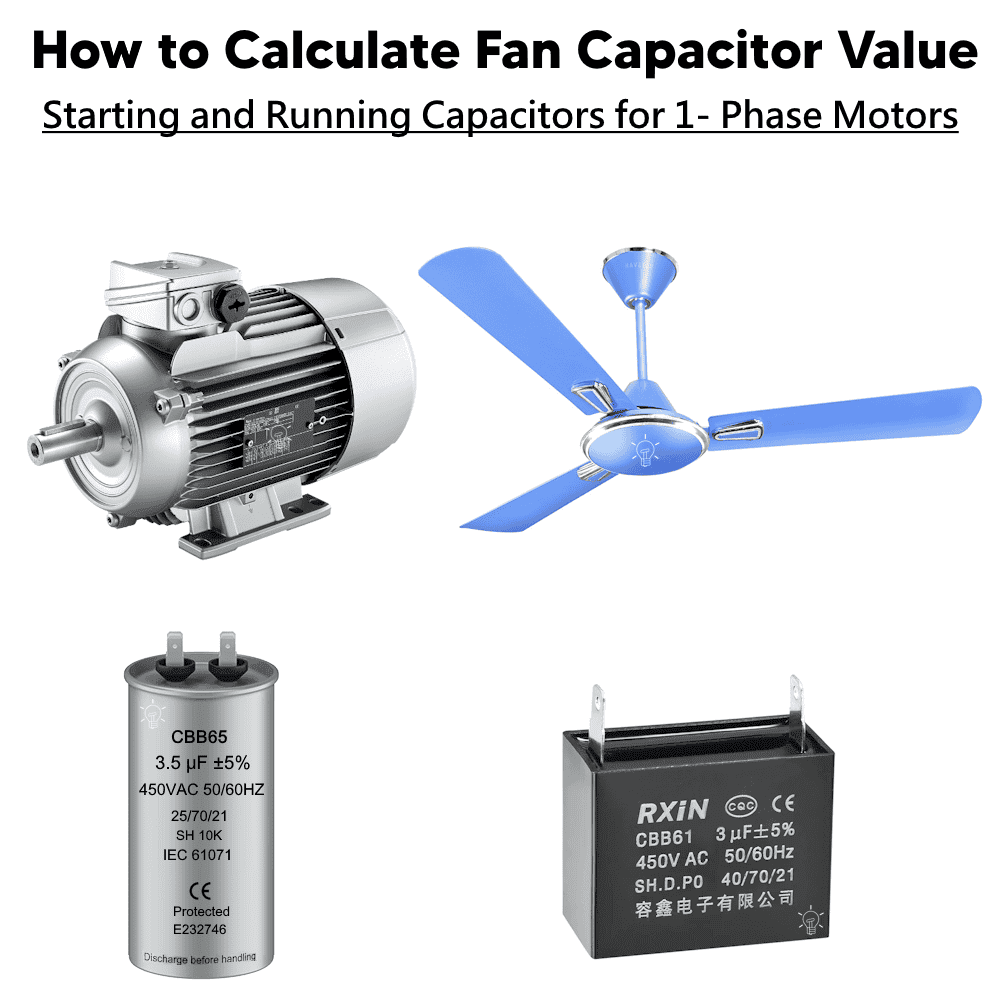
Starting Capacitor
A starting capacitor (also called a start capacitor) is a high-capacitance capacitor used in single-phase AC motors to provide the extra starting torque needed to start the motor from rest. It is connected in the circuit only during startup and is automatically disconnected by a centrifugal switch, relay, or electronic control once the motor reaches a certain speed.
Starting capacitors are commonly used in air conditioners, compressors, pumps, and other heavy-duty motor applications.
Finding the Value of Starting Capacitor
The value of starting capacitor can be calculating using the following formula
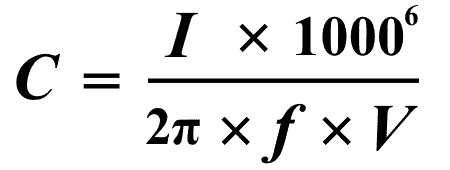
Where;
- C = Capacitance in microfarads (μF)
- I = Motor’s current (Amps)
- π = 3.14159
- V = Supply voltage (Volts)
- f = Mains frequency (50 Hz or 60Hz)
You can see that the motor current must be known before calculating the required starting capacitor value. If the motor current is not available, use the following equation to determine the motor current first and then calculate the starting capacitor value.
Motor’s Current Formula
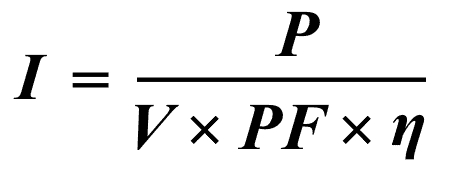
Where;
- I = Motor’s current (Amps)
- P = Power rating of the motor (Watts)
- V = Supply voltage (Volts)
- η = Motor efficiency
- P.F = Power factor
Running Capacitor
A running capacitor (also called a run capacitor) is a continuous-duty capacitor that remains connected to the motor circuit during normal operation. Its primary function is to improve the motor’s power factor, efficiency, torque, and smooth operation by creating a phase shift between the main and auxiliary windings.
Running capacitors are commonly used in ceiling fans, exhaust fans, blowers, and other 1-phase AC motors that require continuous performance enhancement.
Finding the Value of Running Capacitor
If you need to replace the capacitor in a typical ceiling fan, you can calculate the required running capacitor value by using the following formula:
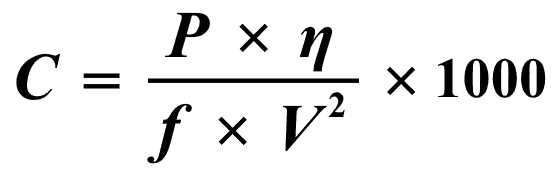
Where;
- C = Capacitance in microfarads (μF)
- P = Power rating of the fan motor (Watts)
- η = Motor efficiency
- V = Supply voltage (Volts)
- f = Mains frequency (50 Hz or 60Hz)
Example 1:
What is the required value of running capacitor for a 100W ceiling fan operated at 230V – 50Hz while the efficiency of fan is 80%?
Solution:
Putting the values in the equation
- C = [(P × η) ÷ (V² × f)] × 1000
- C = (100W x 80 ) ÷ 230V2 × 50Hz) × 1000
- C = 3.0 μF
Hence, you need a 3μF of running capacitor.
Example 2:
What is the motor current and estimated value of starting and running capacitor for an 60W fan operated at 120V – 60Hz having 87% efficiency. Assume the power factor = 0.95
Solution:
Motor Current
- I = P ÷ (V × PF × η)
- I = 60W ÷ (120V × 0.95 × 87)
- I = 0.60 A
Starting Capacitor:
- C = (I × 10⁶) ÷ (2π × f × V)
- C = (0.6A × 10⁶) ÷ (2π × 60Hz × 120V)
- C = 13.37 μF
Running Capacitor
- C = [(P × η) ÷ (V² × f)] × 1000
- C = [80W x 87 ) ÷ 120V2 × 60Hz) × 1000
- C = 6.0 μF
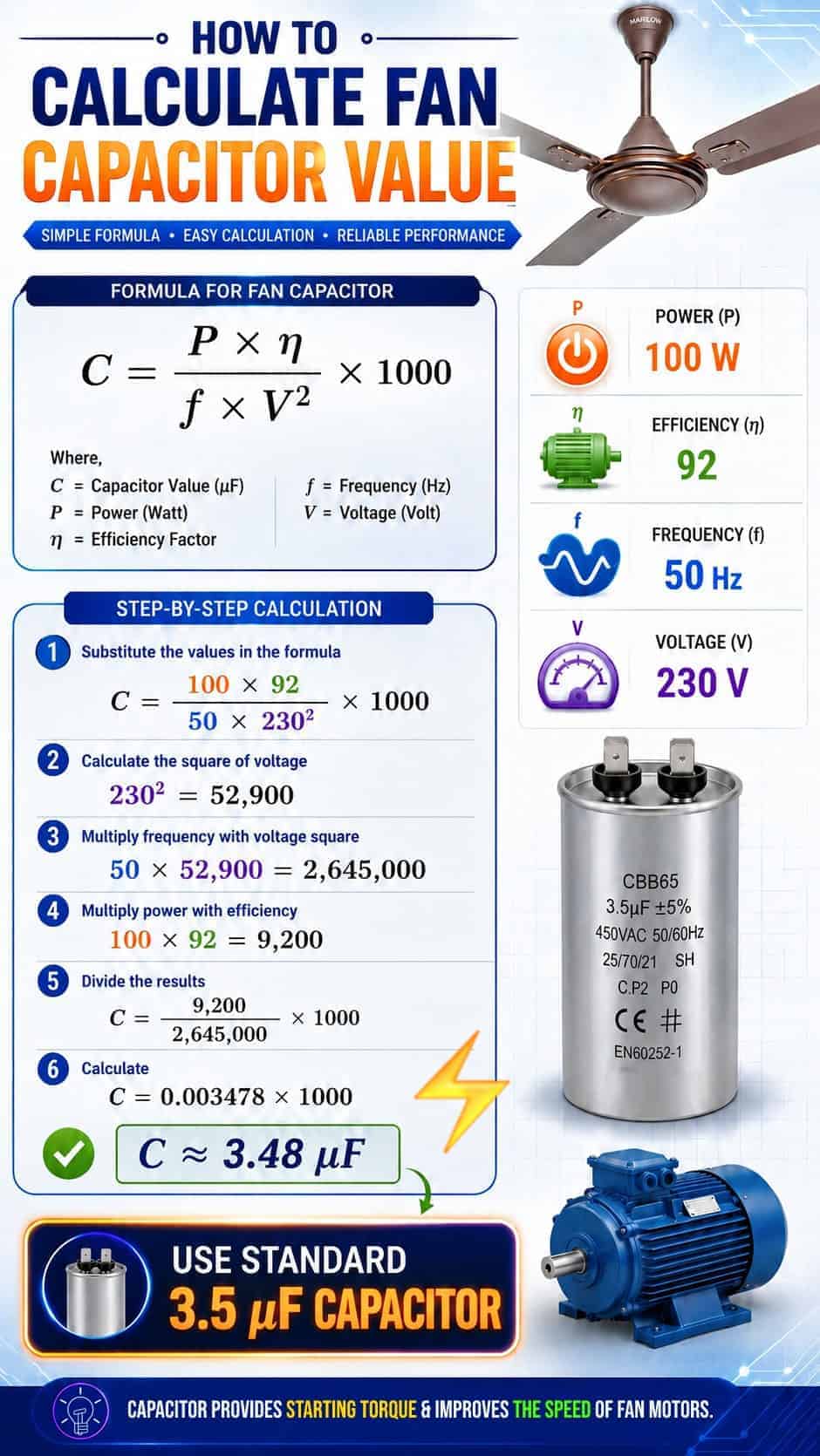
Example 3:
The following pictorial view example shows how to size a fan capacitor with step by step calculation.
Click image or open in a new tab to enlarge
Typical Fan Run Capacitor Values
In 230V AC systems (commonly used in Europe, the UK, Australia, and many Asian countries), the run capacitor for most ceiling fans typically ranges from 2.0 µF to 3.5 µF, with a voltage rating of 250V to 450VAC (450VAC is the most common replacement rating).
In 120V AC systems (commonly used in the United States and Canada), the run capacitor value for most ceiling fans typically ranges from 4 µF to 6 µF.
For fans designed to operate on 120-240V AC, the following capacitor combinations are commonly used:
- 3-wire dual-capacitor combination: 4 µF + 5 µF or 5 µF + 6 µF
- 4-wire or 5-wire multi-capacitor combination (e.g., Hunter or Harbor Breeze ceiling fans):
- 4 µF for low speed
- 5 µF for medium speed
- 6 µF for high speed
- HVAC condenser fan motors (120V, 208V, or 240V): 3 µF to 10 µF
- Small box fans and window fans: 1.5 µF to 4 µF
These values are typical industry ranges. Always verify the exact capacitor value specified on the motor nameplate, wiring diagram, or original capacitor before replacement.
Motor Capacitor Calculator:
For convenience, you may use the following calculator to determine the required values of the starting and running capacitors for single-phase motors.
Precautions:
When replacing a fan capacitor, always verify these additional specifications:
- Voltage Rating: Voltage rating of the capacitor should be at least 1.5 × the supply voltage (e.g., use a 400V or 450V cap on a 230V line). Using a lower voltage capacitor (like 250V) will result in it burning out or failing. Similarly, a 120V US fan capacitor must always be rated for at least 250V AC to 300V AC. Never use a capacitor rated exactly at 120V, or it will rapidly fail or explode.
- Tolerance: Capacitors often have a tolerance range of ±5%.
- Check the Label: The safest and most accurate method is to see the nameplate data raring on the capacitor. In this case, check the manufacturer’s label directly on the old fan capacitor and replace it with the exact same rating.
- No-Polarized: Always use a non-polarized (AC-rated) film capacitor – never an electrolytic.
- Small Capacitor: Using a too-small capacitor will cause weak starting, slow speed and overheating.
- Large Capacitor: using a too-large capacitor with a fan motor will cause overcurrent, noisy operation and possibly damage the motor.
Related Posts:
- What Happens If You Install a Larger Capacitor in a Fan?
- What is the Role of Capacitor in a Ceiling Fan?
- Why is a Capacitor Needed for a Single-Phase Motor?
- Why are 1-Phase Motors Not Self-Starting Like 3-Phase Motors?
- How to Size and Find the Numbers of Ceiling Fan in a Room?
- Why Do Most Fans Have Three Blades?
- How to Replace a Ceiling Fan Capacitor – 3 Ways
- How to Wire a Ceiling Fan? Dimmer Switch and Remote Control Wiring
- How to Wire AH3 OFF-Delay Timer and Relay with Boiler Fan?
- Why is the Synchronous Motor Not Self Starting?
- Why Do DC Motors Have Higher Starting Torque than AC Motors?
- Why Does A Capacitor Block DC But Pass AC?
- What Happens if We Connect a Polar Capacitor the Wrong Way?
- How to Calculate the Suitable Capacitor Size in µ-Farads & kVAR
- Why Do We Need to Install a Starter with a Motor?
- What is Motor Efficiency and How to improve it?
- Difference Between AC and DC Motors
- Difference between Synchronous and Asynchronous Motor
- Why is a Motor Rated in kW instead of kVA?
- Why is a Capacitor Bank Rated in kVAR, Not in Farad?
- Why is the Rating of a Capacitor Expressed in Farad?