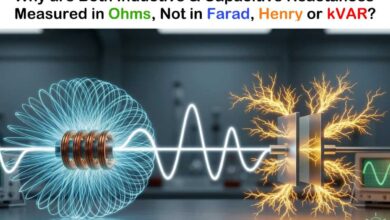
Why is a Capacitor Bank Rated in kVAR, Not in Farad?
Why is the Rating of a Capacitor Bank Expressed in kVAR Instead of Watt or Farad
We know that a capacitor is rated in Farads because its capacitance value indicates how much electric charge it can store per volt applied across its terminals. Therefore, the rating of a capacitor is commonly expressed in Farads (F). That is why you often see µF (microfarads) marked on the nameplate of small capacitors.
However, when these capacitors are used in a power system, their rating is usually expressed in kVAR instead of Farads. Why is this so? Let’s find out.
Good to Know: In power transmission lines, capacitors are connected in series for voltage regulation and system performance, while for power factor improvement, capacitors are connected in parallel with the load.
- Related Post: Why is the Rating of a Capacitor Expressed in Farad?
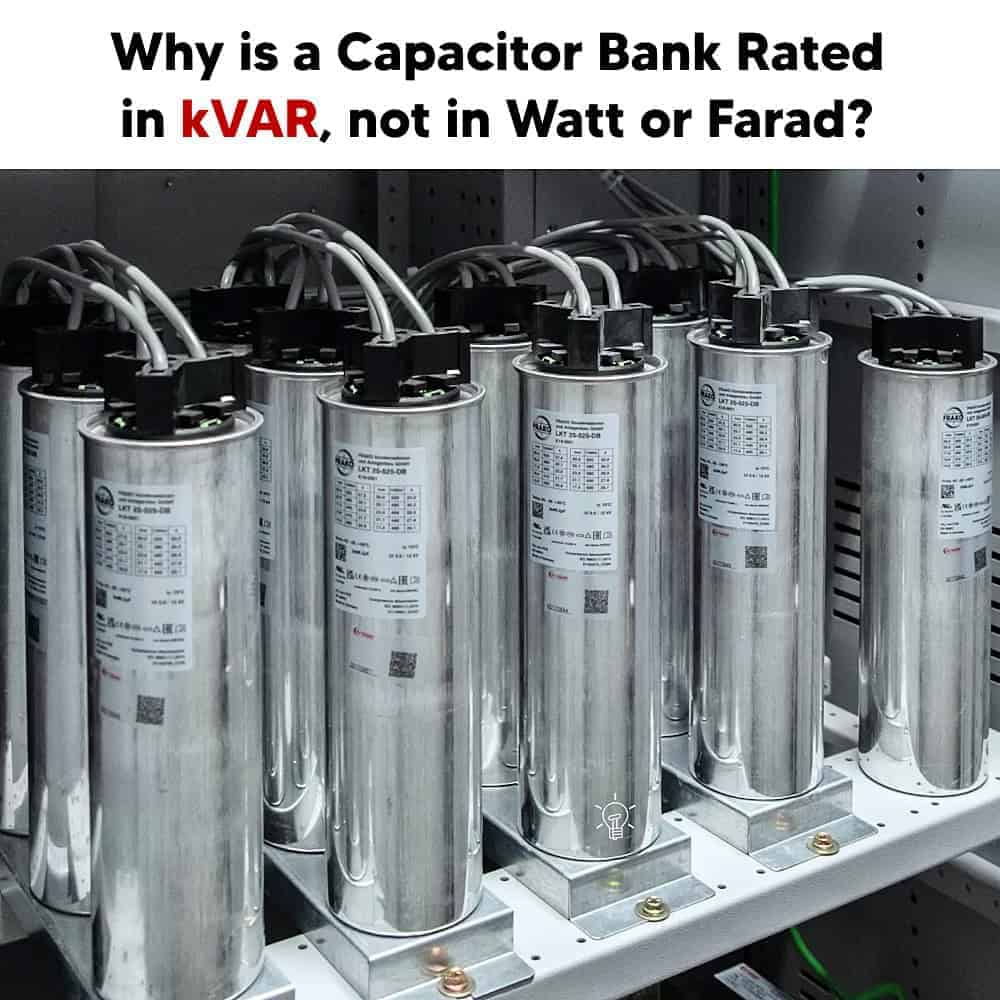
Why kVAR is Used for Capacitor Banks
In an AC system, a capacitor continuously charges and discharges during each cycle. While doing so, it supplies reactive power to the system. This reactive power helps compensate the lagging reactive power drawn by inductive loads such as:
- Induction motors
- Transformers
- Generators/alternators
- Fluorescent lighting
- Welding machines
- Air-conditioners
A single capacitor is rated in Farads (F) because it indicates the amount of electric charge (Q) the capacitor can store per volt applied across its plates.
However, capacitor banks are rated in kVAR (kilo-Volt-Amperes Reactive) instead of Farads because their primary function in power systems is to supply reactive power for power factor correction rather than supplying active or real power (Watt) or store static charge. That is why its rating is expressed in kVAR (kilovolt-ampere reactive) instead of Farads.
The useful effect of a capacitor bank in a power system is therefore measured by how much reactive power it can provide, not merely by its capacitance value.
Hence, capacitor banks are rated in:
VAR = Reactive Power Capacity in (Volt-Amperes Reactive)
instead of:
Farad = Charge Storage Capacity
Electrical loads (for instance, motors, transformers) consume active power (kW) and reactive power (kVAR) respectively. Rating capacitors in (kVAR) allows engineers to directly match and cancel out the (kVAR) consumed by inductive loads, making it easy to calculate kVAR for Power Factor (P.F) correction.
For example, when an engineer sees a 500 kVAR capacitor bank at 11kV, 50Hz, they immediately know:
- How much reactive power it will compensate
- Whether it matches the inductive load they need to offset
- How to size it in relation to transformers, cables, and generators (all rated in VA or VAR)
In simple words, capacitance in Farads only measures a capacitor’s physical ability to store charge. It does not tell you how much reactive power the capacitor can inject into a live, alternating current (AC) grid to stabilize voltages.
Good to Know: The actual reactive power output of a capacitor depends heavily on both the system voltage and grid frequency. Stating the (kVAR) at a specific voltage (e.g., 440V) at (50Hz)) provides an exact value of VARs.
Relationship Between Capacitance Farad and kVAR
The reactive power supplied by a capacitor depends on capacitance value, system voltage and frequency.
The relation is:
Q = 2ωV2
Q = 2πfCV2 … (ω = πfC)
Where:
Q = Reactive power (VAR)
f = Frequency (Hz)
C = Capacitance (Farad)
V = Applied voltage in volts
This equation shows that the same capacitance can produce different kVAR values at different voltages or frequencies. Therefore, the kVAR rating is more practical and meaningful in power system applications.
For example, a 100 µF capacitor at 415V produces a very different kVAR than at 11kV. Similarly, a capacitor bank labeled 50 kVAR means:
- It can supply 50 kilovolt-ampere reactive power to the AC system.
- Its main purpose is to improve power factor and reduce reactive current in the electrical network.
The actual capacitance in Farads may vary depending on whether the bank is designed for:
- 120V, 230V, 240V single phase or 400-480V three phase systems.
- 50Hz or 60Hz frequency
The Farad rating alone tells you nothing useful without also knowing the voltage and frequency. That is why industrial capacitor banks are almost always specified in kVAR rather than Farads.
Good to Know:
If you ever need to calculate between the kVAR or Farad, you can convert the reactive power (Q) to Farads and vice versa using the following standard electrical formulas:
Farad to kVAR
Q = C x 2π x f x V2 x 10-9 … (in kVAR)
kVAR to Farad
C = kVAR x 103 ÷ 2πf x V2 … (in Farad)
Where:
- Q = kVAR (kilo Volt-ampere-reactive)
- f = frequency in Hz
- C = capacitance in μF
- V = The line voltage
Related Posts:
- Why is a Transformer Rated in kVA, but Not in kW?
- Why is a Motor rated in kW instead of kVA?
- Why is an Alternator and Generator rated in kVA, not in kW?
- Why is a Battery rated in Ah (Ampere hour) and not in VA?
- Why is an Air-condition (AC) Rated in Ton, not kW or kVA?
- Why is a Power Plant Capacity Rated in MW and not in MVA?
- Why was a Circuit Breaker Capacity Rated in MVA and Now in kA and kV?
Resources:
- General Capacitor Nameplate Rating (Electrolytic Capacitor)
- Why are Capacitors Connected in Series in Power Lines?
- Why is a Capacitor Bank Connected in Parallel and Not in Series for P.F?
- Difference Between Shunt Capacitors and Shunt Reactors
- Why is a Capacitor Needed for a Single-Phase Motor?
- Capacitor Color Codes – How To Read Capacitor Value? Calculator
- Capacitor Bank in kVAR & µF Calculator for Power Factor Correction
- How to Calculate the Suitable Capacitor Size in µ-Farads & kVAR for P.F Improvement
- How to Convert Capacitor μ-Farads to kVAR and Vice Versa? – For P.F Correction
- Power Factor Correction Calculator – How to Find P.F Capacitor in µF & kVAR?
- Formula and Equations For Capacitor and Capacitance
- What Happens if We Connect a Polar Capacitor the Wrong Way?
- What is the Role of Capacitor in a Ceiling Fan?
- What is the Role of Capacitor in AC and DC Circuit?
- Why Does A Capacitor Block DC But Pass AC?
- Difference Between a Battery and a Capacitor
- How to Test a Capacitor using Digital and Analog Multimeter