What Happens If You Install a Larger Capacitor in a Fan?
Disadvantages of Using Higher Capacitance with AC Fans
The primary function of a capacitor in a ceiling fan is to provide the necessary phase shift for starting torque and to help the motor run efficiently at its designed speed. When a fan starts running slowly over time, many DIYers replace the original capacitor with a larger one without understanding the consequences. Although this may temporarily increase the fan’s speed, it can lead to serious problems in the long run.
Recommended Capacitor Values for Ceiling Fans
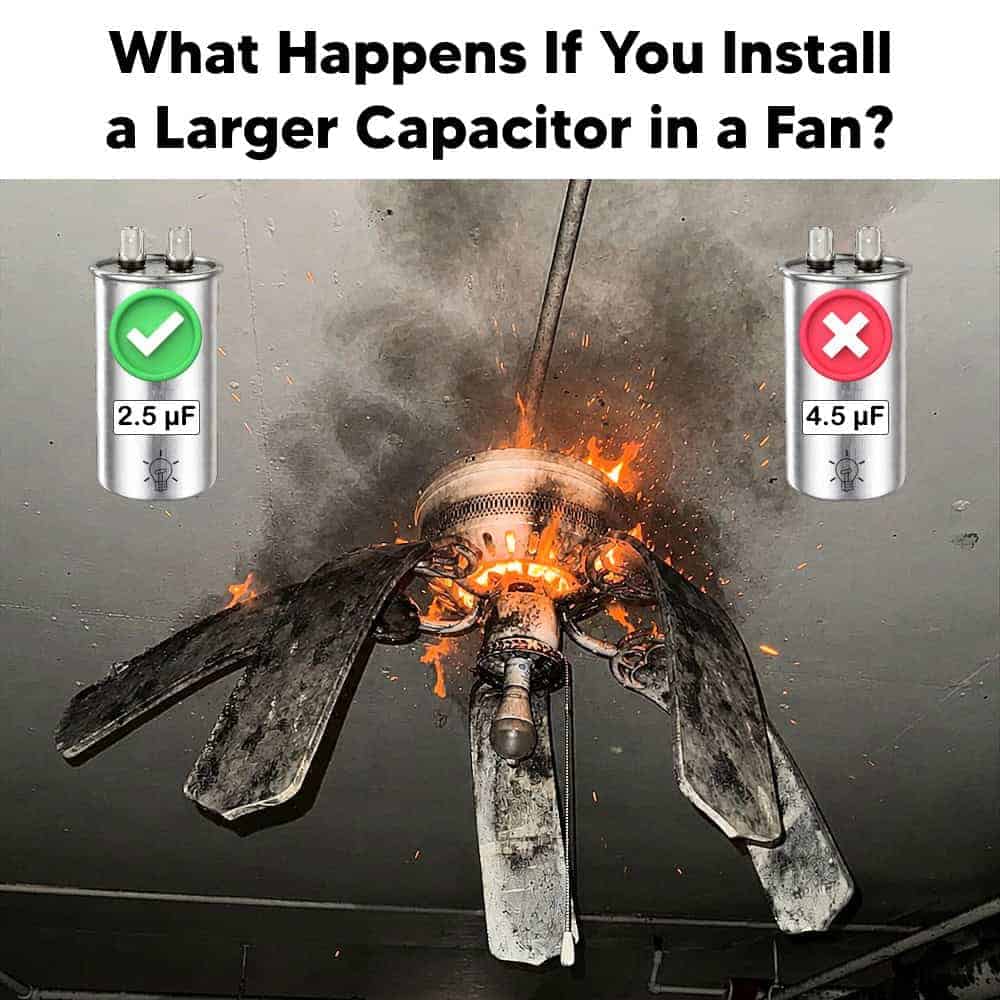
Most residential ceiling fans rated between 50 and 80 watts operated at 230V AC are designed to operate with a capacitor value of approximately 2.25 µF to 2.5 µF, as specified by the manufacturer (generally printed on the capacitor nameplate). However, when the fan ages (after years of operation), it develops mechanical problems, or operates under low-voltage conditions. In this case, some YouTube electricians install larger capacitors such as 3.5 µF or 4.5 µF in an attempt to increase the fan’s speed.
In 120V AC systems (used in the US and Canada), the capacitor value for most ceiling fans typically ranges from 4 µF to 6 µF. This is generally higher than the capacitor values used in 230V AC systems (UK, EU, and many Asian countries) because the supply voltage is nearly half that of a 230V system.
This because a lower supply voltage generally requires a larger capacitance to achieve the required phase shift and motor performance.
Below are some of the common values of running capacitor for 120/240V systems.
- 3-wire dual-combo: 4 µF + 5 µF or 5 µF + 6 µF
- 4-wire or 5-wire combination (e.g., Hunter or Harbor Breeze ceiling fans):
- 4 µF for low speed
- 5 µF for medium speed
- 6 µF for high speed
- HVAC condenser fan motors (120V, 208V, or 240V): 3 µF – 10 µF
- Small box fans and window fans: 1.5 µF – 4 µF
The capacitor values listed above are typical industry guidelines. Before replacement, always confirm the correct capacitor rating from the motor nameplate, wiring diagram, manufacturer’s documentation, or the original capacitor.
Let’s examine the potential advantages and disadvantages of using a a capacitor with a higher capacitance rating than the rated value specified for the fan motor.
Advantage of Installing a Larger Capacitor
Increased Fan Speed
A larger capacitor can increase the phase shift and starting torque of the motor. If the fan winding has weakened or the supply voltage is low, a larger capacitor may temporarily increase the fan’s speed and airflow. As a result, the fan may appear to perform better immediately after installation.
However, this benefit is usually temporary and does not address the actual cause of the problem.
Disadvantages of Installing a Larger Capacitor
Motor Overheating
A capacitor larger than the manufacturer’s recommended value can increase the current flowing through the motor windings. This additional current causes the motor to operate at a higher temperature than intended. Thus, the generated excessive heat reduces its efficiency and lifespan.
Reduced Winding Life
Continuous overheating accelerates the aging of the winding insulation. Over time, the insulation may deteriorate, which leads to winding faults, short circuits, and eventual motor failure.
Increased Power Consumption
A fan operating with an oversized capacitor may draw more current than necessary. Although the increase in power consumption varies depending on the motor design, the fan may consume more electricity than it was originally designed to use. This may cause higher energy costs and increased electric bill.
Wear of Bearings & Shaft
Higher operating speeds and temperatures can accelerate wear on the bearings. Excessive heat may cause the lubricant inside the bearings to dry out, which leads to noise, vibration, and reduced bearing life.
In addition, excessive operating speed or a seized bearing can lead to internal mechanical damage or shaft breakage in the fan, potentially causing the fan to detach and fall while in operation.
Short Life Span
Running the fan outside its designed operating conditions places additional stress on various mechanical and electrical components. This can lead to more frequent maintenance issues and a shorter service life for the fan.
What to Do if a Fan Runs Slower Than Its Rated Speed
If your fan is running slowly with the correct 2.5 µF capacitor, it does not necessarily mean that the capacitor value is too small. The actual cause may be one of the following:
- The existing capacitor has weakened and needs replacement with a new capacitor of the same rating. (Most Common – 90% of cases)
- The fan bearings are dirty, dry, worn, or partially seized.
- The supply voltage is significantly lower than the rated voltage.
- The motor windings have deteriorated due to age and prolonged use.
- The fan may simply be at end-of-life due to cumulative wear (10-20 year lifespan).
Other than the above mentioned cases, Installing a 3.5 µF or 4.5 µF capacitor in a fan designed for a 2.25 µF or 2.5 µF capacitor may provide a temporary increase in speed, but it does not solve the underlying problem. In many cases, it can increase motor temperature, accelerate component wear, and reduce the overall lifespan of the fan.
For safe, reliable, and efficient operation, always use the proper capacitor value for motor fans specified by the manufacturer. If the fan is running slowly, identify and correct the root cause rather than compensating for it with an oversized capacitor.
Is It Safe to Use a Higher Microfarad Rating than Original?
No, it is generally NOT safe to use a significantly higher microfarad (µF/MFD) rating for a ceiling fan’s running capacitor.
Small Increase (up to 10-20%) in capacitor sizing generally considered safe for most ceiling fans. For instance, 2.5 µF original capacitor changes with 2.7 µF or 3.0 µF is acceptable and may slightly change speed or efficiency.
However, large increase (>20%) in capacitor rating will cause motor overheating due to excessive current, wrong phase shift and consequently burned-out motor.
This is because running capacitors stay in the circuit all the time (unlike starting capacitors), so excess capacitance continuously stresses the motor.
In this case, higher µF causes lower impedance. Lower impedance means higher current will flow in the circuit which cause overheating.
For example, an 8 µF capacitor has ~400 Ω impedance at 50Hz, while 25 µF has only ~128 Ω. It means, 3 times more current will flow through the winding.
In this case, if your original is 2.5 µF, stay within 2.2-3.0 µF. Use 3.0 µF max, and never go to 4-5 µF or higher unless the motor specifically requires it.
Related Posts:
- What is the Role of Capacitor in a Ceiling Fan?
- Why is a Capacitor Needed for a Single-Phase Motor?
- Why are 1-Phase Motors Not Self-Starting Like 3-Phase Motors?
- How to Size and Find the Numbers of Ceiling Fan in a Room?
- Why Do Most Fans Have Three Blades?
- How to Replace a Ceiling Fan Capacitor – 3 Ways
- How to Wire a Ceiling Fan? Dimmer Switch and Remote Control Wiring
- How to Wire AH3 OFF-Delay Timer and Relay with Boiler Fan?
- Why is the Synchronous Motor Not Self Starting?
- Why Do DC Motors Have Higher Starting Torque than AC Motors?
- Why Does A Capacitor Block DC But Pass AC?
- What Happens if We Connect a Polar Capacitor the Wrong Way?
- How to Calculate the Suitable Capacitor Size in µ-Farads & kVAR
- Why Do We Need to Install a Starter with a Motor?
- What is Motor Efficiency and How to improve it?
- Difference Between AC and DC Motors
- Difference between Synchronous and Asynchronous Motor
- Why is a Motor Rated in kW instead of kVA?
- Why is a Capacitor Bank Rated in kVAR, Not in Farad?
- Why is the Rating of a Capacitor Expressed in Farad?