Which is More Dangerous – AC or DC?
First of all, keep in mind that both AC and DC voltage and current are dangerous and potentially hazardous. They can be both our friends and our worst enemies. If given the chance, neither will spare you.
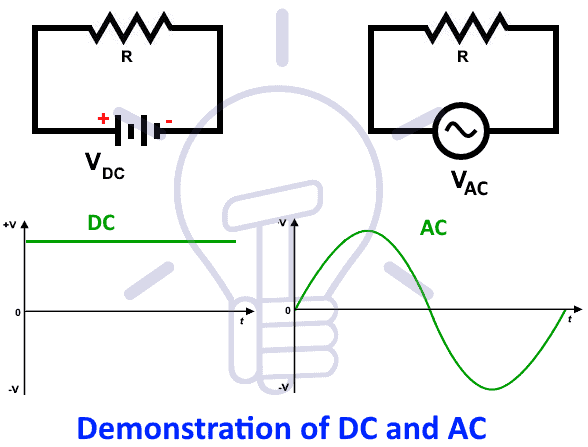
AC is considered more of a “serial killer” because its lower frequency (50 Hz in the EU and 60 Hz in the US) affects the human body more severely than DC at the same voltage level. In simpler terms, 230V AC (or 120V AC) is generally more dangerous than 230V DC or 120V DC, respectively. However, this does not mean DC is safe. DC has the potential to severely injure or even kill. If AC can shock you, DC can roast you. In short, stay cautious and never underestimate the dangers of either.
AC voltage and current at low frequencies (such as 50 Hz or 60 Hz) are more dangerous than AC at higher frequencies (e.g., 500 or 600 Hz). Additionally, AC currents and voltages are generally three to five times more hazardous than DC at the same voltage level.
In the case of DC, it typically causes a single convulsive contraction (a sudden, jerky, and uncontrollable muscle tightening) which can often throw the victim away from the source of the shock.
In contrast, AC causes tetany (a condition marked by intermittent muscular spasms) or extended muscle contraction. This can result in the victim (or part(s) of the body) being “frozen” in place, unable to let go of the energized object. Hence, it significantly increases the danger.

Due to the alternating nature behavior of AC, it causes the heart’s pacemaker neurons into atrial fibrillation which is more dangerous than DC, where cardiac standstill (due to ventricular fibrillation) occurs in case of electric shock. In this case, there is a better chance for “frozen heart” to get back on the normal track as compared to fibrillating heart caused by AC. In those cases, defibrillating equipment (which supplies DC units to halt the fibrillation and bring back the heart to the normal condition) are used as emergency medical service.
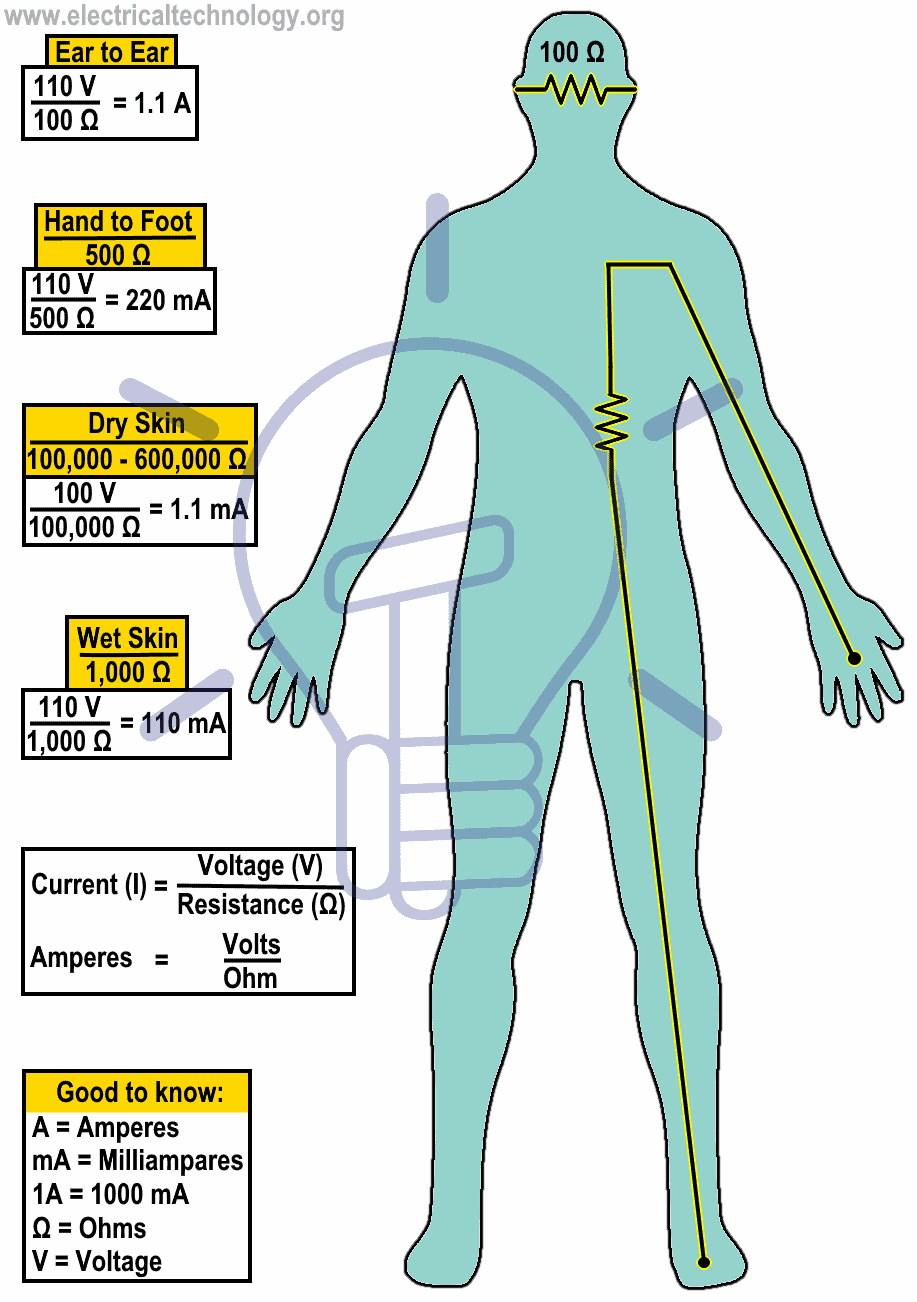
Generally, the final decision depends on multiple factors like, human body resistance, wet or dry skin or place, thickness of the skin, weight, sex, age, level of current and voltages, frequency etc.
If we consider the minimum level of AC and DC voltages, 50V AC in Dry condition and 25V in humid and wet places and up to 120V DC are considered safe in case of direct or indirect contacts with electrical installations. The above statement and the following table shows that AC Current and Voltage are more dangerous than DC.
For example, In case of AC, the safest limit is 50V (or 25V in humidity) where in DC, the safe limit is 120V DC. Same is the case for current, i.e. lower currents are needed for the same effect on the human body compared to DC which is low. The following table shows the story of AC and DC and its effects on the human body.
- Related Post: Which One is More Dangerous? 120V or 230V and Why?
Always Remember: It’s the current (amperes) that kills, not the voltage. However, voltage is necessary to push the current through the body. In other words, amperes are responsible for electrocution, not volts.
| AC in mA (50Hz) | DC in mA | Effects |
| 0.5 – 1.5 | 0.4 | Perception |
| 1.3 | 4 – 15 | Surprise |
| 3 – 22 | 15 – 88 | Let’s Go (Reflex Action) |
| 22 – 40 | 80 – 160 | Muscular Inhibition |
| 40 – 100 | 160 – 300 | Respiratory Block |
| More than 100 | More than 300 | Usually Fatal |
- Related Post: Which One is More Dangerous? 50Hz or 60Hz in 120V/230V?
Why AC is More Dangerous than DC?
Following are some reasons showing that AC is more dangerous than DC.
RMS and Peak Value
The domestic supply in our homes are 230V AC (in EU) and 120V/240V AC in US. It is the effective or RMS Voltage. It means that alternating voltage available has the same heating effect as 230V DC or 120V AC respectively.
The equation of this alternating current is
V = Vm Sin ω t
Where
- Vm = √2 VRMS
- ω = 2πf … (f = 50 0r 60 Hz Frequency)
Putting the values and solving for Voltage:
230 × √2 Sin × 2 (3.1415) × 50Hz x t
230 × √2 Sin × 314 × t Volts.
Now the Peak Value of AC Voltage or Current, (this doesn’t apply on DC due to the alternating sinusoidal waves of AC).
VRMS = VPK ÷ √2 or VRMS = 0.707 × VPK
Similarly,
IRMS = IPK ÷ √2 or IRMS = 0.707 × IPK
Using the above formula, we find the value of AC Peak Voltage and Current as follow
VPK = √2 × VRMS and IPK = √2 × IRMS
To calculate the max or peak value of AC Voltage for our homes supply (where home supply is 230V or 120V AC)
VPK = 1.414 x 230V = 325V AC (or 170V Peak AC in case of 120V AC home supply).
The above calculation shows that our home supply voltage which is 230V AC or 120V AC are RMS voltages and the Peak voltages of these RMS voltages are 325V or 170V or 650 peak to peak or 320 peak to peak voltages.
Respectively, whereas DC has only RMS value which is contact i.e. 230V DC or 120V DC.
In other words, for both AC and DC having the same level of Voltage, AC turns out to be about 325V or 170V i.e. it’s more than it appears and yes, the more voltage, the higher the chance of electrocution. In short, More DC voltage or current is needed to induce the same hazardous effect as AC voltage and current.
- Related Post: Difference between AC and DC (Current Voltage)
Capacitance
A victim body acts as an insulating medium between the live wire and ground leading to capacitance. But we know that a capacitor blocks DC while AC can pass through it. Let’s see mathematically,
- Frequency in DC = 0Hz
- Frequency in AC = 50 or 60 Hz.
Resistance:
Resistance in DC:
XC = 1 ÷ 2πfC in Ω
If we put “f = frequency” as zero, then the capacitive reactance (XC) would be infinite. That’s why the capacitor blocks DC to pass through it.
Now Resistance in AC (also known as impedance)
Impedance = Z = √ (R2 + XC2)
If we put frequency as 50 or 60Hz, the overall impedance (i.e. resistance) would decrease. This way, AC has the ability to easily pass through the capacitor. It means AC is more dangerous than DC in cases when the human body acts as a capacitor.
In short, the impedance and resistance in DC is lower than AC as it decreases when frequency increases. This way, AC is more harmful than DC.
- Related Post: What Happens When an AC Line Touches a DC Line?
Frequency
Some having the concept that DC is more dangerous than AC with the same level of voltage because AC changes it direction multiple times (i.e. AC touches the zero value 50 or 60 times) per second due to frequency and there is a chance for the victim to skip the shock, whereas there is no frequency in DC.
Now if we consider the frequency as 60 or 50Hz, let’s see how fast AC changes its direction.
T = 1 ÷ f
T = 1 ÷ 50Hz = 0.02 Seconds.
It shows that AC touches the zero point after each 0.20 seconds, where the human brain is not that much faster (except the unintentional functions) to respond to electric shock and move back from the voltage source.
- Related Post: Difference between AC and DC Resistance
The 50 or 60Hz frequency plays an important role in the electric shock effect on the human body. For example, the low voltage about 25V AC with 60 Hz are harmful (wet and humid body).

NOTE:
- Both AC and DC voltages and currents are dangerous. Never touch live wires.
- In the event of an electric shock, immediately try to disconnect the power supply. If it is safe to do so, push the victim away from the source using an insulated object, but only if you are properly insulated yourself.
- Always call a professional electrician for repairs or troubleshooting. In case of an emergency, contact local emergency services immediately.
Good to Know:
Related Articles:
- Why are “High Voltage” Signs used when Only Current Kills?
- Why Earth Pin is Thicker and Longer in a 3-Pin Plug?
- Why Do Prongs in Electrical Plugs Have Holes in Them?
- Why is the Neutral Prong or Slot Wider on a Plug or Outlet?
- If Lightning Strikes the Sea, How Far Away is it Dangerous?
- Why Can’t a 12V Car Battery Electrocute You?
- Can you Combine AC and DC Ground in a Solar Installation?
- Will I Get an Electric Shock If I Touch the Ground Wire?
- Can the Neutral Wire Cause Electric Shock? Different Cases
- What Will Happen If You Connect a Male-to-Male Plug Between Outlets
- Why You Should Never Buy or Use Male-to-Male Extension Cords
- Is It Possible to Get Electrocuted by an Electric Vehicle?
- What Happens if a Power Line Falls into the Ocean Water?
- What happens if You Connect a 3-Φ Induction Motor to 1-Phase Supply?
- What Happens to the Battery with Reverse Polarity Wiring Connection
- Will a Man Get an Electric Shock If He Hangs on a Live Wire?
- What Happens When You Touch an Electrical Busbar?
- Why Do The Positive And Negative Wires Spark When Touched?
- Why is the Grounding Wire Bare and Not Insulated?
- How Many Amps Will Flow in a Short Circuit Powered by a 120V, 20A Breaker?
- Why AC Needs More Insulation Than DC at Same Voltage Level?
- Protective Actions to Avoid & to Reduce Electric Hazardous
- Personal Protective Equipment (PPE) for Electrical Works
- Why Do Electronic Circuits Use DC Current instead of AC?
- Why Can’t We Store AC in Batteries instead of DC?
- Is Lightning AC or DC ?
-
 Germany’s Electric Drone Hits 699 km/h, Eyes World Record
-
 Arkansas School Uses Rooftop Solar to Raise Teacher Pay
-
 Why are Inductive & Capacitive Reactances Measured in Ohms?
-
 What Happens If You Install a Larger Capacitor in a Fan?
-
 Robotic Snakes that Crawl Power Lines to Detect Faults
-
 Can You Install Breakers and Switches on Neutral Conductor