Why Does the High Leg Measure 208V Instead of 120V?
Why Does the High Leg Measure 208V to Neutral While Normal Hot-to-Neutral (L–N) Measures 120V?
In North America, 208V is commonly available in two configurations of single-phase and three-phase supply systems:
- Wye-Wye (Three-phase, four-wire system): Provides both 120V and 208V, suitable for single-phase and three-phase loads.
- Wye-Delta or Delta-Delta (including Open-Delta, three-phase, four-wire system): Provides 120V, 208V, and 240V for both single-phase and three-phase applications.
In a 120V/240V supply system, the voltage between a phase (hot conductor) and neutral measures 120V single-phase, while the voltage between two hot conductors (phases) measures 240V single-phase.
The question then arises: if the voltage between hot and neutral is 120V, why does the voltage between the high-leg (hot leg) and neutral measure 208V? How is this possible?
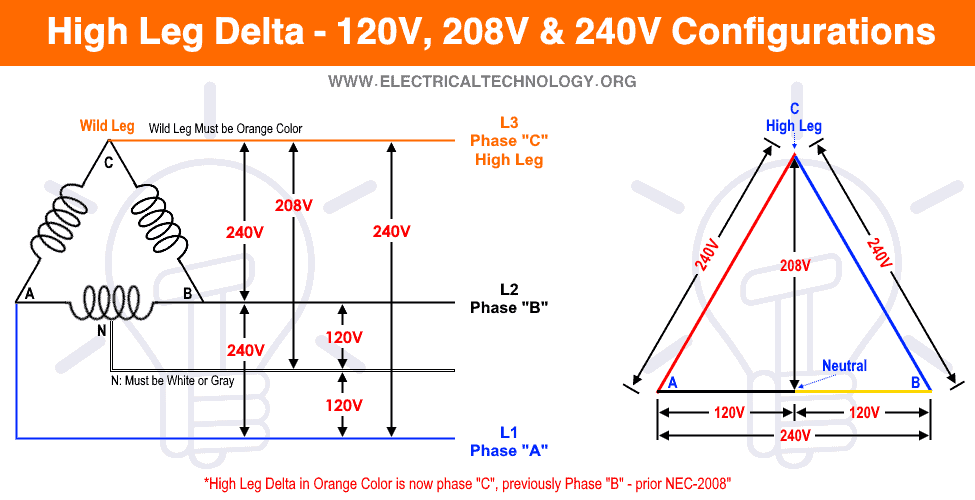
Hot to Neutral = 120V
In this system, the utility provides 240V delta as the base supply. A center tap is taken from one transformer winding, which crates a neutral point. From either end of that winding to neutral, you measure 120V.
A normal hot (A or B phase) + neutral gives you 120V single phase because of the center-tap transformer winding. The configuration is shown in the above fig.
Mathematically, voltage between A-N or B-N is equal to 120V because the 240V (line to line) is split in hot to neutral in the middle.
½ × 240V = 120V – Single-Phase
High Leg to Neutral = 208V
The high-leg voltage to neutral is approximately √3 × 120V ≈ 208V. This is because the neutral point splits the phase-to-phase voltage (240V) into two 120V segments for the other two phases, but the high leg’s voltage to neutral is derived from the delta’s geometry, resulting in a higher voltage.
As shown in the above figure, the third winding of transformer (phase C) in the delta is connected to the midpoint of the opposite windings (A and B). Because of this geometry, the C phase (high-leg or wild-leg) is not symmetrically placed with respect to neutral.
When you measure from C phase to neutral, the voltage is higher because:
VCN = (2402 − 1202) ≈ 208 V
or
√3 × ½ × 240V = 208V
or
√3 × 120V = 208V
This comes directly from applying the Pythagorean theorem in a phasor diagram. That’s why the system is called high-leg delta because one leg is “higher” to neutral than the others.
Mathematically, in a high leg power distribution system:
- Voltage between Hot and Neutral = ½ × 240V = 120V – Single-Phase
- Voltage between High leg and Neutral = ½ × 240V × √3 = 208V – Single-Phase
- Voltage between two Hot (Line to Line) = 120V × 2 = 240V – Single-Phase
- Voltage between All three Hots = 240V – Three-Phase
Why it’s Designed this Way?
If we can easily obtain and use a 208V single-phase supply from a Wye-Wye 120V/208V, three-phase four-wire system, then why design a different and more complex High-Leg Delta system to achieve the same 208V supply
The key advantage of the High-Leg Delta system is that it provides three different voltage levels within a single system: 120V, 208V, and 240V. This flexibility allows it to serve both lighting loads (120V), certain equipment requiring 208V, and heavy machinery or appliances that operate at 240V.
For example, high leg delta system allows:
- 120V single-phase loads (line-to-neutral, but only from A or B to N).
- 208V single-phase loads (Hot leg (C) to neutral).
- 240V single-phase loads (line-to-line).
- 240V 3-phase loads (using all three delta phases).
The High-Leg Delta configuration typically placed the high leg on Phase B in switchboard and panelboard. On the other hand, the ANSI standard requires the high leg to be connected on Phase C in meter box, and it must be identified with orange color for proper marking and safety compliance (NEC – 110.15, 230.56, 408.3(E)(1), 409.102)(B), & 408.3(F)(1)).
Related Posts & Wiring Tutorials:
- When and Why Did the U.S. Transition from 110V to 120V Supply?
- What Do the Green Dot or Orange Triangle Outlets Mean?
- What is the White Powder on the Circuit Breaker Terminals?
- Difference Between EGC and GEC in Electrical Grounding
- What is the Difference Between 15-Amp and 20-Amp Outlet?
- Why Must Neutral and Ground Wires Be Bonded in the Main Panel?
- Can the Neutral Wire Cause Electric Shock? Different Cases
- What Happens if You Use a 120V Device on 240V & Vice Versa?
- Can I Use a 1-Phase Breaker on a 3-Phase Supply & Vice Versa?
- Can I Run 1-Phase Load on 3-Phase Supply and Vice Versa?
- Can you use 15A Breaker on 20A Circuit and Vice Versa?
- Can You use a 15A Outlet on a 20A Circuit and Vice Versa?
Wiring Guides:
- How to Wire 120V/240V Main Panel? Breaker Box Installation
- How to Wire 120V/208V, 1-Phase & 3-Phase Main Panel?
- How to Wire 120/208/240V High Leg Delta 1-Phase & 3-Phase Main Panel?
- How to Wire 277/480V, 1-Phase & 3-Phase Main Service Panel?
- How to Wire 347/600V, 1 and 3-Phase Main Service Panel?
- Single Phase Electrical Wiring Installation in Home according to NEC & IEC
- Three Phase Electrical Wiring Installation in Home – NEC & IEC
- How to Wire a Subpanel? Main Lug Installation for 120V/240V
- How to Size a Load Center, Panelboards and Distribution Board?
- How to Determine the Number of Circuit Breakers in a Panel Board?
- How to Determine the Right Size Capacity of a Subpanel?