What Happens If You Install a Breakers or a Switches on Neutral Instead of Line (Hot or Phase)?
A single-phase electrical load typically requires two current-carrying conductors (Phase/Line and Neutral), along with a grounding conductor. If either the phase (ungrounded) or neutral (grounded) conductor is disconnected, the load will stop operating. Technically, this means a breaker or switch could be installed in the neutral conductor instead of the phase conductor. However, doing so creates serious safety hazards and defeats the primary purpose of these protective devices.
Protective devices such as breakers, fuses, and other control devices such as light switches are designed to disconnect the energized (live) conductor from the load. When they are installed in the neutral conductor instead of the phase conductor, the circuit may appear to be OFF, but dangerous voltage can still be present within the equipment. As a result, the protective function is compromised, which makes the installation unsafe.
It is also important to note that residential supply voltages vary around the world. For example, the United States and Canada commonly use 120/240V AC systems, while most European countries, the United Kingdom, and many countries following IEC standards use 230V AC systems. The possibility of wiring protective devices on Neutral depends on voltage distribution configuration through load centers, panels and consumer units operated at 120V, 240V and 230V.
- Related Post: Can You Use a 2-Pole Breaker Instead of a 1-Pole Breaker
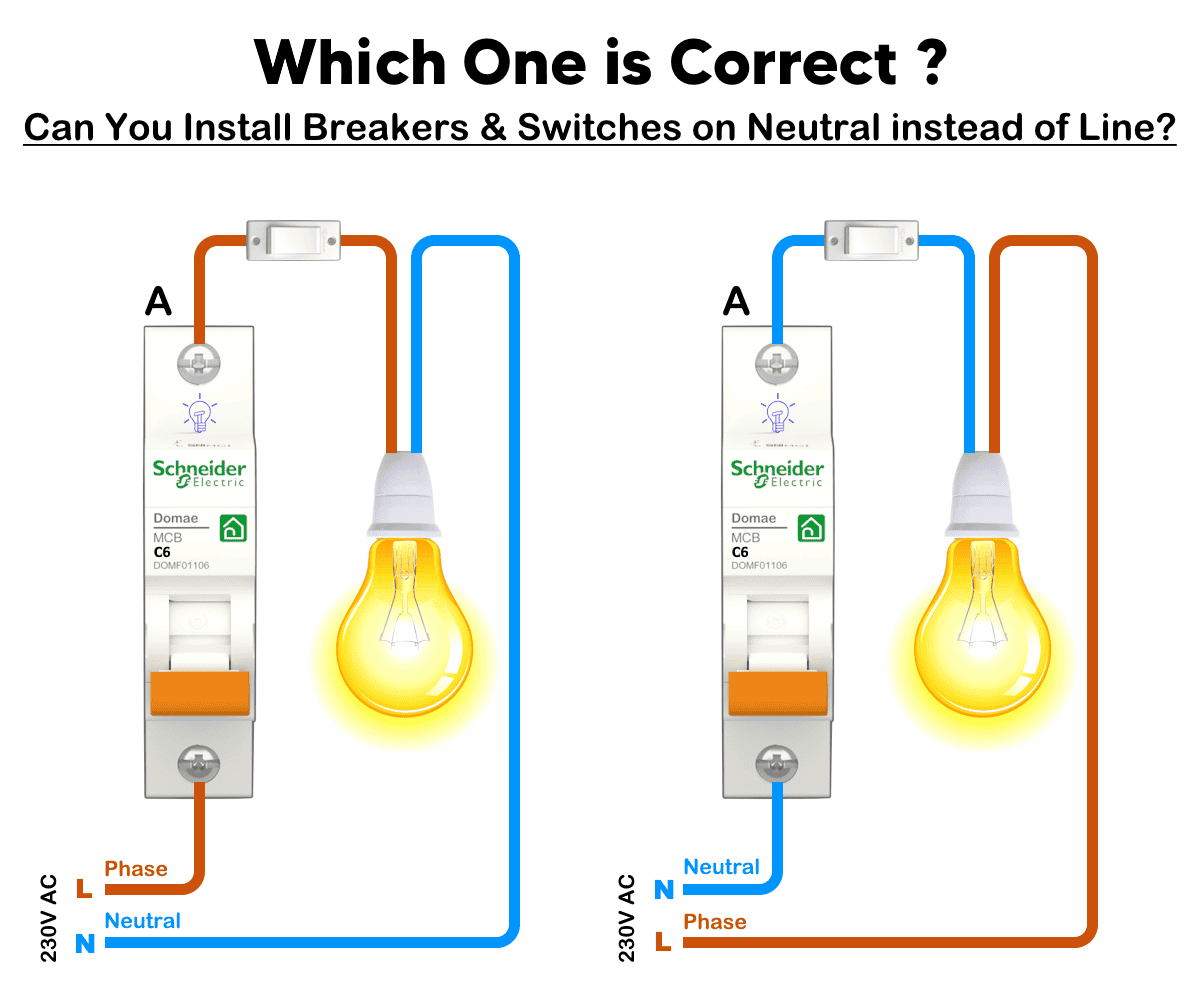
May I Install a Breaker or a Switch on Neutral
NO – While technically possible, it is highly dangerous and against electrical code to connect breakers or switches on the neutral line. For proper operation and protection, all protective devices and switches must be wired to the hot (live or phase) wire.
Let’s examine what will happen when breakers or switches are installed on the neutral conductor instead of the phase (hot, live, or line) conductor in both 120/240V and 230V electrical systems.
230V System – IEC
In distribution boards and consumer units used in 230V electrical systems, both single-pole and double-pole circuit breakers are commonly used to protect sub circuits and final sub-circuits. A single-pole breaker disconnects only the phase (live) conductor, while a double-pole breaker simultaneously disconnects both the Phase and Neutral conductors.
Likewise, load points such as ceiling fans, light fixtures, and sockets are normally controlled by switches installed in the phase (live) conductor. This arrangement ensures that the load is completely isolated from the energized supply when switched OFF. This is why the Neutral wire must not be disconnected in TNS system (except in the newer models of 4-pole switches with Neutral terminal).
Installing switches or circuit breakers in the neutral conductor instead of the phase conductor is prohibited by electrical codes and standards because it can leave the load and associated wiring energized even when the circuit appears to be disconnected. This creates a significant shock hazard and defeats the intended safety function of the switching and protective devices.
Protective Devices
In BS 7671 and the IEC 60364 series, installing overcurrent devices (like circuit breakers or fuses) on the Neutral conductor is strictly prohibited, while switches on the Neutral are only permitted under specific isolation rules.
BS 7671 Regulation and IEC 60364-4-43 (Clause 431.2.2) explicitly states that for overcurrent protection, no single-pole protective device (breaker or fuse) shall be inserted in the Neutral conductor. (In polyphase systems, if the neutral is broken, the phase voltages could rise to line voltage, which becomes hazardous and could damage equipment).
Similarly, IEC 60898-1 and 60947-2 require to isolate the phase voltage via disconnectors. That’s also applicable to the circuit breakers used in the consumer units and distribution boards.
Switches and Isolators
BS 7671 Regulation 536.2.2 & IEC 60364-5-53 require that switching devices must isolate all live conductors. Therefore, a switch can break the Neutral, but it must not open the Neutral before the Phase conductors, and it must reconnect the Neutral before or at the same time as the Phase conductors.
BS 7671 Regulation 461.2 prohibits single-pole switching (using a switch/breaker to turn off) on the Neutral conductor alone unless it is part of a linked multi-pole device that breaks the Phase at the exact same time.
120/240V System – NEC
Inside load centers and electrical panels designed for 120V/240V systems, you will commonly find both single-pole and two-pole breakers used for branch circuit protection.
A single-pole breaker disconnects only one line (hot) conductor. In contrast, a double-pole breaker simultaneously disconnects both hot conductors (Hot 1 and Hot 2). However, neither type of breaker disconnects the neutral or grounding conductors, as these are intended to remain continuous in normal operation.
In 120/240V panels, it is generally not practical (or intended) to install a circuit breaker in the neutral conductor, especially within the main load center. This is because breaker connections are designed to engage with the hot bus bars only, using standardized stab mechanisms.
On the other hand, the neutral and grounding conductors terminate on separate neutral and ground bars, which are mechanically isolated from the breaker positions and typically mounted along the sides or rear of the enclosure. This layout ensures that only ungrounded (hot) conductors are switched or protected by breakers, while the neutral remains continuous except in specific multi-pole or specially designed switching applications.
While circuit breakers and switches can physically be connected in the neutral conductor, this practice is generally not permitted by NEC (except in specific circumstances permitted by the code) because it can create hazardous conditions and compromise circuit safety.
According to NEC 404.2(B), switches and circuit breakers shall not disconnect the grounded (neutral) conductor of a circuit. It means, switching shall be done only using ungrounded (hot or live) conductors (such using two-way, three-way and four-way switches) – NEC 404.2.
Similarly, when a switch is in the OFF position, it must disconnect all ungrounded (live or hot) conductors in accordance with NEC 404.20(B). Furthermore, under normal operating conditions, the switch must not cause current to flow on the equipment grounding conductor connected to the switch, as specified in NEC 404.22.
These requirements mean that protective and control devices must be installed in the ungrounded (hot) conductor rather than the neutral. The intent is to ensure that when a switch or breaker is turned OFF, the load is fully de-energized from the supply side. Hence, this practice reduce the risk of electric shock during maintenance or troubleshooting.
Good to Know:
- Breakers and switches should always be installed in the live (line/hot/phase/ungrounded) conductor, not in the neutral conductor.
- Neutral and Ground conductors are bonded in the main panel, while they are separated in sub-panels.
Why You Must Never Switch or Break the Neutral
If you switch only the neutral, the appliance or fixture remains electrically energized by the hot wire even when turned “off”. Touching exposed parts (such as changing a lightbulb) can result in severe electric shock.
Circuit breakers are designed to interrupt the hot wire to stop overcurrent. Placing one on the neutral will not stop power from flowing into a faulty circuit.
Similarly, reversed polarity caused by switching the neutral can cause some appliances to malfunction or create a fire hazard.
If a single-pole breaker or switch is placed only on the Neutral line and it trips or is turned off, it creates a severe hazard. The Phase (live) wire will still feed power to the appliance or circuit, meaning all internal components and exposed metal parts will remain energized, even though the load has stopped working.
For example, if a light switch is installed in the neutral wire instead of the live wire, the lamp will go off when switched off, but the lamp holder may still be energized and pose a shock hazard when changing the bulb.
In addition, Metal parts and internal wiring can remain at line voltage relative to ground (earth), and faults may not be properly isolated from the power source. If Neutral is disconnected through a switch and a fault occurs, the fault current may not flow back to the source through the grounding conductors as intended. This may prevent the overcurrent protection devices from tripping which causes prolonged fault conduction, risk of fire or equipment damage.
For example, if a short circuit occurs between the hot conductor and ground while the neutral conductor is switched (opened), the fault current may flow through the load and return to the source through the neutral conductor, bypassing the intended overcurrent protection path. As a result, the current may reach dangerous levels, potentially causing overheating, equipment damage, or fire.
- Related Post: Can you use 15A Breaker on 20A Circuit and Vice Versa?
Rule of thumb: Never rely on opening only the neutral conductor for isolation. Always interrupt the live conductor, or disconnect both live and neutral simultaneously with a properly rated device.
When It is Permissible to Wire Breakers on Neutral
You can break the neutral line only if you are using a multi-pole (e.g., double-pole) switch or breaker that is designed to intentionally disconnect both the hot and the neutral wires at the exact same time. Even then, the hot wire must always be disconnected.
The exception in NEC 404.2(B) permits a switch or circuit breaker to disconnect the grounded (neutral) conductor, but only under specific conditions.
A neutral conductor may be disconnected if all circuit conductors are disconnected simultaneously by the same device, such as a 2-pole, 3-pole, or 4-pole breaker or switch. Alternatively, the device may be designed so that the grounded (neutral) conductor cannot be disconnected until all ungrounded (hot) conductors have already been disconnected.
This requirement ensures that no energized (hot) conductor remains connected to the load while the neutral is open, thereby preventing hazardous conditions and maintaining electrical safety.
For example, common-trip 2-pole breakers and switches used on 120/240V or 230V multiwire branch circuits and certain transfer switches or disconnecting means that simultaneously open all conductors.
Resources & Tutorials:
Related Posts:
- Can We Use AC Circuit Breaker for DC Circuit & Vice Versa?
- Can I Use a 1-Phase Breaker on a 3-Phase Supply & Vice Versa?
- What Happens if You Use a 120V Device on 240V & Vice Versa?
- Can an AC Device Operate on DC Supply, and Vice Versa?
- How Does a Standard Breaker Respond to Electrical Fault?
- Why Doesn’t a Standard Breaker Protract Against Ground Faults?
- How Do GFCI and Standard Breakers Respond to Ground Faults?
- Difference Between 1-Pole and 2-Pole Breakers – NEC & IEC
- Difference Between GFCI and AFCI
- Difference Between Circuit Breaker and GFCI
- Difference Between 15-Amp and 20-Amp Outlet?
- Main Difference between Fuse and Circuit Breaker
- What is the Right Wire Size for 15A Breaker and Outlet?
- What is the Suitable Wire Size for 20A Breaker and Outlet?
- How to Find the Number of Outlets on a Single Circuit Breaker?
- How to Toggle Electric Water Heater Between 120V and 240V?
NEC – Wiring Guides for Breakers Installations
- How to Wire a 1-Pole Breaker
- How to Wire a 2-Pole Breaker
- How to Wire a 3-Pole Breaker
- How to Wire a 1-Pole GFCI
- How to Wire a 2-Pole GFCI
- How to Wire a 3-Phase, 3-Pole GFCI
- How to Wire a Tandem Breaker
- How to Wire GFCI Circuit Breakers
- How to Wire an AFCI Breaker
- How to Find the Proper Size of Circuit Breaker? Breaker Calculator & Examples
- How to Install EV Charging Outlet using GFCI Breakers
- How to Determine the Number of Circuit Breakers in a Panel Board?
- Sizing Motors FLC, HP, Voltage, Breaker Size and Wire Size
- How to Find The Suitable Size of Cable & Wire for Electrical Wiring Installation?
- How to Wire 120/240V Smart Load Center with Smart Breakers
- How to Wire a Smart Breaker in a Smart 120/240V Panel
- How to Wire a Smart GFCI Breaker in a 120/240V Smart Panel
- How to Wire Smart AFCI/GFCI Breaker in a Smart Load Center
- How to Wire 120V & 240V Main Panel? Breaker Box Installation
- How to Wire a Smart Switch in a 120/240V Load Center
IEC – Wiring Guides for Breakers Installations
- How to Wire 1-P & 2-P, 1-Phase & 3-P, 3-Phase GFCI Breakers
- How to Wire Single-Phase, 230V Consumer Unit with RCD? IEC, UK & EU
- How to Wire 1-Phase Split Load Consumer Unit? – RCD+RCBO
- How to Wire 230V Dual Split Load Consumer Unit? – RCD+MCB
- Wiring of the Distribution Board with RCD
- Wiring of the Distribution Board without RCD
- How to Wire a Three Phase, 400V Distribution Board? IEC & UK
- How to Wire Combo of 3 & 1-Φ, 400V/230V Distribution Board?
- How to Wire a Garage Consumer Unit?
- How to Wire an RCBO? Residual Current Breaker with Overcurrent
- How to Wire Wi-Fi & RF Smart Wireless Remote Control Switch?
-
 Germany’s Electric Drone Hits 699 km/h, Eyes World Record
-
 How to Wire and Use Tesla Gen 3 Mobile Connector Charger
-
 How to Wire 48A Level 2 Dual Port EV Charging Station
-
 How to Wire Smart Electric Vehicle Charging Station – 32A/80A
-
 How to Wire ChargePoint Home Flex Charger for Every EV
-
 How to Wire an EV Wall Charger – Hardwired and Plug-in