Why are Outlets and Receptacles in Hospitals Upside Down?
Why Are Hospitals Outlets Upside Down as Compared to the Residential Receptacles
Most of you guys may have noticed the inverted electrical outlets installed in the hospitals while the same receptacles are fixed the right side up in the residential and home applications. General questions arise here: is it the best practice to do so or is it a code and finally, which direction should electrical receptacles be installed? Well, we will discuss one by one as follows.
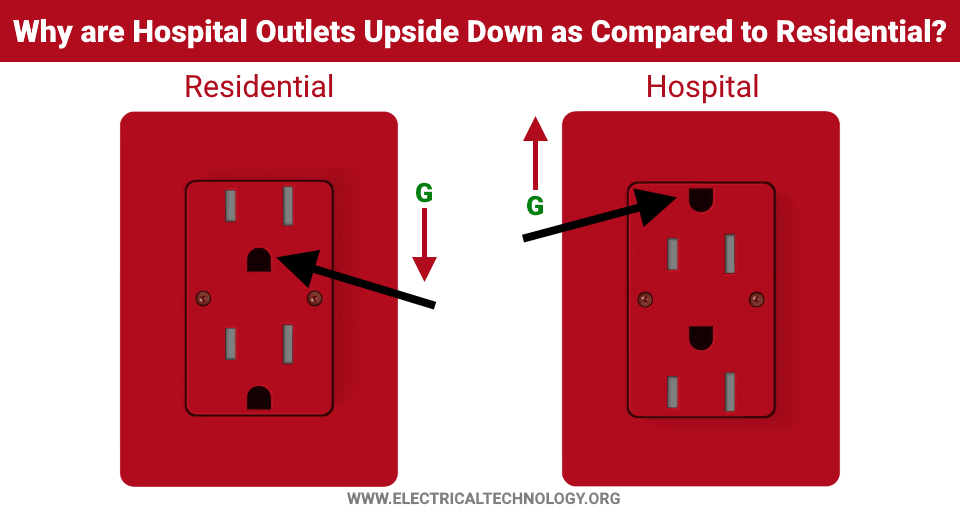
Why are Hospital’s Electrical Outlets Upside Down Instead of Right Side Up?
As we know that in a three prong plug and outlet (also known as socket), the narrow blade is for Hot (live), the wide blade is for Neutral, and the longer Pin is for ground as a safety purpose. The newer 3-prong outlets are installed upside down in hospitals because a partially plugged-in right side up outlet may create chaos in case a fork or any other metallic tool falls down on the upper two terminals (Hot & Neutral) which leads to a short circuit and hazardous fire. This is the reason why they install the receptacles in hospitals in an upside down position instead of right side up.

In case of an upside down outlet, dropping something metallic on the exposed part of the plug, it will first touch the ground pin and may trip the circuit breaker which is supposed to do so for better protection.
Is it OK to Install the Outlet in Upside Down Position?
Well, It is not a code to install the outlet in a specific position e.g. you can install in any direction either the ground prong is top or bottom. The debate still continues between the trade and union electricians but the vote is for Upside down outlets in case of hospitals and patients. In addition, some commercial locations are required to install the receptions in opposite directions (upside down position) in case of metallic faceplate. Nowadays, plastic faceplates are common in home applications, so it does not make sense to install the inverted positioned outlets.
Should the Ground Prong be on Top or Bottom?
In case of the right side up (Ground at bottom), the ground is the last pin to disconnect when you pull out the three pin plug. On the other hand (Ground at Top), the Hot and Neutral wires are still energized when you pull out the plug. This way, you may reduce the risk of electric shock and possible electrocution hazard in case of accidental pulled out plugs.
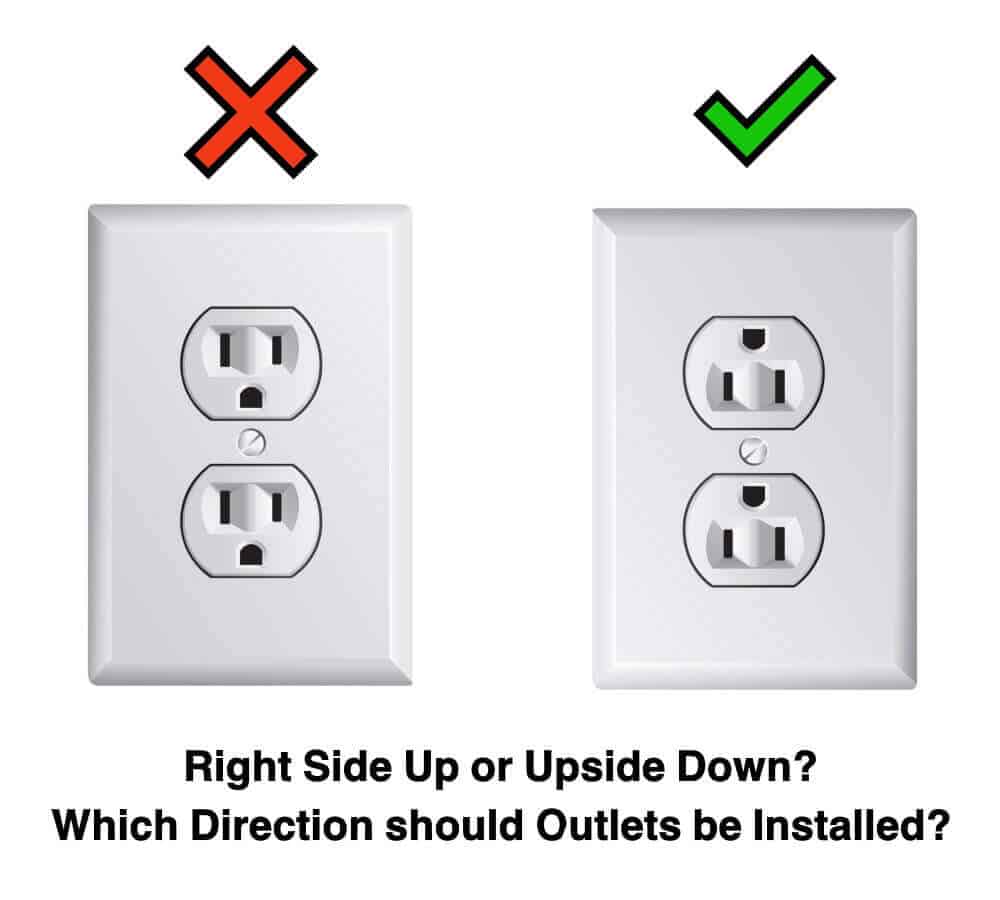
Right Side Up or Upside Down? Which Direction should Outlets be Installed?
As mentioned above, you can install an electrical outlet in any direction as the standard position is not mentioned in the code yet. It will still work the same without affecting the operation either in upside down, right side up or sideway etc. So it is up to you which side you select but most electricians install them in the right side up position.
Why are Red Color Outlets installed in the Hospitals?
The red color outlets in a hospital indicate that the receptacles are on emergency backup power. The different color of outlets are identical to the doctors, nurses and paramedic staff and they quickly connect the medical equipment to the desired receptacles and outlets in case of emergency.
Related Posts:
- What Happens if a Battery is Connected to the AC Supply?
- What Happens to the Battery with Reverse Polarity Wiring Connection
- What Happens if We Connect a Polar Capacitor the Wrong Way?
- Can We Use AC Circuit Breaker for DC Circuit & Vice Versa?
- Which One Kills – Current or Voltage and Why? Amps vs. Volts
- AC or DC? Which One is More Dangerous And Why ?
- Why Can’t a 12V Car Battery Electrocute You?
- Will I Get an Electric Shock If I Touch the Ground Wire?
- Why is the Long Prong Neutral Instead of the Narrow Prong?
- Why is the Neutral Prong or Slot Wider on a Plug or Outlet?
- Why is the Neutral Wire Size Smaller than the Phase Wire?
- Can the Neutral Wire Cause Electric Shock?
- Will a Man Get an Electric Shock If He Hangs on a Live Wire?






I worked electrical maintenance in hospital they feel like if the plug is partially out of the outlet and some metallic falls 🤔 on the exposed prongs it will hit the ground lug 1st
It is believed to reduce the probability of short-circuit accidents. However, the extent of its effect is not known.
I always put the ground down because that’s where the earth is, you can’t idiot proof everything. If you look at most 90 deg. flush plugs they will drape towards the floor with ground down
USA lagging (again!) behind in standards, technology and thus safety.
Typical European:
Only the tip is metal. Most countries have recessed outlets, also for giving mechanical support.
The shown German/Dutch/Belgian/Nordic ‘Shuko’ solution boasts also shutters, preventing kids of putting sticks in.
Yes, we have about 7 different types since we are 40+ independent countries, but the safety solutions are similar and typical travel equipment fits everywhere, only earthed equipment (high-end laptops) may need adapters in Switzerland, Italy & few others.
yea that seems so much more advanced to not have a standard system so you have to have adapters for some things…… you gotta be kidding bro
You need adapters all over the world. Most of us dont use your 110-120V 60Hz. My phone charger works ALL over Europe, Israel, Ethiopia, SriLanka, South Africa, Marocco… Yours? North America. That’s it.
Adapters only needed for heavier equipment (bringing professional tools) while most hotels have dual standard anyway.
It really only matters if you’re using stainless steel wall plates in that case you need to put the ground up in case the plate comes loose and fall down and all your other reasons you can have all you want, but that’s really the only reason that I have any use for after 35 years of taken care of that sort of thing in the hospital that’s how we did it
Well.. if you look at the print on any outlet or gfi… the text is always oriented with the ground prongs up. So the way you’re used to seeing is wrong.
Well then why do many manufacturers make night lights or inline switches or other items that are right-side up when plugged into outlets where the load slot (smaller slit) is to the right side of the neutral slot (longer slit) which means the ground prong is below the others?