How Do Some Devices Operate on Both AC and DC Supplies?
How Do Some Electrical Devices Operate on Both AC and DC Input Voltages?
We know that high-power electrical devices and equipment are generally not designed to operate on DC supply due to difficulties in voltage conversion and issues with long-distance transmission. This is why the AC supply system is commonly used in household and residential applications. While some devices are designed to support dual-input voltage range, such as 100-240V AC, this is not the same as running an AC device on DC supply or a DC device on AC supply. However, there are some specially designed devices (such as universal motor) that can operate on both AC and DC power under specific conditions.
In the world of electrical and electronic engineering, devices are typically designed to work with either alternating current (AC) or direct current (DC), depending on their internal circuitry and power requirements. However, there are certain devices and components that can operate on both AC and DC inputs without any significant modification such as universal motors, five-tube FM radio, SMPS-based charges and battery-powered systems.
- Related Post: Can an AC Device Operate on DC Supply, and Vice Versa?
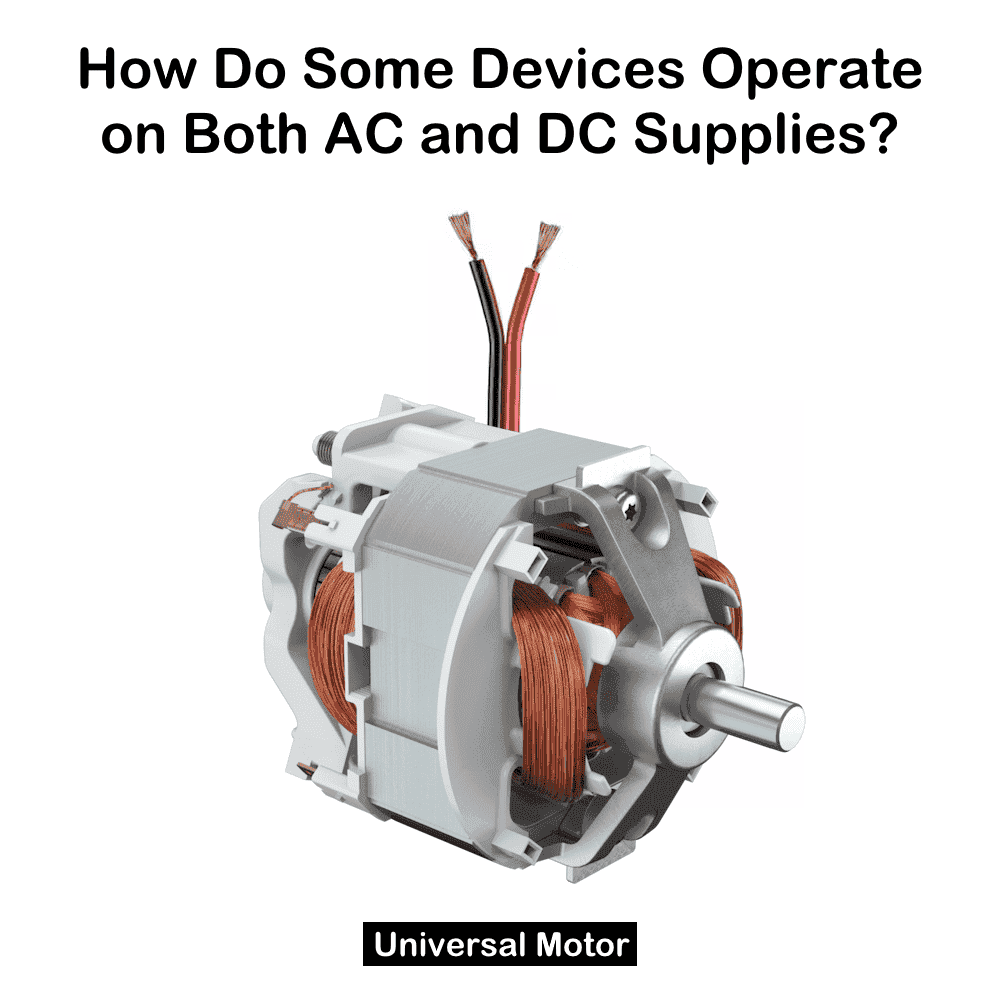
How Do Some Devices Accept Both AC and DC?
AC and DC differ fundamentally in their flow of electric charge. AC reverses direction periodically at 50 or 60 Hz, as supplied by alternators and household power grids. DC, on the other hand, flows in a single direction without frequency, as provided by batteries, solar panels or rectified power supplies. For a device to operate on both AC and DC, its internal circuitry and components must be designed to handle both types of current without damage or performance degradation.
The power conversion between AC and DC involves the following operating mechanisms that allow a device to function on both AC and DC supplies.
- Rectification: Many dual-compatible devices use a rectifier (such as a diode bridge) to convert AC into DC internally. This allows the device to process AC input as if it were pulsating or pure DC needed for the circuit. The process of rectification ensures consistent operation of the device regardless of the input type.
- Component: Components like resistors, incandescent bulbs, or heating elements are inherently agnostic to the type of current. Their operation depends on voltage and current magnitude, not the direction of flow. Hence, it makes them suitable for both AC and DC.
- Switch-Mode Power Supplies (SMPS): Modern devices often employ SMPS, which can accept a wide range of input voltages (AC or DC) and convert them into the required DC output for internal circuits. SMPS use high-frequency switching to regulate power as per circuit requirements.
- Universal Motors: Certain motors, known as universal motors, are designed to run on both AC and DC due to their unique construction and special components like commutator and carbon brushes.
Related Post: Why are High-Power Devices Not Designed to Run on DC Voltage?
How Does a Universal Motor Work on Both AC and DC?
A universal motor is a type of electric motor that can operate on both AC and DC power supplies. These types of motors are commonly found in appliances like vacuum cleaners, power drills, and blenders. Its ability to function with either current stems from its design, which combines elements of series-wound DC motors and AC motors.
Construction: A universal motor consists of a stator (stationary part) with field windings and a rotor (rotating part) with armature windings, connected in series. As it is a series-wound motor, it means the field winding and armature winding are connected in series. Brushes and a commutator facilitate current flow to the rotor, similar to a DC motor.
Working: When either AC or DC is applied, the current flows through both windings in the same direction, producing a torque in one direction. The motor maintains torque because the magnetic polarity of both the field and armature windings reverse at the same time when AC is applied. This keeps the direction of rotation unchanged. On DC, there’s no reversal, but torque is still produced effectively.
Operation on DC: When powered by DC, current flows through the field windings and armature in series, creating magnetic fields in the stator and rotor. These fields interact to produce torque, causing the rotor to spin. The commutator reverses the current in the armature as it rotates, maintaining consistent torque direction.
Operation on AC: With AC, the current alternates, but the series connection ensures that the magnetic fields in the stator and rotor reverse simultaneously. This synchronized reversal maintains the same torque direction, allowing the motor to rotate consistently. The commutator still switches the armature current to align with the changing field.
- Related Post: How Do Some Devices Have Dual Input Voltage Ratings?
Can an Electrical Device Run on Both AC and DC at the Same Time?
Technically, an electrical device cannot run on both AC and DC simultaneously through the same input terminal, as combining AC and DC in a single circuit creates a complex waveform that is neither purely AC nor DC.
AC and DC are fundamentally different types of electrical energy. Mixing both at the same input can cause component damage, overheating, or erratic operation.
Devices are usually designed to accept either AC or DC, not a combination at the same time. Despite the case, some equipment and power systems (like rectifiers, universal motors or hybrid inverters) can accept both AC and DC as separate inputs, switching between sources or prioritizing one.
However, there are scenarios where the concept of applying both AC and DC to a device at the same time is misunderstood or applied differently.
Mixed Waveforms: If AC and DC are applied together, the result is a superimposed waveform (AC riding on a DC offset). Most devices are not designed to handle this, and it may cause malfunction or damage unless the device has specific circuitry to filter or process such inputs.
Separate Inputs: Some devices, like certain industrial equipment, may have dual power inputs (i.e. one for AC and one for DC) used alternately but not simultaneously. For example, a device might switch to DC (battery) during a power outage but cannot use both inputs at once.
Internal Conversion: Devices that accept AC or DC typically convert AC to DC internally. If both AC and DC were supplied simultaneously, the device’s rectifier or power management circuit would prioritize or process one input, effectively nullifying the other.
- Related Post: What Happens When an AC Line Touches a DC Line?
List of Electrical Devices That Can Be Used on Both AC and DC Supply
Several devices and components are designed to be compatible with both AC and DC power supplies. Below is a list of common examples:
Universal Motors: Tools and appliances such as power drills, vacuum cleaners, blenders, and sewing machines often use universal motors, enabling operation on both AC and DC. Small fans with universal motors like those in portable cooling devices can run on AC or DC. Moreover, brush-type DC motors can work on low-frequency AC with reduced efficiency.
Incandescent Lamps: Incandescent bulbs work on both AC and DC, as their filament glows based on current flow, regardless of direction. However, voltage must match the bulb’s rating. Same is the case for halogen lamps which relies on resistive heating.
Heating Elements: Devices like electric stoves, toasters, or soldering irons use resistive heating elements that function equally well on AC or DC, provided the voltage is appropriate.
Certain LED Lights: Some LED fixtures are designed with drivers that accept both AC and DC inputs, commonly used in solar-powered or off-grid systems.
Chargers with SMPS: Many modern SMPS-based adapters and chargers for laptops, phones, or other electronics use switch-mode power supplies convert input AC/DC to low-voltage DC. In other words, they can handle both AC and DC inputs within a specified voltage range. In addition, bridge rectifier circuits accept AC or DC and provides output as filtered DC. Moreover, battery-powered electronics with AC-DC adapters also accept DC input (12V, 24V etc.).
Resistive Loads: Any purely resistive device, such as a simple space heater or kettle, can theoretically operate on both AC and DC and unaffected by waveform if the voltage is compatible. Similarly. thermal fuses operate on temperature rise, not current type. Hence, they can operate on both AC and DC. Moreover, some non-polarized relay coils accept both AC and DC (check datasheet before operation).
Related Posts
- Why is AC Commonly Used in Households Instead of DC?
- AC or DC – Which One is More Dangerous And Why ?
- What Happens if You Use a 120V Device on 240V & Vice Versa?
- What is the Difference Between AC Ground and DC Ground?
- Can you Combine AC and DC Ground in a Solar Installation?
- Should You Connect GND and 0VDC? Combined AC & DC Grounding
- Why Doesn’t DC System Require a Grounding System Similar to AC System?
- Why Do Doorbells Use Low Voltage of 12V-24V AC Instead of DC?
- Why Can’t a 12V Car Battery Electrocute You?
- Why Does an Electric Tester Not Work in DC Circuits?
- Can I Use a 240V Breaker on a 120V Circuit and Vice Versa?
- Can you use 15A Breaker on 20A Circuit and Vice Versa?
- Can You use a 15A Outlet on a 20A Circuit and Vice Versa?
- Why Do DC Motors Have Higher Starting Torque than AC Motors?
- Difference between AC and DC Transmission System & Power Lines
- Difference Between AC and DC Generator
- Difference Between AC and DC Motors
- Differences Between HVAC and HVDC
- Difference Between AC and DC Resistance
- Difference between AC Drives and DC Drives
- Difference Between GND, 0VDC, Common and Virtual Ground
- Advantages of HVDC over HVAC Power Transmission
- Why Does AC Need More Insulation than DC at the Same Voltage Level?
- Is Lightning AC or DC ?