Main Difference Between a Circuit Breaker and a GFCI
Electricity, like fire, is a good servant but a bad master. When kept under control, it is highly useful; however, if it gets out of control, it can cause serious injuries or significant damage to a building. Therefore, multiple types of protective devices are used to reduce electrical hazards. Circuit breakers and GFCIs are two commonly used electrical protection devices in residential installations. Although both provide protection against electrical faults, their functions and purposes are quite different.
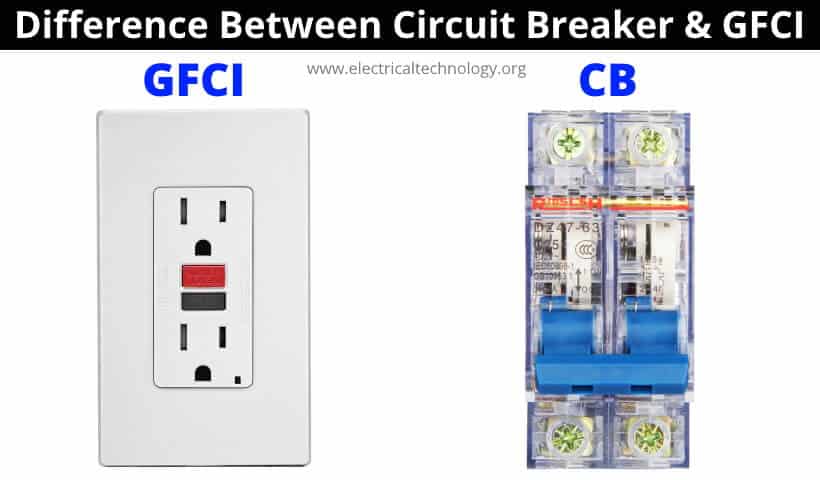
- Related Post: Difference Between GFCI and AFCI
The following figure illustrates the differences and terminal wiring of single-pole and two-pole standard circuit breakers, as well as GFCI breakers.
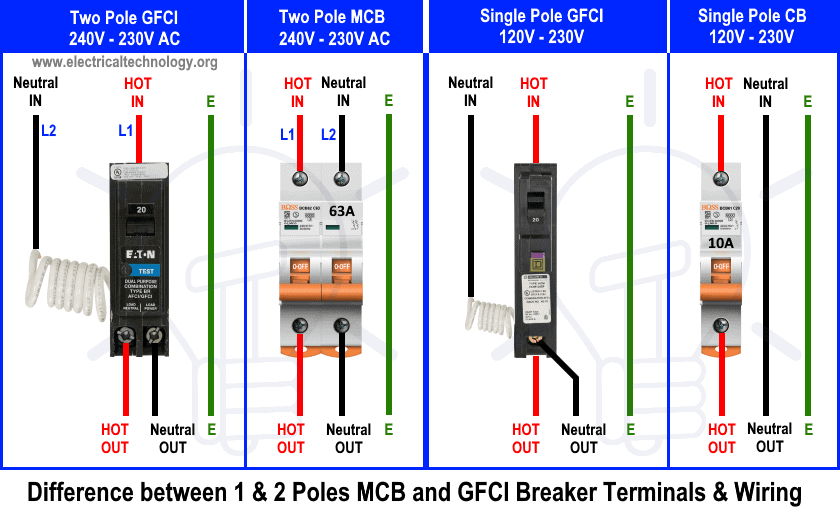
Before discussing the differences between a circuit breaker and a GFCI, it is important to first understand the basic operation and purpose of each device.
Standard Circuit Breaker
A circuit breaker is an automatically operated switching device designed to protect an electrical circuit from overcurrent conditions such as overloads and short circuits. It provides protection against abnormal current flow by detecting excessive current and automatically interrupting the power supply. By tripping under fault conditions, the circuit breaker helps prevent damage to wiring, connected equipment, and the building’s electrical system.
The current rating marked on a circuit breaker and class type are very important to consider for circuit protection. The breaker trips and interrupts the circuit whenever the current exceeds its rated limit. Excess current can occur for several reasons, including circuit overloading, short circuits, or large current surges on the supply lines. Overloading typically results from connecting multiple high-power loads to a single circuit or from a faulty appliance drawing excessive current. Short circuits usually occur when conductors come into direct contact due to damaged insulation, loose connections, or deteriorated wiring.
For example, a circuit breaker rated at 15 amperes will automatically trip and interrupt the circuit when the current flowing through it exceeds 15 amperes.
Circuit breakers are installed in the main breaker panel or distribution board of a building. Each circuit breaker controls the power supply to a specific room or designated area. If an abnormal current condition occurs within that area, the corresponding circuit breaker trips and disconnects power to all outlets and loads on that circuit. To restore power, the circuit breaker must be manually reset at the breaker panel after the fault condition has been identified and corrected.
Good to Know:
Standard circuit breakers are available in 15A to 100A+. The standard current rating in NEC Table 240.6(A) is 10A – 6kA.
- Related Post: Difference between Fuse and Circuit Breaker
GFCI (Ground Fault Circuit Interrupter)
A Ground-Fault Circuit Interrupter (GFCI) is a electrical protective device designed to reduce the risk of electric shock. In a proper grounding system, It continuously monitors the current flowing in the ungrounded (hot) and grounded (neutral) conductors and trips the circuit within milliseconds if it detects an imbalance caused by current leaking to ground. This rapid disconnection helps prevent serious injury or electrocution, especially in situations where a person may come into contact with energized parts.
GFCIs are commonly used in locations where moisture, water, or damp conditions increase the likelihood of ground faults. According to the National Electrical Codes (NEC) – Article 210.8, GFCI protection is required in areas including bathrooms, kitchens, laundry rooms, garages, basements, outdoor outlets, and near sinks or water sources.
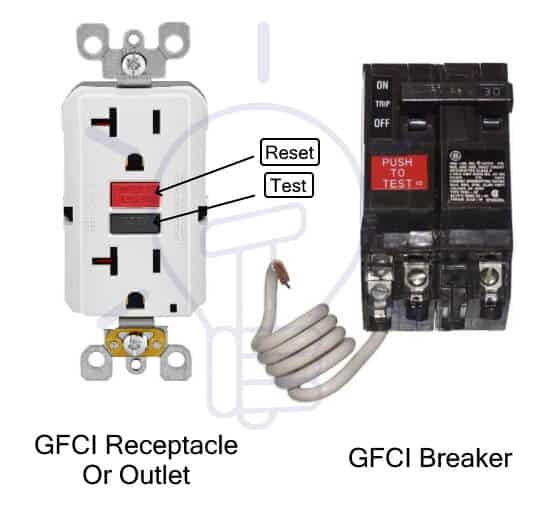
GFCI protection can be provided through GFCI receptacles or GFCI circuit breakers, depending on the application and installation requirements.
GFCI Circuit Breaker
A GFCI (Ground-Fault Circuit Interrupter) breaker is a circuit breaker installed in the electrical panel that provides both overcurrent protection and ground-fault protection. It continuously monitors the current flowing out on the ungrounded (hot) conductors and returning on the grounded (neutral) conductor. If an imbalance typically as small as 4-6 mA is detected, indicating current leakage to ground, the breaker trips immediately to reduce the risk of electric shock.
A GFCI circuit breaker provides protection against both overloads (including those caused by short circuits) and ground-fault conditions. On the other hand, a standard circuit breaker provides protection only against overloads and short circuits.
The “TEST” button on a GFCI breaker is used to verify that the ground-fault protection mechanism is operating correctly. When pressed, the button creates a small, intentional current imbalance inside the breaker, simulating a ground-fault condition. If the breaker is functioning properly, it will trip immediately, cutting power to the protected circuit.
Good to Know:
For 240V circuit protection against ground faults, you wi
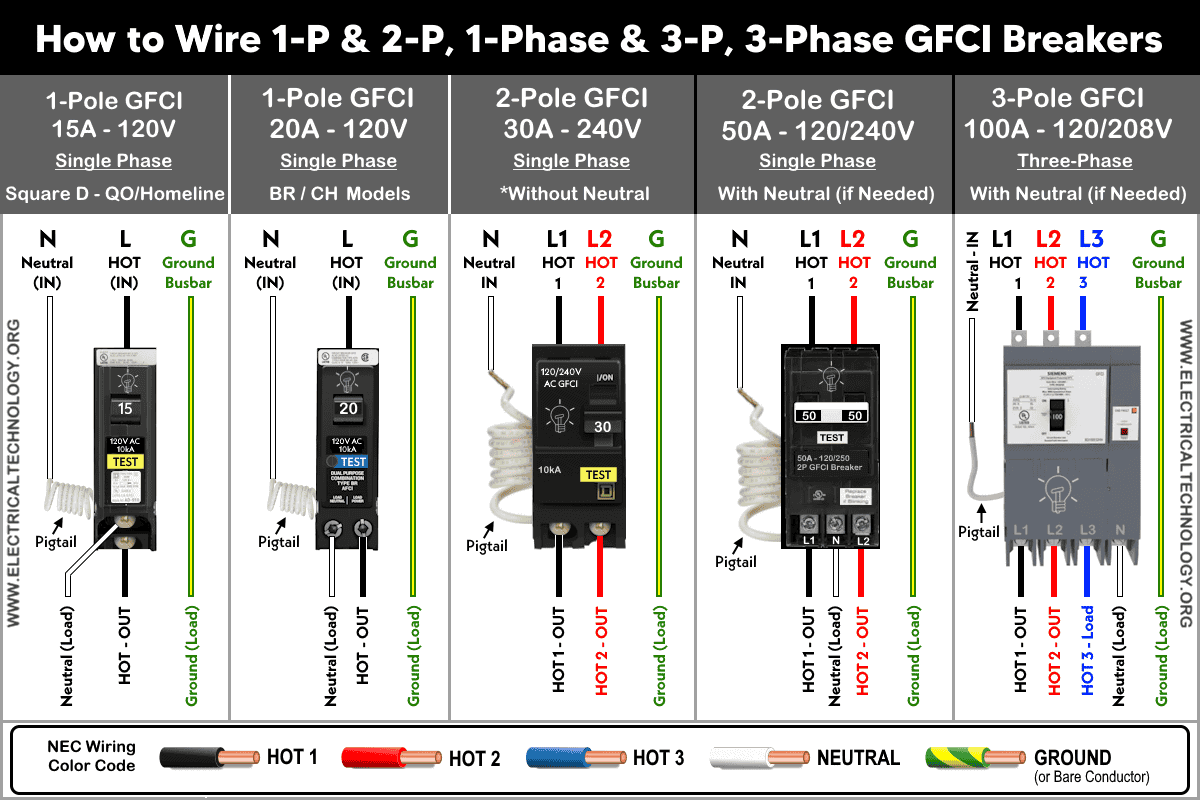
The following figure shows the different wiring connections for single-pole, two-pole, and three-pole GFCI breakers, both with a neutral connection and without a neutral connection.
When to Use a GFCI Breaker
A GFCI breaker is used when ground-fault protection is required for an entire branch circuit rather than a single outlet. It is especially useful when multiple receptacles or hardwired loads are on the same circuit, or when downstream receptacles are not easily accessible for testing and resetting. It is also preferred when panel-level protection simplifies compliance with NEC Article – 210.8(A) & (B) requirements.
Where to Use a GFCI Breaker
GFCI breakers are commonly used in areas requiring GFCI protection under the NEC-Article – 210.8(A), such as bathrooms, kitchens, garages, basements, laundry areas, outdoors, and around pools or spas. They are also suitable for dedicated circuits supplying equipment in damp or wet locations. Installing the protection at the panel ensures all connected devices on the circuit are protected.
GFCI Outlet (Receptacle)
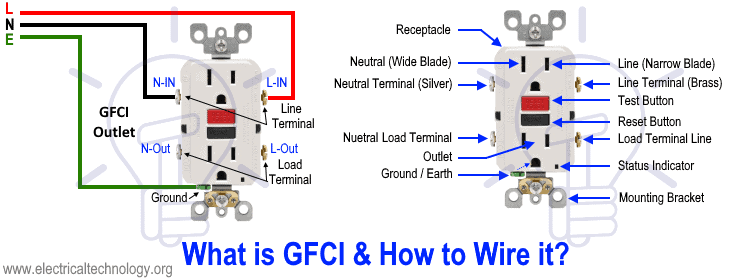
A GFCI outlet, also called a GFCI receptacle, is a point-of-use device designed to protect people from electric shock caused by ground faults. It performs the same current-imbalance monitoring as a GFCI breaker but is installed at the receptacle location. Most GFCI outlets include “TEST” and “RESET” buttons for manual verification of proper operation.
A GFCI outlet does not trip due to circuit overloading or a short circuit in the connected appliance. Instead, it responds only to ground-fault conditions. In the event of an overload or short circuit, the upstream circuit breaker supplying the GFCI receptacle will trip to interrupt the circuit.
The “TEST” button is used to verify proper GFCI operation. When pressed, it momentarily creates an imbalance between the ungrounded (hot) conductor and the grounded (neutral) conductor within the device, causing it to trip.
The “RESET” button is used to restore power after the GFCI has tripped. However, it should not be pressed until all connected appliances or loads have been disconnected.
Good to Know:
If ground-fault protection is required for a 240-volt circuit, a two-pole 240V GFCI circuit breaker must be used instead of a GFCI outlet because GFCI receptacles are not manufactured for 240V applications. This is because GFCI outlets are available only in 15-amp and 20-amp ratings for 120V circuits
When to Use a GFCI Receptacle
A GFCI receptacle is used when protection is needed at a specific outlet rather than for an entire circuit. It is often selected for retrofit installations, cost-effective upgrades, or when only one or a few receptacles require GFCI protection. It can also provide downstream protection to additional standard receptacles when wired using the LINE and LOAD terminals.
Where to Use a GFCI Outlet
GFCI outlets are installed in locations where receptacles are exposed to moisture or increased shock risk, such as bathrooms, kitchens (countertop outlets), garages, unfinished basements, laundry rooms, and outdoor areas. They are also commonly used near sinks and wet work surfaces.
Related Post:
- Should GFCI Protection Be in the Main Panel or Receptacle?
- Difference Between Relay and Circuit Breaker
Key Differences Between Circuit Breaker and GFCI
| Circuit Breaker | GFCI |
| A protective device that safeguards a circuit against overloads and short circuits. | A protective device that safeguards a circuit against ground faults (leakage current). |
| Trips when the current exceeds its rated value due to overload or short circuit. | Trips when it detects an imbalance (leakage) between the hot and neutral conductors. |
| Monitors current flow only in the ungrounded (hot) conductor. | Monitors current flow in both the hot and neutral conductors. |
| Protects wiring and equipment from overheating and fire hazards. | Protects people from electric shock due to ground-fault conditions. |
| Does not trip due to electric shock unless the current exceeds the breaker’s rating. | GFCI outlet does not trip due to overloads or short circuits, while the GFCI breaker does. |
| Rated current values are typically high (e.g., 15A, 20A, 30A …. to 100A+ etc.). | Available in 15A and 20A at 120V only. Rated leakage trip level is very low, typically 4-6 milliamperes. |
| Does not include TEST or RESET buttons. | Includes “TEST” and “RESET” buttons for functionality verification and restoration. |
| Cannot be tested locally for ground-fault protection. | The “TEST button” allows verification of ground-fault detection functionality. |
| Must be reset manually at the breaker panel after tripping. | Can be reset directly at the receptacle or at the breaker, depending on the type. |
| Installed in the main breaker panel or distribution board. | GFCI receptacles are installed at outlets; GFCI breakers are installed in the breaker panel. |
| Required for all branch circuits supplying rooms or specific areas. | Required by NEC in wet or damp locations such as bathrooms, kitchens, garages, outdoors, and similar areas. |
| Interrupts power to all outlets and loads on the protected circuit. | When used as a receptacle, interrupts power only to connected and downstream loads. |
| Generally less expensive than GFCI devices. | Generally more expensive than standard circuit breakers. |
In short, both circuit breakers and GFCIs are protective devices used in a building to provide protection against electrical hazards. GFCIs are specifically required in wet and damp locations to protect people from electric shock caused by ground faults (as per NEC 210.8), while circuit breakers are installed in electrical panels to protect conductors and equipment from electrical fires resulting from overloads and short circuits.
Resources & Tutorials:
Related Posts:
- Can We Use AC Circuit Breaker for DC Circuit & Vice Versa?
- Can you use 15A Breaker on 20A Circuit and Vice Versa?
- Can You use a 15A Outlet on a 20A Circuit and Vice Versa?
- Can I Use a 1-Phase Breaker on a 3-Phase Supply & Vice Versa?
- What Happens if You Use a 120V Device on 240V & Vice Versa?
- Can an AC Device Operate on DC Supply, and Vice Versa?
- How Does a Standard Breaker Respond to Electrical Fault?
- Why Doesn’t a Standard Breaker Protract Against Ground Faults?
- How Do GFCI and Standard Breakers Respond to Ground Faults?
- Difference Between 1-Pole and 2-Pole Breakers – NEC & IEC
- Difference Between 15-Amp and 20-Amp Outlet?
- Difference Between GFCI and AFCI
- Difference Between MCB, MCCB, ELC, RCD and RCBO Circuit Breakers
- Main Difference Between Contactor and Starter
- Difference between Circuit Breaker and Isolator / Disconnector
- Difference Between Neutral, Ground and Earth
- What is the Right Wire Size for 15A Breaker and Outlet?
- What is the Suitable Wire Size for 20A Breaker and Outlet?
- How to Find the Number of Outlets on a Single Circuit Breaker?
- How to Toggle Electric Water Heater Between 120V and 240V?
NEC – Wiring Guides for Breakers Installations
- How to Wire a 1-Pole Breaker
- How to Wire a 2-Pole Breaker
- How to Wire a 3-Pole Breaker
- How to Wire a 1-Pole GFCI
- How to Wire a 2-Pole GFCI
- How to Wire a 3-Phase, 3-Pole GFCI
- How to wire GFCI Circuit Breakers?
- How to Wire a Tandem Breaker
- How to Wire GFCI Circuit Breakers
- How to Wire an AFCI Breaker
- How to Wire an AFCI Outlet?
- How to wire a GFCI Outlet?
- How to Install EV Charging Outlet using GFCI Breakers
- How to Determine the Number of Circuit Breakers in a Panel Board?
- Sizing Motors FLC, HP, Voltage, Breaker Size and Wire Size
- How to Find The Suitable Size of Cable & Wire for Electrical Wiring Installation?
- How to Wire 120/240V Smart Load Center with Smart Breakers
- How to Wire a Smart Breaker in a Smart 120/240V Panel
- How to Wire a Smart GFCI Breaker in a 120/240V Smart Panel
- How to Wire Smart AFCI/GFCI Breaker in a Smart Load Center
- How to Wire 120V & 240V Main Panel? Breaker Box Installation
- How to Wire a Smart Switch in a 120/240V Load Center
IEC – Wiring Guides for Breakers Installations
- How to Wire 1-P & 2-P, 1-Phase & 3-P, 3-Phase GFCI Breakers
- How to Wire Single-Phase, 230V Consumer Unit with RCD? IEC, UK & EU
- How to Wire 1-Phase Split Load Consumer Unit? – RCD+RCBO
- How to Wire 230V Dual Split Load Consumer Unit? – RCD+MCB
- Wiring of the Distribution Board with RCD
- Wiring of the Distribution Board without RCD
- How to Wire a Three Phase, 400V Distribution Board? IEC & UK
- How to Wire Combo of 3 & 1-Φ, 400V/230V Distribution Board?
- How to Wire a Garage Consumer Unit?
- How to Wire an RCBO? Residual Current Breaker with Overcurrent
- How to Wire Wi-Fi & RF Smart Wireless Remote Control Switch?
-
 Germany’s Electric Drone Hits 699 km/h, Eyes World Record
-
 How to Wire and Use Tesla Gen 3 Mobile Connector Charger
-
 How to Wire 48A Level 2 Dual Port EV Charging Station
-
 How to Wire Smart Electric Vehicle Charging Station – 32A/80A
-
 How to Wire ChargePoint Home Flex Charger for Every EV
-
 How to Wire an EV Wall Charger – Hardwired and Plug-in