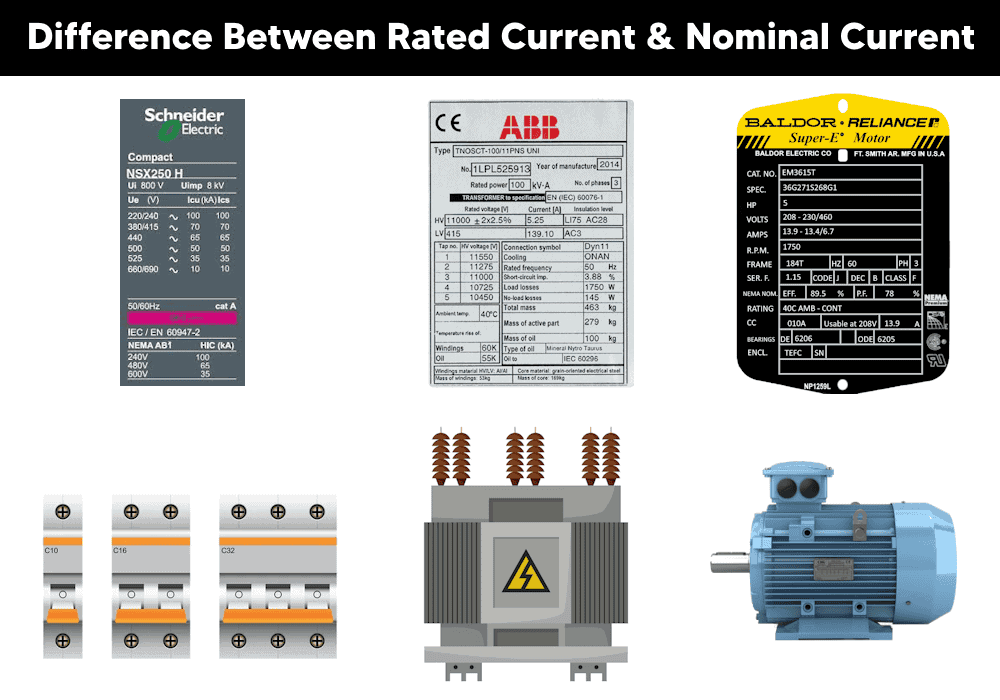
Difference Between Rated Current and Nominal Current
Difference Between Rated Current, Nominal Current, Max Current and Relation with Full-Load Ampere (FLA) and Full-Load Current (FLC)
The terms rated current and nominal current sound similar and are often used interchangeably, but they have slightly different meanings depending on standards, design, or specific applications in electric circuits and devices.
To make things simple and easy to understand, even for a layperson, let’s look at how nominal current and rated current are applied in motors, transformers, circuit breakers, and other electrical devices.
Rated Current
Definition: The rated current is the maximum continuous current that a device, conductor, or equipment can safely carry continuously under specified operating conditions without overheating or degrading.
The value of rated current is given and tested by the manufacturers, based on design, insulation class, temperature rise, and safety standards. This value represents the safe and continuous operating current under normal conditions for motors, transformers, circuit breakers, or wire/cables etc.
In most cases, the current should not exceed the rated value by more than 10%. Otherwise, it will “overload” the branch circuit and branch circuit conductors used for an appliance.
For Example:
- A 10A circuit breaker has a rated current of 10A. It can carry 10A indefinitely under standard conditions.
- A motor with a rated current of 15A. It is designed to safely handle up to 15A continuously without issues.
In motor circuits, rated current is refer to the Full Load Amperes “FLA” or maximum current (Imax) which is the value of current printed on the motor’s nameplate. It means, the rated current is the actual maximum current drawn by an electric motor when operating at rated voltage and frequency while providing full-rated horsepower (H.P). on the other hand, nominal current is the current drawn by the motor under normal operating conditions.
Related Post: Difference Between NEMA and IEC Motor Starters & Contactors
Nominal Current
Definition: The nominal current is a reference value or a designated current that a conductor or an electrical device is expected to carry under normal operating conditions (IEEE. 725.2). It is often used as a general or approximate value by equipment design for selection or comparison purposes.
As the name suggests, nominal current (INOM) is more like an expected or average working current rather than the maximum safe limit (rated current). It is used for system design, such as for selecting fuses, circuit breakers, or cables, to match the expected load.
In the case of transformers, the terms nominal current and rated current are generally used in the same context. However, in the case of motors, the nominal current refers to the current drawn by the motor under normal operating conditions, while the rated current indicates the maximum current the motor can safely handle.
The value of nominal current is generally derived from the device’s nominal power rating and supply voltage. Think of a a circuit breaker which have a nominal current of 16A. It indicate it’s designed for a circuit where the typical load is around 16A, but with designed tolerance in %, its rated current might be higher to account for temporary overloads.
For example:
- A 2 kW motor at 230V, cosϕ = 0.85, will have a nominal current of about 10A (calculated).
- A 100W lamp operated at 230V will have a nominal current = 0.43A.
Calculation of Rated Current & Nominal Current
If the exact values are unknown from the table and nameplate rating, the following formulas can be used to determine the approximate value of rated current, nominal current, full-load-ampere (FLA) or full-load current (FLC).
Single-Phase Motors
When the 1-phase motor’s rating in given in HP:
Rated Current = PHP × 746 / (V × Cosϕ × ɳ)
When the 1-phase motor’s rating in given in kW:
Rated Current = PkW × 1000 / (V × Cosϕ × ɳ)
Three-Phase Motors
When the 1-phase motor’s rating in given in HP:
Rated Current = PHP × 746 / (√3 × V × Cosϕ × ɳ)
When the 1-phase motor’s rating in given in kW:
Rated Current = PkW × 1000 / (√3 × V × Cosϕ × ɳ)
Where;
- P = Motor rating in HP or kW
- V = Line Voltage
- P.F = Power Factor (Cos ϕ)
- ɳ = Motor efficiency
Related Post: Difference Between Current and Voltage
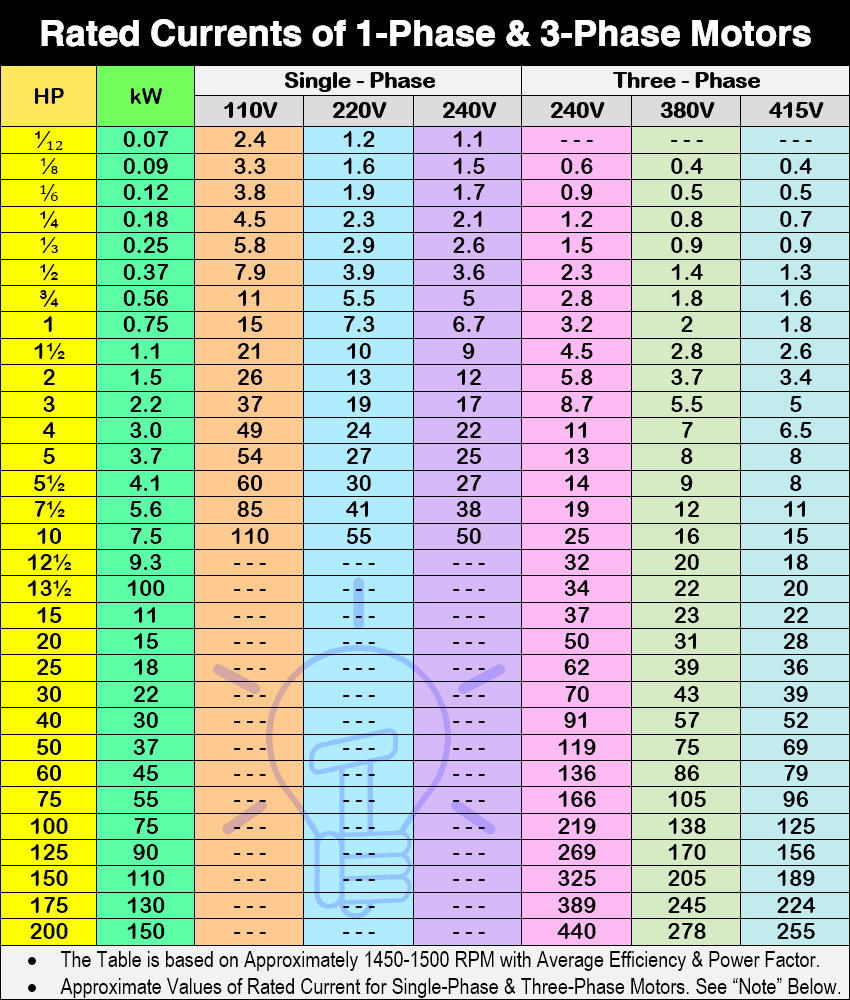
The following table shows the approximate rated current of single-phase and three-phase induction motors.
| Rated Currents of 1-Phase & 3-Phase Motors | |||||||
| HP | kW | Single – Phase | Three – Phase | ||||
| 110V | 220V | 240V | 240V | 380V | 415V | ||
| ¹⁄₁₂ | 0.07 | 2.4 | 1.2 | 1.1 | – – – | – – – | – – – |
| ⅛ | 0.09 | 3.3 | 1.6 | 1.5 | 0.6 | 0.4 | 0.4 |
| ⅙ | 0.12 | 3.8 | 1.9 | 1.7 | 0.9 | 0.5 | 0.5 |
| ¼ | 0.18 | 4.5 | 2.3 | 2.1 | 1.2 | 0.8 | 0.7 |
| ⅓ | 0.25 | 5.8 | 2.9 | 2.6 | 1.5 | 0.9 | 0.9 |
| ½ | 0.37 | 7.9 | 3.9 | 3.6 | 2.3 | 1.4 | 1.3 |
| ¾ | 0.56 | 11 | 5.5 | 5 | 2.8 | 1.8 | 1.6 |
| 1 | 0.75 | 15 | 7.3 | 6.7 | 3.2 | 2 | 1.8 |
| 1½ | 1.1 | 21 | 10 | 9 | 4.5 | 2.8 | 2.6 |
| 2 | 1.5 | 26 | 13 | 12 | 5.8 | 3.7 | 3.4 |
| 3 | 2.2 | 37 | 19 | 17 | 8.7 | 5.5 | 5 |
| 4 | 3.0 | 49 | 24 | 22 | 11 | 7 | 6.5 |
| 5 | 3.7 | 54 | 27 | 25 | 13 | 8 | 8 |
| 5½ | 4.1 | 60 | 30 | 27 | 14 | 9 | 8 |
| 7½ | 5.6 | 85 | 41 | 38 | 19 | 12 | 11 |
| 10 | 7.5 | 110 | 55 | 50 | 25 | 16 | 15 |
| 12½ | 9.3 | – – – | – – – | – – – | 32 | 20 | 18 |
| 13½ | 100 | – – – | – – – | – – – | 34 | 22 | 20 |
| 15 | 11 | – – – | – – – | – – – | 37 | 23 | 22 |
| 20 | 15 | – – – | – – – | – – – | 50 | 31 | 28 |
| 25 | 18 | – – – | – – – | – – – | 62 | 39 | 36 |
| 30 | 22 | – – – | – – – | – – – | 70 | 43 | 39 |
| 40 | 30 | – – – | – – – | – – – | 91 | 57 | 52 |
| 50 | 37 | – – – | – – – | – – – | 119 | 75 | 69 |
| 60 | 45 | – – – | – – – | – – – | 136 | 86 | 79 |
| 75 | 55 | – – – | – – – | – – – | 166 | 105 | 96 |
| 100 | 75 | – – – | – – – | – – – | 219 | 138 | 125 |
| 125 | 90 | – – – | – – – | – – – | 269 | 170 | 156 |
| 150 | 110 | – – – | – – – | – – – | 325 | 205 | 189 |
| 175 | 130 | – – – | – – – | – – – | 389 | 245 | 224 |
| 200 | 150 | – – – | – – – | – – – | 440 | 278 | 255 |
|
|||||||
Table in Image Format – Click or open in a new tab to enlarge
- Related Post: Difference between AC and DC (Current and Voltage)
Comparison Between Nominal and Rated Current
| Aspect | Rated Current | Nominal Current |
| Definition | The maximum continuous current a device can safely carry under normal conditions. | The expected operating current under nominal voltage, power, and load conditions. |
| Given By | Manufacturer on the device nameplate (based on design limits, insulation, standards). | Calculated from nominal voltage, power, and power factor (or sometimes stated on nameplate). |
| Purpose | Safety/design limit → tells how much current it can withstand safely. | Normal working condition → tells how much current it will actually draw. |
| Nature | A limit value (not to be exceeded in continuous use). | A working value (usually below rated current). |
| Depends On | Temperature rise, insulation, material, ambient conditions. | Rated power, supply voltage, power factor, efficiency. |
| Examples: | Motor Rated current = 15 A (manufacturer’s safe continuous current). | Motor Nominal current = 13 A (actual current at rated load & voltage). |
| Circuit Breaker Rated current = 20 A (safe continuous capacity). | Circuit Breaker Nominal current = load current (e.g., 16 A lighting circuit). | |
| Transformer Rated current = 100 A (safe continuous current at rated kVA). | Transformer Nominal current = ~95 A (actual load current at typical power factor). | |
| Lamp Rated current = 0.5 A (max safe at rated voltage). | Lamp Nominal current = 0.43 A (calculated from P = VI). |
Related Posts about Motor Circuits:
- Part 1 – Motor Load Circuits: NEC Terms and Basic Terminologies
- Part 2 – NEC Requirements for Motor Circuits
- Part 3 – Understanding NEMA Motor Nameplate Data
- Part 4 – Calculating Locked Rotor Current (LRC) for Motors
- Part 5 – Sizing Motor Branch Circuit Conductors
- Part 6 – Sizing Motor Feeder Conductors
- Part 7 – Sizing Motor Overcurrent Protection and OCPD’s Devices
- Part 8 – Sizing Motor Feeder Protection
- Part 9 – Sizing Motor Overload Protection
- Part 10 – Overcurrent Protection for Motor Control Circuits
- Part 11 – Sizing Disconnecting Means for Motor & Controller
- Part 12 – Sizing Motor Starter & Contactor – NEMA – NEC
- Part 13 – Sizing Direct Online (DOL) Starters/Contactors for Motors (*Bonus)
- Part 14 – Sizing Star-Delta Motor Starters/Contactors for Motors (*Bonus)
- Sizing Motors FLC, HP, Voltage, Breaker Size and Wire Size