Why is a Motor Rated in kW instead of kVA?
Why are Electric Motors Rated in kW or Horsepower (hp) and Not in kVA?
We already know that transformer ratings may be expressed in kVA instead of kW. The same applies to generators and alternators, which are also rated in kVA while motors are rated in kW or hp (horsepower). This is because the manufacturer and designer don’t know the actual consumer power factor (P.F) while manufacturing transformers and generators.
The power factor (PF) of transformers and generators/ alternators depends on the nature of the connected load, such as resistive, capacitive, and inductive loads. These factors affect the overall power factor of transformer and generator, as they consume reactive power according to the load. The scenario is different in the case of the rating of electric motors.
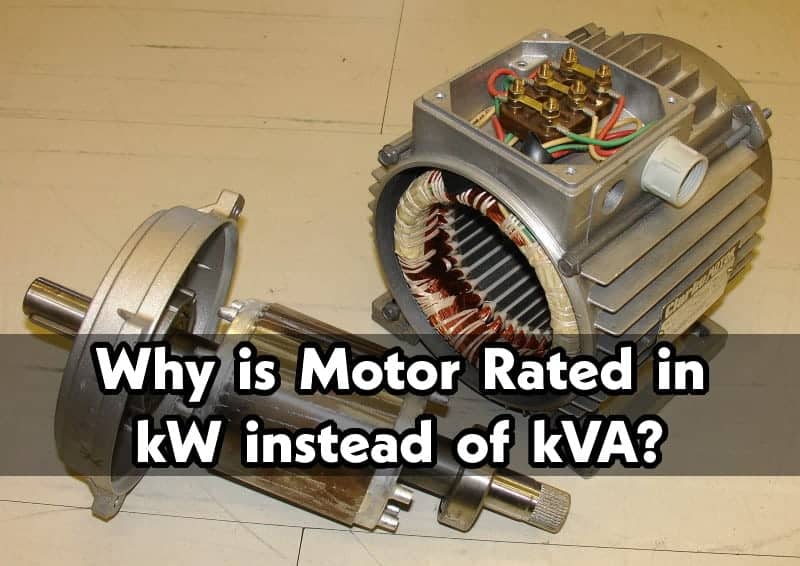
On the other hand, an electric motor has a fixed power factor, i.e., the motor has a defined power factor (P.F), and the rating is mentioned in kW on the motor nameplate data table. That’s why we rate the motor in kW or HP (kilowatts/horsepower) instead of kVA. In clearer terms, the motor only consumes active power in watts as input and provides mechanical power in hp (horse power) or kW at the motor shaft as output.
In addition, an electric motor is a machine that converts electrical power into mechanical power. In this case, the load is not electrical but mechanical (motor’s output), and we take into account only active power, which has to be converted into mechanical load. Moreover, the motor power factor does not depend on the load, and it works with any power factor due to its design. These are the simple reasons why a motor is rated in horsepower (hp) or watts (W) instead of volt-amperes (VA).
Related Posts:
- Why is a Transformer rated in kVA, not in kW?
- Why is an Alternator and Generator rated in kVA, not in kW?
- Why is an Air-condition (AC) Rated in Ton, not kW or kVA?
- Why is a Battery rated in Ah (Ampere hour) and not in VA?
- Why is a Power Plant Capacity Rated in MW and not in MVA?
- Why was a Circuit Breaker Capacity Rated in MVA and Now in kA and kV?




Glad to have found your site. Keep up the good work!
There is a AC synchronous generator with cosθ = 0.85 supply for a AC asynchronous motor with cosθ = 0.92
Could you explain for me the different between two power factors.
Thanks so much !
Thanks for such an informative post. The difference between kW and kVA is not known to most of the people.
How do you calculate the size compasitor needed on any motor
It was great thank you very much
There is a AC synchronous generator with cosθ = 0.85 supply for a AC asynchronous motor with cosθ = 0.92
Could you explain for me the different between two power factors.
Thanks so much !
No . Motor power factor depends upon the load. Increasing the load increasing the power factor. So a induction motor should always be pit on maximum load. If we have only induction motor loads in a factory then we we use capacitor bank
if exitation are falling how to make new it
it is very good said for all eng student
Its interesting while reading the informations. but answers are not clear in many topics. many of the answers are specified with some reasons. There wont be any explanation for those reasons. At the time, we get struck to believe the answers which are specified is really a correct. so please explain the reason along with the answer. then only the reader get to understand it clearly. just i expressed my suggestion. :-)
Kw
KV a
Kvar
Kwh
Is there really 1 ton ac consume 3.516 kw power ?
If we have three phase and neutral supply and we get deferent voltage between each phase and neutral. I want to know that how can we get equal voltage in between each phase and neutral.
equalize the phase angle between each phase i.e 120.
The in formation provided clears the doubts and makes the concept very clear of an interested reader.
Its really good and had gain knowlage from it
thank a lot
it is really interview based questtion
excellent answer..im rly satisfied
it is very good site for all engineering student
Cos 0.85 will not affect the motor which has a pf of 0.92
The kW and kVA problem is much simpler to solve! The specified power of the motors means the shaft power (this is mechanical power), which does not depend on either the voltage (V) or the current (A) and of course does not depend on the phase factor (“cosine-phi”) either! The motor must be able to deliver this power, provided that the input parameters are appropriate. The misinterpretation is caused by the fact that most people can interpret kW exclusively as electrical power. This misconception is also reinforced by HP, which is mainly interpreted as mechanical power, although 1 kW = 1.36 HP, i.e. they are “compatible” with each other. I note that a healthy Muraköz horse is capable of developing 15 – 20 HP (12.9 – 17.2 kW) of power for a short time