Which Bulb Glows Brighter When Connected in Series and Parallel & Why?
Two Bulbs of 80w and 100w are Connected in Series and Parallel. Which One Will Glow Brighter and Why?
The most frequently asked and confusing question we receive is: If two bulbs are connected, first in series and then in parallel, which one will glow brighter, and what are the exact reasons? While there’s a lot of information available online, we aim to provide a clear, step-by-step explanation to calculate the exact values and eliminate any confusion.
Firstly, it’s essential to understand that the bulb with higher power dissipation, regardless of whether it’s connected in series or parallel, will glow brighter. In other words, the brightness of a bulb depends on the power it consumes, which is determined by the applied voltage, the current flowing through it, and its resistance.
(P = V × I or P = I2 × R or P = V2 / R)
Also, it’s important to note that wattage (power) is not the direct unit of brightness. Brightness is technically measured in lumens (lm), the SI unit of luminous flux, or candela (cd), the SI unit of luminous intensity. However, in most practical lighting scenarios, the brightness is directly proportional to the power rating of the bulb, which means a bulb that consumes more wattage generally emits more light and appears brighter.
Related Posts:
- Why Does the High-Wattage Bulb Glow Dimmer in a Series Circuit?
- Why Does the High-Wattage Bulb Glow Brighter in a Parallel Circuit?
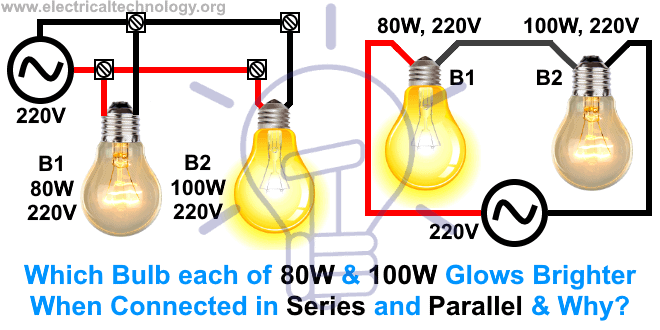
When Bulbs are Connected in Series
Bulbs with Different Wattage Ratings Connected in a Series Circuit:
Suppose we have two bulbs: one rated at 80W (Bulb 1) and the other at 100W (Bulb 2). Both are rated for 220V, and they are connected in series to a 220V AC supply.
In this case, the bulb with the higher resistance and greater power dissipation will glow brighter. Surprisingly, that will be the 80W bulb (Bulb 1), while the 100W bulb (Bulb 2) will appear dimmer.
Why is that?
In a series connection, the same current flows through both bulbs. However, the voltage drop across each bulb depends on its resistance. The bulb with higher resistance will have a greater voltage drop, leading to higher power dissipation and hence greater brightness.
Let’s understand this clearly with calculations and examples below.
- Related Post: Why is Earth Pin Thicker and Longer in a 3-Pin Plug?
Power in an electric circuit:
P = V × I or P = I2 R or P = V2 / R
Now, the resistance of Bulb 1 (80W);
We know that current is same and voltage are additive in a series circuit but the rated voltage of bulbs are 220V. i.e.
Voltage in series circuit: VT = V1 + V2 + V3 …+ Vn
Current in series circuit: IT = I1 = I2 = I3 …In
Therefore,
R = V2 / P80
R80W = 220V2 / 80W
R80W = 605Ω
And, the resistance of Bulb 2 (100W);
R = V2 / P100
R100W = 220V2 / 100W
R100W = 484Ω
Now, Current;
I = V/R
= V / (R80W + R100W)
= 220V / (605Ω + 484Ω)
I = 0.202A
Now,
Power dissipated by Bulb 1 (80W)
P = I2R
P80W = (0.202A)2 × 605Ω
P80W = 24.68 W
Power dissipated by Bulb 2 (100W)
P = I2R100
P100W = (0.202A)2 × 484Ω
P100W = 19.74 W
Hence, proved power dissipated P80W > P100W i.e. Bulb 1 (80W) is greater in power dissipation than bulb 2 (100W). Therefore, the 80W bulb is brighter than 100W bulb when connected in series.
You may also find the voltage drop across each bulb and then find the power dissipation by P = V × I as follows to verify the case.
V = I × R or I = V/R or R = V / I … (Basic Ohm’s Law)
For Bulb 1 (80W)
V80 = I × R80 = 0.202A × 605Ω = 122.3V
V80 = 122.3V
For Bulb 2 (100W)
V100 = I × R100 = 0.202A × 484Ω = 97.7V
V100 = 97.7V
Now,
Power dissipated by Bulb 1 (80W)
P = V280/R80
P80W = 122.32V / 605Ω
P80W = 24.7 W
Power dissipated by Bulb 2 (100W)
P = V2100/R100
P100W = 97.722V / 484Ω
P100W = 19.74 W
Total Voltage in the series circuit
VT = V80 + V100 = 122.3 + 97.7 = 220V
Again proved that 80W bulb is greater in power dissipation than the 100W bulb when connected in series. Hence, 80W bulb will glow brighter than the 100W bulb when connected in series.
- Related Post: Why is the Grounding Wire Bare and Not Insulated?

When Bulbs are Connected in Parallel
Bulbs with Different Wattage Ratings Connected in a Parallel Circuit:
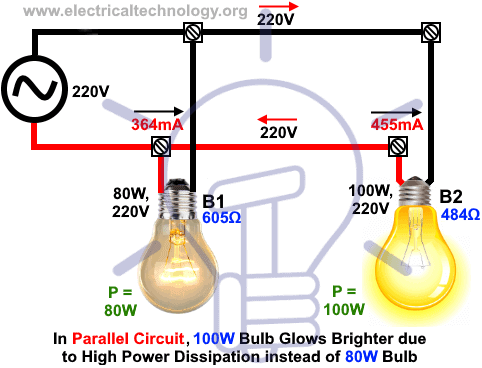
Now, consider the same two bulbs i.e. 80W (Bulb 1) and 100W (Bulb 2), connected in parallel across a 220V AC supply.
In this case, the situation is reversed: the bulb with higher current draw and greater power dissipation will glow brighter. That is, the 100W bulb (Bulb 2) will glow brighter, while the 80W bulb (Bulb 1) will appear dimmer.
Why?
In a parallel connection, both bulbs receive the same voltage (220V). The bulb with lower resistance will allow more current to flow through it, resulting in higher power dissipation and hence greater brightness.
Feeling confused by the change compared to the series case? Don’t worry, we’ll walk through detailed calculations and examples below to clear it all up.
Power Formulas
P = V × I or P = I2 R or P = V2/R
Now, the resistance of Bulb 1 (80W);
- Related Post: What are the Tiny Cylinders in Power Cords and Cables?
We know that voltages are the same in the parallel circuit and the rated voltage of bulbs are 220V. i.e.
Voltage in Parallel Circuit: VT = V1 = V2 = V3 …Vn
Current in parallel circuit: IT = I1 + I2 + I3 …In
Therefore,
R = V2 / P
R80W = 220V2 / 80W
R80W = 605Ω
And, the resistance of Bulb 2 (100W);
R = V2 / P
R100W = 220V2 / 100W
R100W = 484Ω
Now,
Power dissipated by Bulb 1 (80W) as voltages are same in a parallel circuit.
P = V2/R1
P80W = (220V)2 / 605Ω
P80W = 80 W
Power dissipated by Bulb 2 (100W)
P = V2/R2
P100W = (220V)2 / 484Ω
P100W = 100 W
Hence, proved P100W > P80W i.e. Bulb 2 (100W) is greater in power dissipation than bulb 1 (80W). Therefore, the 100W bulb is brighter than 80W bulb when connected in parallel.
To verify the above case, you may also find the current for each bulb and then find the power dissipation by P = V × I as follows. We used the rated voltage of the bulb which is 220V.
I = P / V
For Bulb 1 (80W)
I80 = P80 / 220V = 80W / 220V = 0.364A
I80 = 0.364A
For Bulb 2 (100W)
I100 = P100 / 220V = 100W / 220V = 0.455A
I100 = 0.455A
Now,
Power dissipated by Bulb 1 (80W) as voltages are same in the parallel circuit.
P = I2R1
P80W = 0.3642A × 605Ω
P80W = 80 W
Power dissipated by Bulb 2 (100W)
P = I2R2
P100W = 0.4552A × 484Ω
P100W = 100 W
Total Current in the parallel circuit
IT = I1 + I2 = 0.364A + 0.455A = 0.818A
Again proved that 100W bulb is greater in power dissipation than the 80W bulb when connected in parallel. Hence, 100W bulb will glow brighter than 80W bulb when connected in parallel.
Without Calculations & Examples
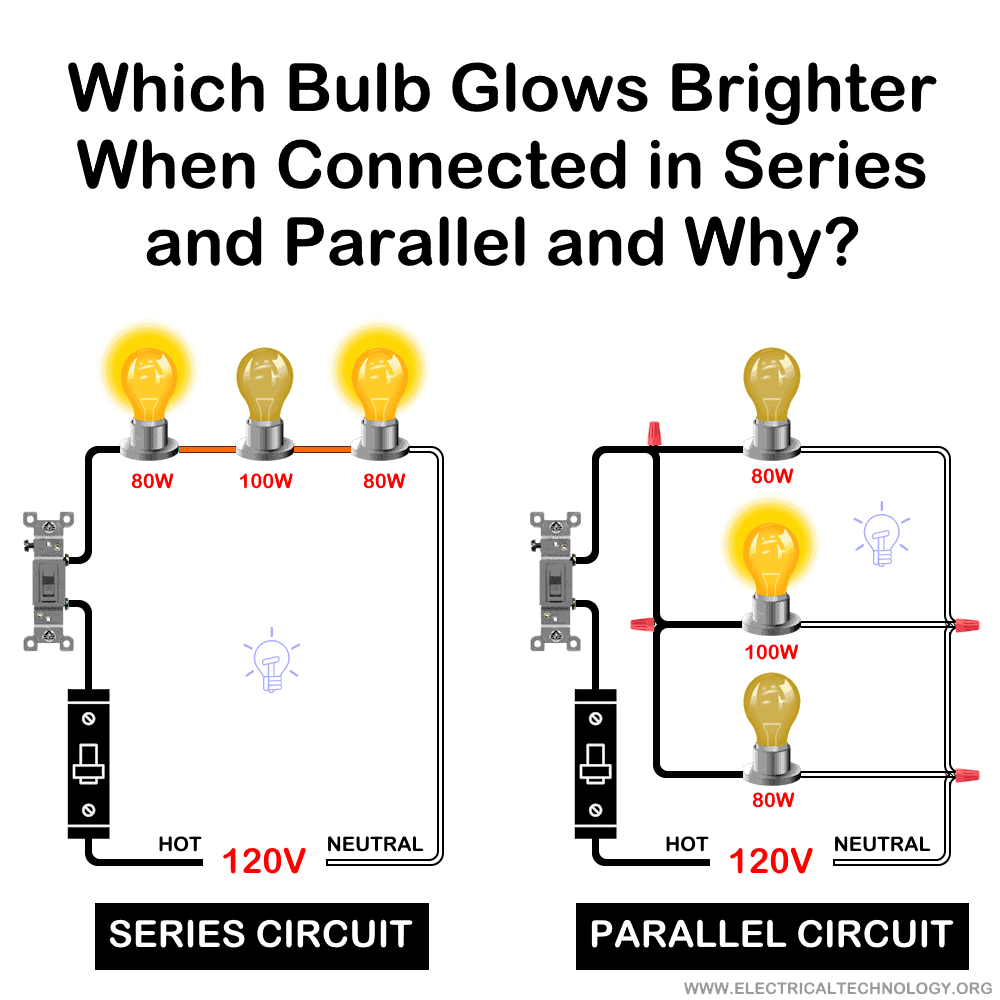
To make things easier for beginners, just keep this key fact in mind:
This is because its filament is thicker, allowing more current to pass through. In our case, the 100W bulb has lower resistance and a thicker filament, while the 80W bulb has higher resistance and a thinner filament.
Bulbs in Series:
In a series circuit, the same current flows through both bulbs, but the voltage divides between them.
Now, since the 80W bulb has higher resistance, it will have a larger voltage drop across it. As a result, it will dissipate more power (using the formula P = V2/R) making it glow brighter than the 100W bulb. Why? Because although the current is the same for both, the 80W bulb’s higher resistance causes more power to be converted into heat and light.
Bulbs in Parallel:
In a parallel circuit, the voltage across each bulb is the same, but the current differs based on each bulb’s resistance.
Now, the 100W bulb has lower resistance, so more current flows through it. This means it will dissipate more power (using the formula P = I2 R), and therefore, glow brighter than the 80W bulb.
Calculations and examples are for newbies. To make it simple, keep the fact in mind that always, The bulb with a “high power” will have “less resistance”. The filament of the bulb with a high rating is thicker than the lower wattage. In our case, the filament of the 80W bulb is thinner than the 100W bulb.
Related Posts:
- Introduction to Series, Parallel and Series-Parallel Connections
- Series, Parallel and Series-Parallel Connection of Batteries
- Difference Between Series and Parallel Circuit – Comparison
How to know if Bulbs are Connected in series or Parallel?
Most of the household electrical wiring & installation are wired in parallel or series-parallel instead of series as parallel wiring has some advantages over a series wiring. So we may notice that higher rated bulb glows more brightly as compared to lower wattage rated bulbs. In that case, 100W bulb glows more brightly than 60W or 80W bulb.
Now, You should know that the light bulb with higher power rating will glow brighter when connected in parallel and the light bulb with less power rating will glow brighter in case of series wiring and Vice versa.
Related Posts:
- Why Do Prongs in Electrical Plugs Have Holes in Them?
- Why are US Homes Wired Using Solid Wire rather than Stranded Wire?
- Why 3-Phase Power? Why Not 6, 12 or More for Power Transmission?
- What are the Different Colors Electrical Outlets Used for?
- Why are Outlets and Receptacles in Hospitals Upside Down?
- How to Find the Number of Lights on a Single Circuit Breaker?
- How to Find the Number of Outlets on a Single Circuit Breaker?
- Will I Get an Electric Shock If I Touch the Ground Wire?
- Can the Neutral Wire Cause Electric Shock? Different Cases
- Will a Man Get an Electric Shock If He Hangs on a Live Wire?
- How To Wire Switches In Series?
- How To Wire Switches in Parallel?
- How To wire Lamps in Series?
- How To Wire Lamps in Parallel?





But what’s about leds. Is this eqally applicable for leds ?
Pls tell me.
LEDs are current-operated devices (diodes) and as such only drop a certain voltage across them (.7 – 1 volt typically for small diodes.) They need an external current-limiting device such as a resistor or they will immediately go into thermal runaway and burn out.
thanks alot for your support
REALLY helped. Great job!!
Voltage in series circuit: VT = V1 = V2 = V3 …Vn
* Voltage in series circuit: VT = V1 +V2 +V3 +…Vn
just correct this error in typing in above article
We know that current is same and voltage are additive in a series circuit but the rated voltage of bulbs are 220V. i.e.
Voltage in series circuit: VT = V1 = V2 = V3 …Vn
The above expression is wrong
is should be : VT = V1+ V2 + V3 …Vn
As mentioned, Voltage are additive in series circuit, so it is a typo which is corrected now. Any way, Thanks for the attention.
please reply
why are both 80w and 100w bubs in series connection having voltage of 220
arent devices connected in series required to split the total voltage , then how can it be said that both bulbs have 220V
thanks a lot. it was really helpful
This is not a base-level question, so think beyond the explanation above. And by the way I don’t have a good answer.
re: lightbulbs in series. A bulb’s resistance increases proportional to temperature, so as a bulb heats up, its increasing resistance acts as an automatic current limiter. With multiple bulbs in series, why does not the highest-resistance bulb not get hotter and hotter until it fails, with the other bulbs getting colder and colder as the first bulb’s resistance keeps going up and reducing current to them?
I am thinking that as the filament gets hotter, it radiates more heat, limiting its temperature to an equilibrium point. Ditto for the lower-resistance bulbs, whose equilibrium point is at a lower temperature. Thoughts?
I have a question . My house has parallel connection but still all the bulbs glow at their full brightness even though they are different watt and ratings?? Why is that ? Thanks plz answer.
Thank you so much for this detailed answer. It made my all confusions clear.