120V / 230V AC Mains Operated LED Night Lamp Circuit
Transformerless 230V/120V AC Operated LED Light Circuit Diagrams
In this article, we will create various powerful and extra-bright LED light bulb and night lamp circuits that can operate directly from a 120V or 230V AC mains supply. All the circuits are transformerless, hence it makes them easy to assemble on a simple breadboard for DIY experimentation or on a PCB for practical lighting applications.
Circuit 1: 230V / 120V Mains Operated LED Night Lamp
Components
- Input = 230V – 50HZ AC Supply
- C1 = 0.22µF /1000V (Polyester Capacitor)
- R1 = 1k Ω – 3 Watt Resistor
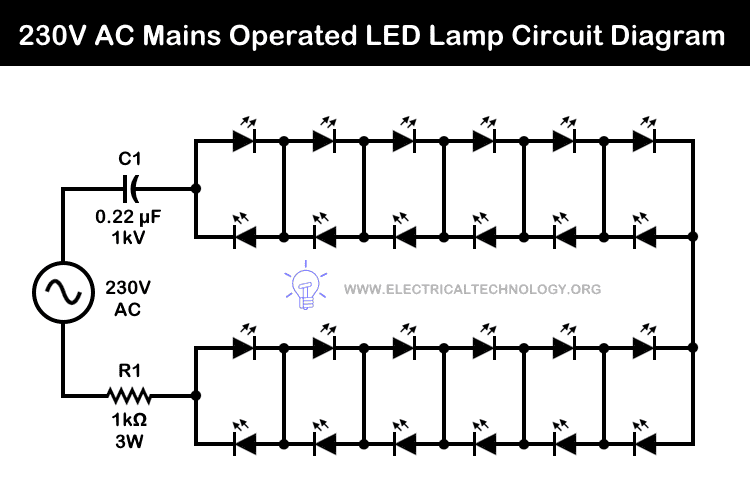
- LED = 24 White Color LEDs (3.2V – 25mA)
- Output = 15 Watts
Circuit Diagram
Working on 230V:
The C1 capacitor reduces the voltage to a safe operating level for the LEDs. The R1 resistor, connected in parallel with C1, acts as a protective component, and discharge stored energy and limit the excessive current. The circuit is capable of handling voltage spikes and surges. The 24 LEDs in this design consume approximately 15W, which is capable to provide sufficient illumination and makes it an ideal, powerful LED-based night lamp.
Operating on 120V
If you plan to operate this circuit on a 120V, 60Hz AC mains supply, replace C1 with a 0.68 µF (250V) polyester capacitor. Similarly, reduce R1 to 220 Ω, ½ W. Ensure the use of 3.2V, 25 mA bright LEDs.
Modifications to the Circuit:
- For 100 LEDs (connected back-to-back as shown above): Reduce R1 to 220 Ω, 1W and C1 to 0.47 µF / 400V.
- For 50 LEDs (connected back-to-back as shown above), lover the value of R1 to 220 Ω, ¼W or ½W and C1 to 0.47 µF / 400V.
- With 0.1 µF, you can connect one pair of LEDs (back-to-back).
- By reducing R1 to 220 Ω, ¼ W, the power consumption can be further lowered, which is ideal for night lamp applications.
- Stay safe: Please be careful while working on live circuits. The author will not be liable for any damage or loss(es) while practicing these circuits.
Circuit 2: Automatic 120V Super Bright LED Night Light
Components
- Input = 120V – 60HZ AC Supply
- R1 = 1 Mega Ω Resistor
- R2 = 5.6Ω – 1 Watt
- R3 = 820kΩ
- R4 = 100kΩ – Photocell
- C1 = 0.68µF /400V (Polyester Capacitor)
- C2 = 4.7µF or 10V µF (Polyester)
- D1 = 1A, 400V – 4 No’s of 1N4007 Diodes (Full Wave Bridge Rectifier)
- D2 = Zener Diode – 4754
- D3 = Zener Diode – IN4744
- Q1 = Transistor – ZVN 2106 (N-channel FET)
- LED = 10 LEDs
Circuit Diagram
Operation of the Circuit
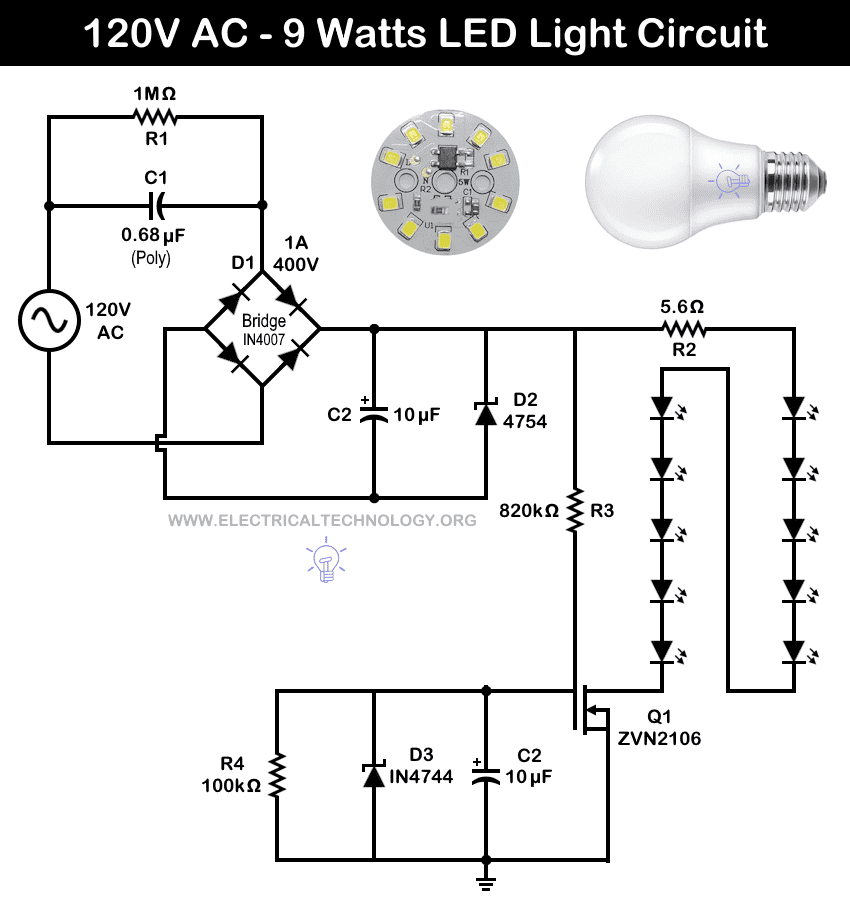
This super-bright LED night lamp is designed to operate directly from a 120V AC mains supply. In this circuit, the capacitor C1 and resistor R1, connected in parallel, form a voltage and current-limiting network for protection.
The full-wave bridge rectifier (D1) converts the AC supply into DC. Capacitor C2 filters the pulsating DC, while D2 limits the peak voltage across C1 during LED switching and helps regulate the DC voltage.
An additional feature of this circuit is the N-channel FET (Q1), which automatically switches OFF the lamp when sufficient ambient light is detected. The photocell is set to a value of 100 kΩ for full brightness. When the photocell resistance drops below 100 kΩ (due to increased light), the circuit switches off the LEDs.
In operation, ten white LEDs connected in series produce high brightness when powered from the 120V AC supply.
Circuit 3: 230V Ultra Bright LED Night Light
This is the same but modified version of the circuit to operate on 230V AC supply shown above in circuit 2 for 120V.
Components
- Input = 230V – 50HZ AC Supply
- R1 = 470k Ω – 0.25 Watt Resistor
- R2 & R3 = 100 Ω – 0.5 Watt Resistor
- C1 = 1µF /400V (Polyester Capacitor)
- C2 = 10µF /160V (Polyester Capacitor)
- D1 = 1A – 400V Full Wave Bridge Rectifier – 4 No’s of 1N4007 Diodes
- LED = 24 White Color LEDs (50mA)
- Output = 15 Watts
Circuit Diagram:
Working of the Circuit
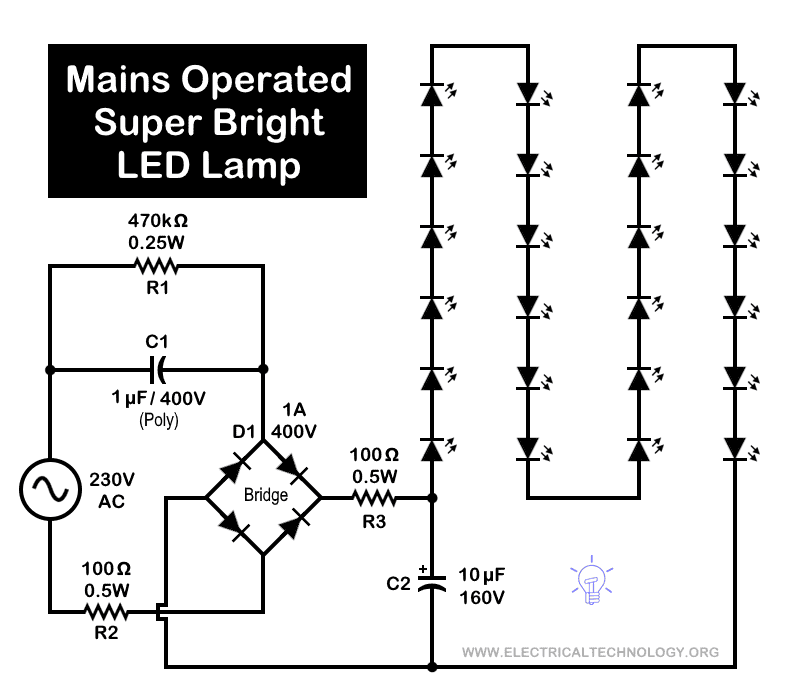
During this modification, the automatic ON/OFF section of the circuit has been removed. It means, the lamp will now be operated manually on a 230V AC supply.
The operation is the same as described earlier for Circuit 2, except for a few component changes listed in the components required section. In this version, 24 super-bright 50 mA LEDs are used instead of the previous 10 LEDs.
The circuit has been tested and provides illumination that is well above the level of a typical 15W tube light or CFL bulb. Therefore, this uniformly illuminated night lamp, based on a simple circuit design, serves as an excellent alternative to more complex circuits.
Circuit 4: 230V AC LED Night Bulb
Internal Components
- R1 = 1 Mega Ω Resistor
- R2 = 560Ω – 1 Watt Resistor
- C1 = 0.22µF /400V (Polyester Capacitor)
- C2 = 35V DC Capacitor
- D1 = 4 No’s of 1N4007 Diodes (Full Wave Bridge Rectifier)
- LED = 16 LEDs, Each Rated at 3V DC
Circuit Diagram:
Operation:
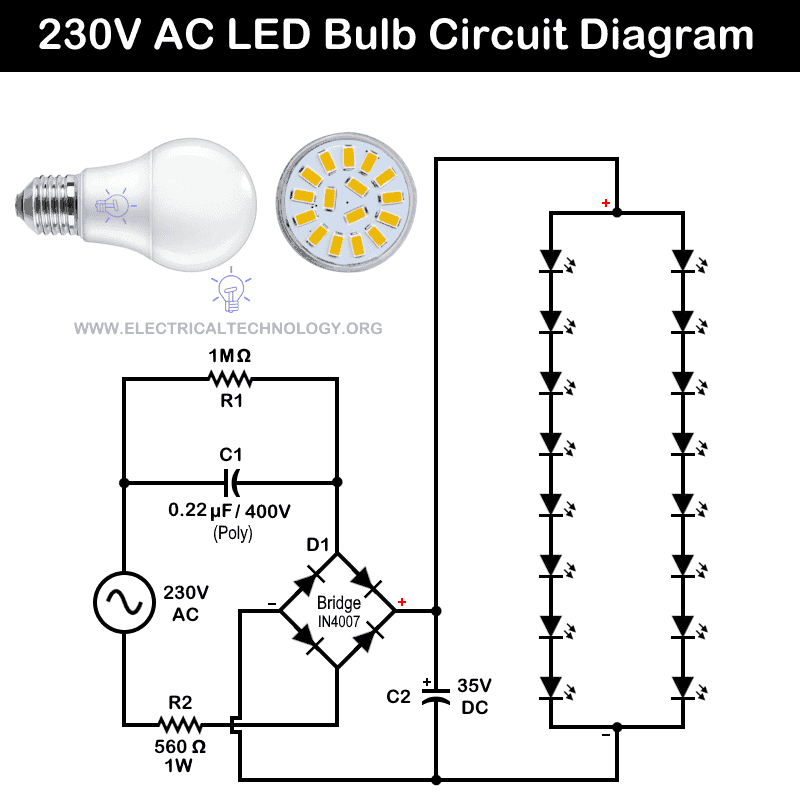
This circuit operates by dropping the 230V AC mains voltage to 24V AC. The 0.22µF series polyester capacitor acts as a reactive impedance that limits the current. This limited current then powers the LED string, which naturally stabilizes around 24V DC according to the LED’s forward voltage. The 1 MΩ resistor in parallel with capacitor is used to safely discharge the stored energy when the circuit is switched off. In addition, the 560 Ω resistor is used for short-circuit protection.
The reduced AC voltage is converted to DC through a full-wave bridge rectifier and filtered by an electrolytic capacitor. This way, it provides a stable 24V DC supply for the LED array. Two parallel strings of eight 3V LEDs each are powered, matching the total forward voltage to the supply while sharing current. As a result, we have efficient and bright illumination.
These kind of circuits are mostly used in commercial LED light lamps used in household applications.
Circuit 5: 230V Brighter LED Light
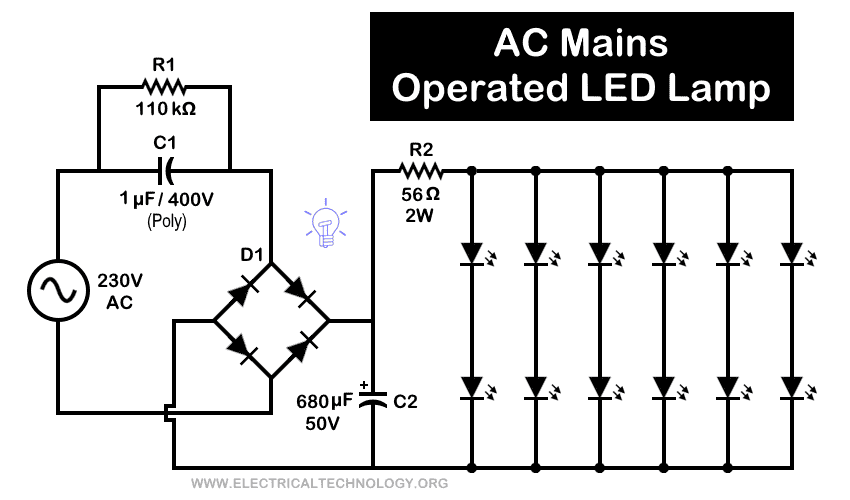
Components:
- Input: 230V AC
- R1 = 110k Ω Resistor
- R2 = 56Ω – 1 Watt Resistor
- C1 = 1µF /400V (Polyester Capacitor)
- C2 = 680µF – 50V
- D1 = 4 No’s of 1N4007 Diodes (Full Wave Bridge Rectifier)
- LED = 12 White LEDs
Circuit Diagram:
Operation:
This is another basic, cost-effective, yet bright LED circuit based on a transformerless AC mains power supply. When the mains supply is connected, capacitor C1 and resistor R1, connected in parallel, reduce the voltage to a safe level.
The bridge rectifier then converts the reduced AC voltage into DC, while capacitor C2 filters the pulsating DC into a stable DC output. Resistor R2 limits the current to match the LEDs’ current rating.
In this compact, lightweight, and efficient circuit, 12 bright white LEDs connected in series strings produce bright illumination when powered from a 230V AC supply.
Bonus Circuit 6: 230V Mains Operated Blinking LED Circuit
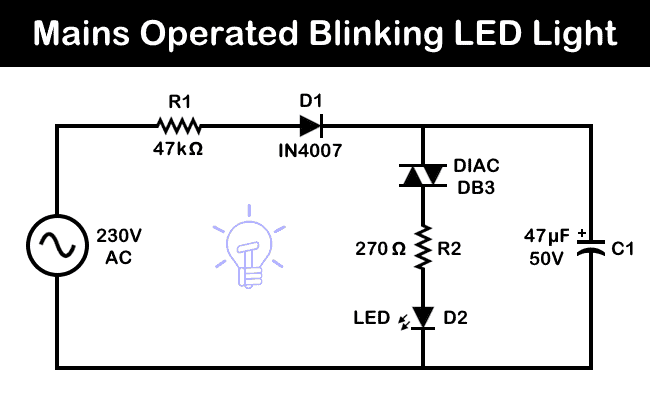
Components
- Input = 230V – 50HZ AC Supply
- R1 = 47k Ω – 3 Watt Resistor
- R2 = 270 Ω
- D1 = Diode – IN4007
- D2 = LED
- C1 = 47µF /50V (Polyester Capacitor)
- DIAC = DB3
Circuit Diagram:
Working of the Circuit
This is a very basic blinking LED circuit designed to operate on a 230V AC mains supply. When the mains power is switched ON, capacitor C1 begins charging through resistor R1 and diode D1. Once the voltage across C1 exceeds 32V (the breakover voltage of the DIAC DB3) the DIAC conducts, causing the LED to flash.
At the same time, C1 discharges through the LED, completing the flash cycle. This process repeats continuously, producing a blinking effect. The blinking rate of the LED depends on the values of R1 and C1.
Related LED’s Circuits and Projects:
- LED Light Bulb Circuit – 230V / 120V Mains Operated LEDs
- Emergency LED Light Circuit – DP-716 Rechargeable 30 LED’s Lights Schematic
- How to Make a Simple LED Flashing Circuit using 555 Timer IC
- 1 Minute, 5 Minute, 10 Minute and 15 Minute Timer Circuit Diagram
- Automatic Night Lamp Using Arduino
- LED Roulette Circuit Diagram using 555 Timer & 4017 Counter
- USB Propeller LED Fan Clock – Circuit Diagram & Project Code
- How to Calculate the Value of Resistor for LED’s & Different Types of LED Circuits
- LED Resistor Calculator – Required Value of Resistor for LED’s Circuit
- How to Make Christmas LED & Bulb Blinking Light String Circuit at Home
- Automatic Street Light Control Circuit using LDR & Transistor BC 547
- PCB Design of LED Flasher Circuit. Step by Step






Can you please tell me what is the purpose of connecting wire between two LED lines after each LED. And what is benefit of making two groups of LEDs?
In this configuration, two LEDs are placed in parallel, and the pattern continues. At first glance, it may appear that there are two separate strings or groups of LEDs. However, when you design this circuit on a general-purpose PCB or in a simulation program, you will find that it is actually a single string or group of LEDs. This design approach is preferred when constructing the circuit on PCB boards.
I got the 2nd point
1) Why to make LEDs parallel? No current flows through these wires at any time. What if these wires are not inserted?
Can we increase more LEDs in the circuit?
Yes – You Can!.
Read the “Modifications to the Circuit” for the 1st circuit for 50 or 100 no’s of LEDs.
Awesome circuit. Pretty simple. I set up this way. however the resistor in the circuit is burning out in less than a minute. I’m waiting eagerly for a solution. I connected 24 LEDs with one resistor and one capacitor in series. 1kohm/3W and 0.22uF/1200W.
Hey, I am for the first time here. I came across this board for basic led circuits based on diy stuff. Anyway, thanks for the circuits
sir how can i construct a more bright light led circuit operated on 220v ac
Good afternoon friends.
My name is john, my passion to design an LED star lighting system is very intense but i don’t have the complete knowledge yet, that is why i decided to access the internet to acquire more knowledge, in search i found your blog, with what i saw i was amazed and as well happy because i know i can get some aid from you.
My question is if my main is 220V, will i have to change the values of some components?
Here is a detailed guide for different types of LED’s circuits.
How to Calculate the Value of Resistor for LED’s & Different Types of LED Circuits
What is purpose of inserting the capacitor in series with circuit ……
what is the benefit of this grouping of led’s and what is the advantage of this type circuit over a circuit in which we connect all leds in series and a resistor accordingly without capacitor? Also, what is the purpose of capacitor in first diagram, doesn’t it cause over-voltage in the circuit whenever the AC cycle gets reversed ? Potentially, it is dangerous if not handled carefully.
the capacitor drops the voltage from 220v to approx. 4.5v AC and the resistor limits the current to make it suitable to run the LEDs
how to design a circuit in which which i want different LED’S to glow for different voltages like given 1V only red led should glow, for 2V only green led should glow,3V only blue led should glow
Hi. I’ll be trying this out once I have all the materials (LEDs, cap, and res). My question is what capacitor and resistor should I use if I wanted to use 36 LEDs? Can I use the ones for the 50s? I’ve checked out the how to calculate resistor value link above but it only discussed calculating for the resistor (great refresher – for DC, but we’re dealing with AC (the mains).
There !!! I have one question which is already in previous comment but there is not any ans. For this..
my que. Is that ” why we use capacitor in circuit???”
Here is the detailed explanation:
What is the Role of Capacitor in AC and DC Circuit?
Two points I want to raise
1. I agree with FURQAN463, no current flows through the wires and its only a wastage of resources
2. This circuit may flicker at 50 or 60 Hertzs/sec
Am trying to make the 1st circuit, can I use 0.1uf 400v instead of 1000v,
What is the cost of 15w circuit?
Thanks for the simple LED project.
Wohh just what I was looking for, appreciate it for putting up.
I really like your writing style, excellent information, thank you
for posting :D.