How to Read NEMA Motor Nameplates Data Printed on It for Motor Circuits?
What is NEMA?
NEMA (National Electrical Manufacturers Association) is a U.S.-based trade association that develops and publishes technical standards for electrical equipment, including motors, enclosures, wiring devices, and industrial control systems. Founded in 1926, NEMA sets guidelines to ensure safety, compatibility, and performance across various electrical products used in residential, commercial, and industrial applications.
NEMA establishes industry standards for motor design, frame sizes, efficiency ratings, and performance specifications to ensure interchangeability and reliability in accordance with National Electrical Code (NEC) and regulatory bodies like UL (Underwriters Laboratories) and ANSI (American National Standards Institute).
Common NEMA Standards for electric motors are as follow:
- NEMA MG-1 – Motor and generator standards (defines horsepower, efficiency, voltage, and frame sizes).
- NEMA 250 – Enclosure protection ratings (defines environmental protection levels for motor housings).
- NEMA Premium® Efficiency – Defines high-efficiency motor requirements to reduce energy usage.
According to NEMA, a typical electrical motor nameplate or label and marked data printed on it must show:
- Manufacturer Type
- Design Code
- Phase (Single or Multiphase)
- Rated Horsepower (HP)
- Rated Voltage and Amps
- Rated Full-load Amps for each Voltage Level
- Rated Full-load Speed
- Service Factor (S.F)
- Efficiency in %
- Power Factor (P.F)
- Time Rating
- Frame Size
- Frequency in Hz
- Locked-rotor (RLC) Code Letter
- Insulation Class
- Rated Ambient Temperature
It is important to understand the specifications, features, and characteristics of an electric motor before purchasing one for residential or commercial applications. This information is printed on the motor’s nameplate, helping to ensure the right motor is selected for a specific application.
How to Read a Typical NEMA Motor Nameplate Rating and Data?
A NEMA motor nameplate contains motor load circuit and general information that helps in selecting, installing, and maintaining an electric motor. Each parameter provides details about the motor’s electrical, mechanical, and thermal characteristics.

Below is a detailed explanation of each nameplate parameter based on the given nameplate markings for Baldor Reliance Super-E Motor (Model EM3615T).
1 – Manufacturer
The nameplate will display the manufacturer’s name and a unique model or catalog number. This helps in identifying the motor for replacements, specifications, or warranty purposes.
2 – Horsepower (HP)
This indicates the mechanical power output of the motor. One HP equals 746 watts, meaning a 5 HP motor can deliver 3,730 watts of mechanical power. It determines the motor’s power rating and capability to drive loads.
3 – Voltage (V)
The rated operating voltage of the motor, such as 115V, 208V, 230V, 460V, or dual-voltage (e.g., 230/460V). Using a voltage outside the specified range can damage the motor or reduce efficiency.
The operating voltages from the nameplate data:
VOLTS: 208-230/460 → The motor can operate at multiple voltages:
-
- 208V
- 230V
- 460V
As the motor is operable at multiple voltage levels, its wiring installation should be done according to the diagram provided on the nameplate for low-voltage and high-voltage connections.
4 – Full Load Amps (FLA)
FLA represents the current drawn when the motor is operating at full rated load and voltage under full load conditions. It is essential for sizing circuit breakers, fuses, and wiring.
The FLA values from the nameplate data:
AMPS: 13.9-13.4/6.7 → The current drawn depends on the voltage:
-
- 208V: 13.9A
- 230V: 13.4A
- 460V: 6.7A
Good to know: FLA (Full Load Amperes) and FLC (Full Load Current) are not the same. The difference lies in how they are defined and calculated, particularly in accordance with NEC standards for motor circuits.
5 – Locked Rotor Code (Code Letter)
A letter (from A through V) for LRC represents the inrush current during startup. Motors with a high inrush current require careful circuit protection. The estimated value of locked-rotor current (RLC) are determined using NEC Table 430.7(B).
For instance:
- CODE: J → Defines locked rotor kVA per HP. The value of minimum and maximum RLC is 7 – 799 kVA/HP.
6 – Frequency (Hz)
The motor’s frequency rating, typically 60 Hz in North America and 50 Hz in other regions. Running a motor on the wrong frequency can alter its speed and performance.
7 – Phase
Specifies whether the motor operates on single-phase or three-phase power. Single-phase motors are common in residential applications, while three-phase motors are used in industrial settings for better efficiency and power handling.
8 – Speed in RPM (Revolutions Per Minute)
Indicates the motor’s rotational speed per minute at full load. It depends on the number of poles and power frequency (e.g., a 2-pole motor at 60 Hz runs at ~3,600 revolutions per minute (RPM), while a 4-pole motor runs at ~1,800 RPM).
9 – NEMA Frame Size
The frame size (e.g., 56, 143T, 184T) defines the motor’s physical dimensions, shaft diameter, and mounting hole locations and requirements. Motors with the same frame size are interchangeable without major modifications.
10 – Service Factor (SF)
Service Factor S.F or SER.F) is a multiplier that indicates the motor’s ability to operate beyond its rated horsepower for short durations. For example, a 1.15 SF motor can safely handle 15% more load beyond its rated HP without overheating.
The value of service factor is considered when sizing an overload protection for the motor circuit based on the FLA mentioned on the motor’s nameplate (NEC-430.32(A)(1).
11 – Insulation Class
Defines the thermal resistance of the motor’s insulation. Common classes are:
-
- Class B (130°C max temperature)
- Class F (155°C max)
- Class H (180°C max)
Higher classes allow the motor to operate at higher temperatures without degradation.
12 – Design Letter (DES.)
The letter indicates the torque/speed characteristics of the motor.
Generally, they are not indicated for motors larger than 500 HP at 1800 RPM, variable speed applications, and motors across the line starting. Some common NEMA design marks are as follow:
- Design A: Generally have normal locked-rotor torque and higher starting currents, suitable for applications requiring high efficiency and high full-load speed.
- Design B: Normal breakdown torque, low starting current and a high locked rotor torque, best for applications with normal starting torque requirements like pumps, blowers and fans.
- Design C: Low starting current, high locked rotor torque and a normal breakdown torque. Suitable for applications where high starting torque and high inertia are needed like conveyors and positive displacement pumps.
- Design D: Very high locked rotor torque, low starting current and a high slip, ideal for high-inertia applications like hoists and cranes.
13 – NEMA NOM. – Efficiency (%) & P.F
Represents the ratio of mechanical power output to electrical power input. Higher efficiency motors consume less energy, reducing operating costs. For instance: NEMA NOM. EFF.: 89.5% → The motor operates at 89.5% efficiency.
Power Factor (PF)
Power factor (P.F) is the ratio of real power (watts) to apparent power (volt-amperes), typically between 0.7 and 0.95. A higher power factor indicates better electrical efficiency. For instance:
- P.F.: 78% → The motor has a power factor of 0.78.
14 – Temperature Rating and Duty Class
The motor’s maximum rated operating ambient temperature (usually 40°C) and altitude limit (typically 1,000 meters or 3,300 feet above sea level). Higher temperatures or altitudes require derating. The Cont. Indicates whether the motor is designed for continuous duty (CONT) (running continuously at full load) or intermittent duty, where it operates for short periods with rest intervals.
- For instance: RATING: 40C AMB-CONT → The motor is rated for continuous duty in 40°C ambient temperature.
Indicates whether the motor is designed for continuous duty (CONT) (running continuously at full load) or intermittent duty, where it operates for short periods with rest intervals.
- For instance: RATING: 40C AMB-CONT. It indicates the motor is rated for continuous duty in 40°C ambient temperature.
15 – Certified Compliant Number (CC)
This number is printed on all motors that comply with the NEMA Premium Efficiency Specification. They are helpful to select an energy efficient motor to lower the power consumption and reduced electricity bill.
16 – Bearings & Lubrication
Specifies the type of bearings (ball or sleeve bearings) and recommended lubrication frequency for maintenance. For instance:
- DE: 6206 (Drive End) → Bearing type on the drive end.
- ODE: 6205 (Opposite Drive End) → Bearing type on the opposite drive end.
17 – Enclosure Type (NEMA Code)
ENCL. defines the motor’s protection level against environmental factors:
-
- ODP (Open Drip Proof): Allows air circulation, suitable for dry locations.
- TEFC (Totally Enclosed Fan-Cooled): Sealed to prevent dust and moisture entry, with an external fan for cooling.
- TENV (Totally Enclosed Non-Ventilated): Sealed with no cooling fan, used for specific applications.
- Explosion-Proof (XP): Designed for hazardous environments where flammable gases or dust are present.
18 – Serial Number, Catalog Number and Specifications
Unique identifiers for tracking manufacturing date, warranty claims, and part replacements. For instance;
- SN: F1408201403 → Unique motor identification number.
- CAT. NO.: EM3615T → Manufacturer’s catalog/model number.
- SPEC.: 36G271S268G1 → Internal specification code.
19 – Certification Marks
- NEMA Premium Efficiency Certified.
- UL (Underwriters Laboratories) and CSA (Canadian Standards Association) approved.
- Energy Verified mark.
Additional Motor Nameplate Data (Not Shown in the Figure)

In addition to the standard specifications, some motor nameplates include additional useful information, such as:
-
- CW or CCW (Rotation & Reversibility): Indicates the default direction of rotation for CW (Clockwise) or CCW (Counterclockwise), and whether the direction can be reversed.
- Alternate Frequency Ratings: Specifies an alternative operating frequency, such as 50 Hz, if the motor is used outside the U.S.
- IP (International Protection Rating): Classifies the degree of protection against solid objects, dust, and water, as well as personnel safety.
- Hazardous Class: Identifies the motor’s suitability for hazardous locations, specifying classes and groups (A through G) where flammable, combustible, or ignitable substances may be present.
- T-Code (Temperature Code): Specifies the motor’s maximum surface temperature rating (T1 to T6) for use in hazardous environments.
- Rotor Inertia: Represents the motor’s resistance to changes in speed, typically important for variable-speed applications.
- Magnetizing Current (Mag. Cur.): Indicates the magnetizing current, relevant when the motor is used with a variable speed drive (VSD) employing vector control for auto-tuning in a stationary mode.
- INV TYPE (Inverter Type): Specifies the type of inverter and input frequency range suitable for the motor when operated with a variable frequency drive (VFD).
Series Overview: Motor Circuit Calculations
- Part 1 – Motor Load Circuits: NEC Terms and Basic Terminologies
- Part 2 – NEC Requirements for Motor Circuits
- Part 3 – Understanding NEMA Motor Nameplate Data … (You are Here)
- Part 4 – Calculating Locked Rotor Current (LRC) for Motors
- Part 5 – Sizing Motor Branch Circuit Conductors
- Part 6 – Sizing Motor Feeder Conductors
- Part 7 – Sizing Motor Overcurrent Protection and OCPD’s Devices
- Part 8 – Sizing Motor Feeder Protection
- Part 9 – Sizing Motor Overload Protection
- Part 10 – Overcurrent Protection for Motor Control Circuits
- Part 11 – Sizing Disconnecting Means for Motor & Controller
- Part 12 – Sizing Motor Starter & Contactor – NEMA – NEC
- Part 13 – Sizing Direct Online (DOL) Starters/Contactors for Motors (*Bonus)
- Part 14 – Sizing Star-Delta Motor Starters/Contactors for Motors (*Bonus)
Resources & Tutorials:
- Cable Size Calculation for LT & HT Motors
- Three Phase Motor Power & Control Wiring Diagrams
- What is Motor Efficiency & How to improve it?
- Star Delta 3-phase Motor Automatic starter with Timer
- How to Run a Three-Phase Induction Motor on a Single-Phase Power Supply?
- How to Wire ST01 Timer with Relay & Contactor for 120V/240V Motors?
- How to Wire Twin Timer in Repeat Cycle & One-Shot Mode for 120V/240V Motors?
- How to Control a Single-Phase Motor from Multiple Locations?
- Automatic & Manual Control of Motor Using VFD & DOL Starter
- How to Reverse and Forward a Three-Phase Motor Using a VFD?
- How to Wire a VFD with Motor, PLC, Switches & External Devices
- Sequential Motor Control Circuit Using LOGO! V8 PLC
- Automatic Reverse Forward Motor Control Circuit Using Delta – DVP-14SS PLC
- Reverse Forward Motor Control Circuit Using PLC – ZEN Programming Relay
- Motor Protection – Types of Faults and Protection Devices
- How to Read MCB Nameplate Data Rating Printed on It?
- General Capacitor Nameplate Rating (Electrolytic Capacitor)
- Transformer Nameplate Data – Explain the Rating and Features
-
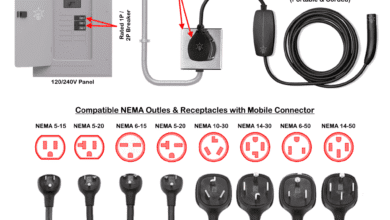 How to Wire and Use Tesla Gen 3 Mobile Connector Charger
-
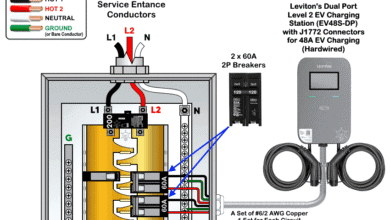 How to Wire 48A Level 2 Dual Port EV Charging Station
-
 How to Wire Smart Electric Vehicle Charging Station – 32A/80A
-
 How to Wire ChargePoint Home Flex Charger for Every EV
-
 How to Wire an EV Wall Charger – Hardwired and Plug-in
-
 How to Wire AC Level 2 EV Smart Breaker Charger – 40A/32A