How to Replace a 20A – 250V, NEMA 2-20 Non-Grounding Receptacle with a 2-P Breaker
The NEMA 2-20 is a non-grounding 2-wire receptacle rated for 20 amps and 250 volts. It belongs to the NEMA 2-series family used primarily in North America and Canada.
The NEMA 2-20 configuration is considered obsolete and unsafe by modern electrical standards. It was used in early two-wire 250V systems that did not include a grounding conductor. Currently, NEC no longer allows these kind of non-grounding outlets and receptacles for most installations. Currently, they are available from various manufacturers, such as Hubbell, and can be used as replacements for existing damaged outlets.
NEC 406.4(D)(2) and 250.130(C) allows the replacements of ungrounded (non–grounding-type (2-wire) receptacle)) under the following three options:
- Replace with another non–grounding-type receptacle. Only if there is no equipment grounding conductor (EGC) present in the circuit.
- Replace with a GFCI-type receptacle. The GFCI must be marked “No Equipment Ground”. GFCI provides shock protection, but not an actual ground path.
- Replace with a grounding-type (3-prong) receptacle protected by a GFCI device (either the receptacle itself or upstream i.e. GFCI breaker). The new receptacle must also be marked “GFCI Protected” and “No Equipment Ground.” even in the absence of equipment grounding conductor (EGC).
Good to Know: Under NEC 406.4(D)(2), if a non-grounding type receptacle (like NEMA 2-20) is replaced:
- You must either install a grounded receptacle with a proper grounding conductor, or
- Replace it with a GFCI-protected outlet and label it “No Equipment Ground.”
The NEMA 2-20 Receptacle
A NEMA 2-20 is a 250V, 20A non-grounding, two-pole, two-wire receptacle for use in older commercial and industrial settings. It features two slots (one vertical and one horizontal) for Hot 1 and Hot 2, designed to accept the two-prong plug of a NEMA 2-20P.
It is considered obsolete for new installations because of its lack of a safety ground, but it can still be found in older equipment and is used for repair purposes, though newer equipment rarely uses this configuration. Currently, NEMA 2-20R is superseded by grounded designs like NEMA 6-20 (2-pole, 3-wire, 250V grounded).
While no longer manufactured for standard use, you might still find NEMA 2-20 receptacles in old industrial buildings, workshops, vintage equipment and machinery from the 1950s-60s.
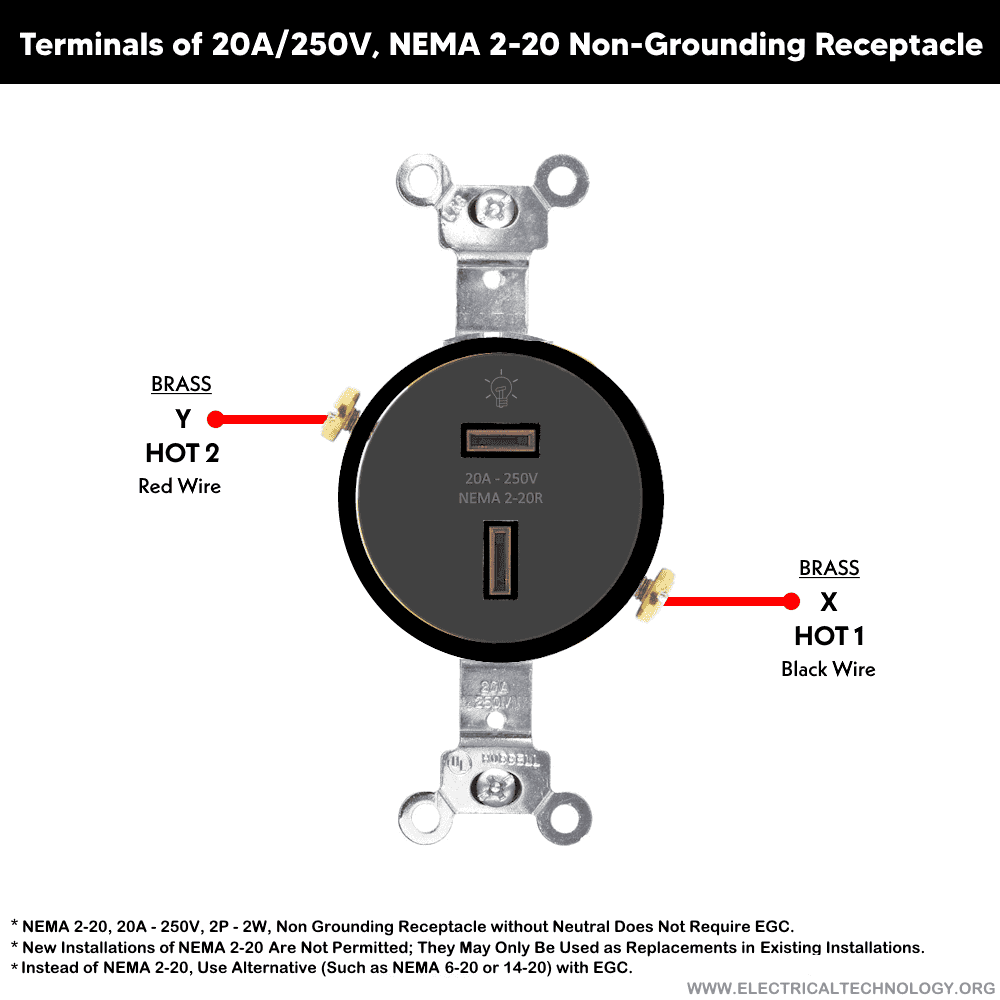
Terminals
There are two terminals in a 2-20R receptacle.
- Hot 1: Black Wire → Brass Screw – Vertical Slot (I)
- Hot 2: Red Wire → Brass Screw – Horizontal Slot (➖)
Click image or open in a new tab to enlarge
Electrical Ratings & Specifications
- NEMA: NEMA 2-20R – Straight-Blade Receptacle
- Poles: 2-Pole, 2-Wire – Non-Grounding without Neutral
- Wires: Two Wires – Hot 1 & Hot 2
- Voltage: 250V – Single-Phase AC Supply – 60 Hz
- Breaker: 20A
- Current: 20A – 16A
- Wattage: 4,800 W
- Wire Size: #12AWG Copper
- Grade & Material: Industrial Grade – Thermoplastic with Steel Strap & Galvanized Steel Screws
- Termination: Side Wired Only
- Mounting: Screw Mounting
- Wiring: Hardwired / Dedicated Circuit
Wiring 15 Amp, Non-Grounding 2-Wire Receptacle
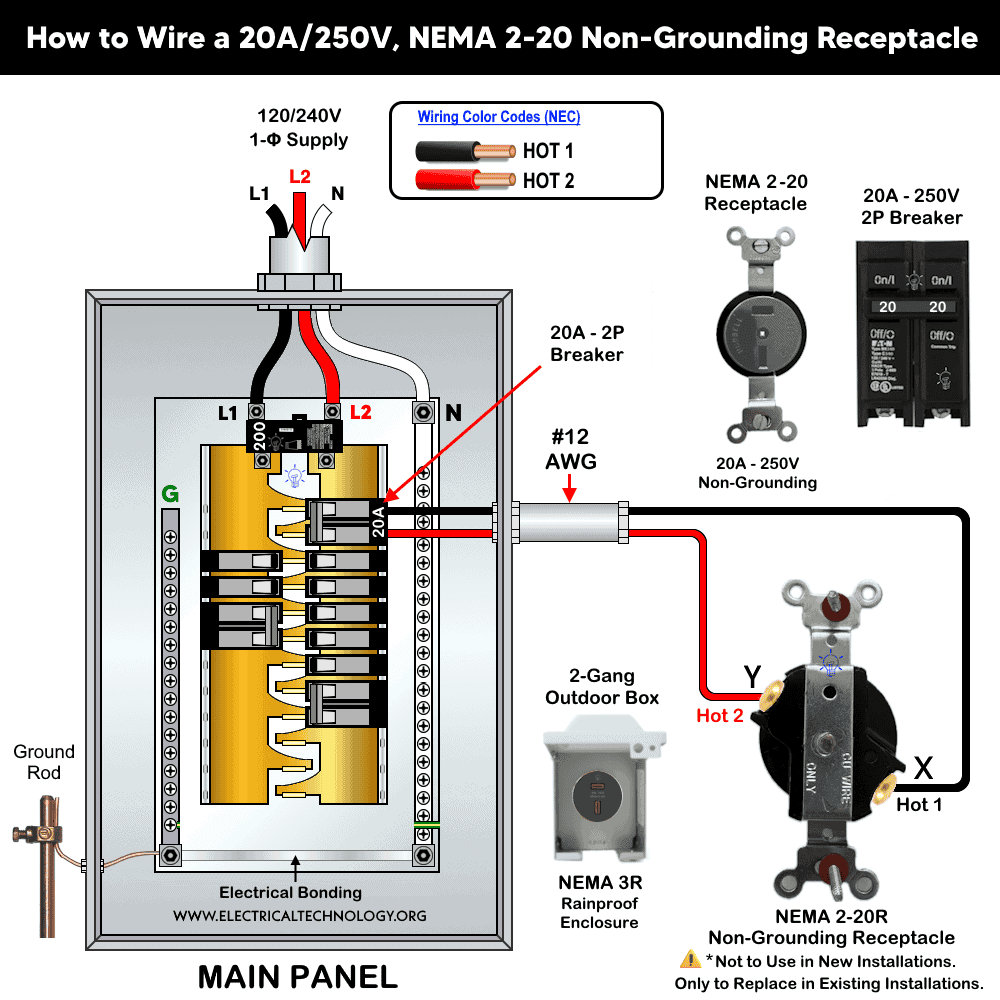
To replace an existing 2-wire non-grounding 20A, 250V receptacle, (NEMA 2-20R), connect the terminals of receptacle to a two-pole, 20A breaker in a 120/240V main panel as shown in the following wiring diagram.
Wiring Steps:
- Use #14 AWG copper conductors, which is the appropriate wire size for a 20A circuit and compatible with the NEMA 2-20R receptacle.
- Strip the ¾ inch (19 mm or 1.9 cm) insulation from the side wire conductors.
- Connect Hot 1 wire (black) to the brass screw terminal, which corresponds to the vertical slot.
- Connect Hot 2 wire (red) to the brass screw terminal on the other side, which corresponds to the horizontal slot.
- After the connections, tighten each terminal screw to approximately 10-14 in·lbs (1.1-1.6 N·m) of torque.
Click image or open in a new tab to enlarge
Good to Know:
As per NEC 406.4(D)(2): “Non–grounding-type receptacles shall not be replaced with grounding-type receptacles unless an equipment grounding conductor is provided.” In simple words, you can only replace a 2-wire (ungrounded) outlet with another 2-wire or a GFCI-type outlet labeled “No Equipment Ground.
FAQs
When Was the NEMA 2-20R Introduced and When Did it Become Obsolete?
The NEMA 2-20R was introduced in the early to mid-20th century for 250-volt, 20-amp two-wire (ungrounded) applications. It became largely obsolete by the late 1960s to early 1970s, following the introduction of grounding-type receptacles (such as NEMA 6-20R) mandated by electrical codes.
Why are NEMA 2-20 Receptacles Considered Outdated?
They are outdated because they lack an equipment grounding conductor (EGC), which is now a fundamental safety requirement. Grounding reduces the risk of electric shock and equipment damage. As the NEC and UL standards evolved, non-grounding 250V outlets like the NEMA 2-20 were phased out from residential and commercial installations.
Reason for obsolescence:
- Lack of grounding conductor (no equipment ground for shock protection).
- Incompatible with modern grounded appliances.
- Superseded by grounded designs like NEMA 6-20 (2-pole, 3-wire, 250V grounded).
Modern standard replacement:
NEMA 6-20R – 250V, 20A, 3-wire grounded receptacle (Hot–Hot–Ground).
How Many Amps Can a NEMA 2-20 Handle Safely?
A NEMA 2-20 receptacle is rated for 20 amperes maximum under standard operating conditions as specified by NEMA. As per NEC Articles 210.19(A), the 20A outlet can be used for 16A continuous load (which runs 3 or more hours) and max 20A non-continuous load.
How Many Watts Can a NEMA 2-20 Receptacle Hold?
At 240 volts and 20 amps, a NEMA 2-20 receptacle can handle up to 4,800W
Watts = Volts × Amps = 250V × 20A = 4,800 watts (4.8 kW)
This is the maximum safe non-continuous load. The continues load can be reduced 80% which is equal to 3,840W.
Which breaker Size is Suitable for a NEMA 2-20 Receptacle ?
The right size breaker for NEMA 2-20 outlet is 15A two-pole breaker or GFCI.
What is the Correct Wire Size and Cable Type to Use with a NEMA 2-20?
Based on NEC Table – 310.16, the minimum wire size for a 20-amp, 250-volt NEMA 2-20 receptacle should be:
- 12 AWG copper (THHN or NM-B) – standard for 20A circuits.
- 10 AWG aluminum (if used, though not recommended for outlets).
Can I Replace a NEMA 2-20 with a NEMA 5-20, 6-20, or 14-20?
Yes & NO.
- Replace with NEMA 5-20R (125V) – No, It is 120V device while NEMA 2-20 is 240V.
- Replace with NEMA 6-20R (250V) – Yes, if it is a 2-wire 250V circuit and a grounding conductor is available. Otherwise, No.
- Replace with NEMA 14-20R (125/250V)- Yes, if a new 4-wire (hot-hot-neutral-ground) configuration is installed. Other wise NO.
According to NEC 406.4(D)(2), a 2-20 can only be replaced with another 2-20, a GFCI receptacle, or a GFCI-protected 2-20 marked “No Equipment Ground.”.
Warning
- Make sure to disconnect the power supply by switching OFF the breaker in the main panel before doing any electrical work.
- If you are unsure, consult with a licensed electrician to ensure any electrical work is performed safely and in compliance with your local codes, as code requirements can vary.
- The author will not be liable for any losses, injuries, or damages from the display or use of this information or if you try any circuit in wrong format. So please! Be careful because it’s all about electricity and electricity is too dangerous.
Resources:
Related Wiring Tutorials
Related Wiring Tutorials
NEMA Family Outlets/Receptacle Wiring
NEMA 5 -Series
- How to Wire a 15A – 120V Outlet – NEMA 5-15 Receptacle
- How to Wire a 20A – 120V Outlet – NEMA 5-20 Receptacle
- How to Wire a 30A – 120V NEMA 5-30 Receptacle
- How to Wire a 50A – 120V – NEMA 5-50 Receptacle
NEMA 6-Series
- How to Wire a 15A – 240V Outlet – NEMA 6-15 Receptacle
- How to Wire a 20A – 240V Outlet – NEMA 6-20 Receptacle
- How to Wire a 30A – 240V – NEMA 6-30 Receptacle
- How to Wire a 50A – 240V – NEMA 6-50 Receptacle
NEMA 10-Series
- How to Wire a 20A, NEMA 10-20 Non-Grounding Receptacle
- How to Wire a 30A, NEMA 10-30 Non-Grounding Receptacle
- How to Wire a 50A, NEMA 10-50 Non-Grounding Receptacle
NEMA 14-Series
- How to Wire a 20A – 125/250V NEMA 14-20 Receptacle
- How to Wire a 30A – 125/250V NEMA 14-30 Receptacle
- How to Wire a 50A – 125/250V NEMA 14-50 Receptacle
- How to Wire a 60A – 125/250V – NEMA 14-60 Receptacle
NEMA General Outlets/Receptacle
- How to Wire a 15A/125V, NEMA 1-15 Non-Grounding Outlet
- How to Wire a 20A/250V, NEMA 2-20 Non-Grounding Receptacle … (You are Here)
- How to Wire a 30A – 125V, NEMA TT-30 Receptacle for RVs
- How to Wire a 3-Phase, 60A – 250V NEMA 15-60 Receptacle
- How to Wire a 3-Phase, 60A – 120/208V NEMA 18-60 Receptacle
Smart Devices Wiring Series
- How to Wire 120/240V Smart Load Center with Smart Breakers
- How to Wire a Smart Breaker in a Smart 120/240V Panel
- How to Wire a Smart GFCI Breaker in a 120/240V Smart Panel
- How to Wire Smart AFCI/GFCI Breaker in a Smart Load Center
- How to Wire a Smart Switch in a 120/240V Load Center
- How to Wire a 15A Wi-Fi Smart Outlet in a Smart Panel
- How to Wire 15A and 20A Wi-Fi Smart GFCI Outlets
General Wiring Installations:
- How to Size a Breaker and Wires in AWG with EGC for Load?
- How to Wire an Outlet Receptacle? Socket Outlet Wiring Diagrams
- How to a Wire 3-Way Combination Switch and Grounded Outlet?
- How to Wire Combo Switch and Outlet? – Switch/Outlet Combo Wiring Diagrams
- How to Wire 120V & 240V Main Panel? Breaker Box Installation
- How to Wire a Subpanel? Main Lug Installation for 120V/240V
- How to Wire 277V & 480V, 1-Phase & 3-Phase, Commercial Main Service Panel?
- How to Wire 240V Water Heater Thermostat – Non-Continuous?
- How to Wire 3-Phase Simultaneous Water Heater Thermostat?
- How to Wire Twin Timer for 120V/240V Circuits – ON/OFF Delay
- How to Wire ST01 Timer with Relay & Contactor for 120V/240V Motors?
- How to Wire Multifunction ON/OFF Delay Timer for 120V/240V Motors?
Switches Wiring
- How to Wire Single Pole, Single Throw (SPST) as 2-Way Switch?
- How to Wire Single Pole, Double Throw (SPDT) as 3-Way Switch?
- How to Wire Double Pole, Single Throw Switch? Wiring DPST
- How to Wire Double Pole, Double Throw Switch? Wiring DPDT
- How to Wire Double Switch? 2-Gang, 1-Way Switch – IEC & NEC
- How to Wire 4-Way Switch (NEC) or Intermediate Switch as 3-Way (IEC)?
GFCI/AFCI Breaker/Outlet Wiring
- How to Wire a GFCI Circuit Breaker?
- How to wire a GFCI Outlet?
- How to Wire GFCI Combo Switch and Outlet – GFCI Switch/Outlet
- How to Wire an AFCI Breaker?
- How to Wire an AFCI Outlet?
Related Posts:
- What is the Right Wire Size for 20A Breaker and Outlet?
- What is the Difference Between 15-Amp and 20-Amp Outlet?
- Difference Between Socket, Outlet and Receptacle
- Difference Between NEMA 14-50 Standard Vs EV Receptacle
- How to Find the Number of Outlets on a Single Circuit Breaker?
- How to Find Voltage & Ampere Rating of Switch, Plug, Outlet & Receptacle
- Can you use 15A Breaker on 20A Circuit and Vice Versa?
- Can You use a 15A Outlet on a 20A Circuit and Vice Versa?
- Ground Terminal Up or Down: Which Way Should Outlets Face?
- What Do the Green Dot or Orange Triangle Outlets Mean?
- What Do the Different Colors of Electrical Outlets Indicate?
- Why are Outlets and Receptacles in Hospitals Upside Down?
- How to Size a Load Center, Panelboards and Distribution Board?
- How to Determine the Number of Circuit Breakers in a Panelboard?
- How to Find the Proper Size of Circuit Breaker? Breaker Size Calculator & Examples
- How to Find The Suitable Size of Cable & Wire for Electrical Wiring Installation?
- Why is the Neutral Prong or Slot Wider on a Plug or Outlet?
- What Will Happen If You Connect a Male-to-Male Plug Between Outlets
-
 How to Wire a Countdown Timer Switch – 15 Mins to 12Hrs
-
 How to Wire a Digital & Smart Fan Speed Controller Switch
-
 How to Wire Humidity Sensor and Fan Control Switch
-
 Wiring Combo Humidity Sensor & Fan Control with Light Switch
-
 How to Wire a Smart Motion Sensing Dimmer Switch
-
 How to Install a Wake and Sleep Wireless Smart Switch