How to Wire a 30A – 125V – NEMA 5-30 Receptacle
How to Install a 30A – 125V Receptacle (NEMA 5-30R) with GFCI / Breaker
A 30A-125V NEMA 5-30 receptacle is a heavy-duty, single-phase grounding electrical outlet designed to supply 120 volts (nominal 125V) with a maximum current rating of 30 amperes. It has three slots (Hot, Neutral & ground) and is used for connecting high-amperage appliances through NEMA 5-30P.
NEMA 5-30R is an older, non-standard type of 30-amp receptacle, rarely used in typical residential and commercial buildings today. In other words, 30A – 125V receptacles are not used with standard household appliances as it’s meant for heavy-duty loads only.
The NEMA 5-30, is a 2P- 3W receptacle used where higher 120V current is required than a typical 15A or 20A outlet can provide. These outlets are used in industrial, commercial, or residential settings such as air compressors, electric heaters, generators and RVs power pedestals rated at 30A – 120V single-phase AC supply.
In the following wiring tutorial, we will show how to wire a NEMA 5-30 receptacle using standard or GFCI breakers with correct breaker and wire sizes for a 30-amp – 120 volt circuits.
The NEMA 5-30 Receptacle
The NEMA 5-30R is a 30A, 125V grounded receptacle designed for use with NEMA 5-30P plugs. As the name suggests, the “30” in 5-30R indicates the maximum current rating in amperes, while the “R” stands for “Receptacle” (outlet). Similarly, the “P” in NEMA 5-30P denotes “Plug,” with “30” representing its maximum current capacity in amperes.
The 20A, 125V receptacle features a 2-pole, 3-wire configuration. It includes two slots i.e. the narrower slot for the hot wire and a half-T-shaped slot for the neutral along with a round or U-shaped hole for the equipment grounding conductor (EGC). This receptacle type is rarely used to power high-demand 125V, 30A circuits found in industrial and commercial settings.
Terminals
There are three terminals in a NEMA 5-30R receptacle as follows:
- (I) = Narrow Vertical Terminal (Brass Screw) on the Right Side: Connects to the Black Wire – Hot
- (┐) Half T-Shaped Terminal (Silver Screw) on the Left Side: Connects to the White Wire – Neutral
- (U) Shaped “G” Terminal (Green Screw): Connects to the Bare or Green Wire – (EGC)
the NEMA 5-30 and TT-30 receptacles are both rated for 30 amps at 120V, but they are not interchangeable and are designed for very different applications. NEMA 5-30R are straight-blade and used for heavy-duty 120 V equipment (industrial, shop tools, HVAC, etc. while TT-30R are angled blade (designed to meet RV-specific standards (ANSI/RVIA) and used for RVs and travel trailers only.
In addition, a NEMA 5-30P plug cannot fit into a TT-30R receptacle, and vice versa. Therefore, do not use a NEMA 5-30 outlet to power an RV because it will not match the plug and may damage electrical equipment if modified.
Electrical Ratings & Specifications
- NEMA: 5-30R – Straight-Blade Receptacle
- Poles: 2-Poles, 3 Wires Grounding – With Neutral
- Voltage: 125V Single-Phase AC Supply – 60 Hz
- Current: 30A -24A
- Breaker / GFCI: 30A
- Wattage: 3,600 W
- Wire Size: #10 AWG Copper
- Grade & Material: Commercial Grade – Nylon with Galvanized Steel
- Mounting: Flush / Screw Mounting
- Outdoor Box: 2-gang outdoor box – NEMA 3R rainproof enclosure
- Wiring: Hardwired / Dedicated Circuit
Click image or open in a new tab to enlarge

Wiring NEMA 5-30 Receptacle
Wiring 30A-125V Outlet using 1-P Breaker
The following wiring diagram illustrates the wiring connections of a 30A, 125V outlet (NEMA 5-30R) to a single-pole, 120V – 30A breaker or GFCI in a 120/240V main panel, as described below:
Before installation, strip the insulation from the conductors according to the connection type. Once completed, tighten all terminal screws to approximately 25 lb-in (3 N·m) of torque.
- Connect the ground (bare or green) wire to the green screw – the centered, round or U-shaped “G” terminal.
- Connect the hot (black) wire to the brass screw – the shorter or narrow vertical slot terminal.
- Connect the neutral (white) wire to the silver screw – the L-shaped or half-T slot terminal.
For this circuit, use #10 AWG copper wire, which is the correct size for a 30A circuit and the corresponding NEMA 5-30R outlet.
For outdoor installations of NEMA 5-30, use a NEMA 3R weatherproof 2-gang enclosure to protect the receptacle from moisture and environmental exposure.
Click image or open in a new tab to enlarge
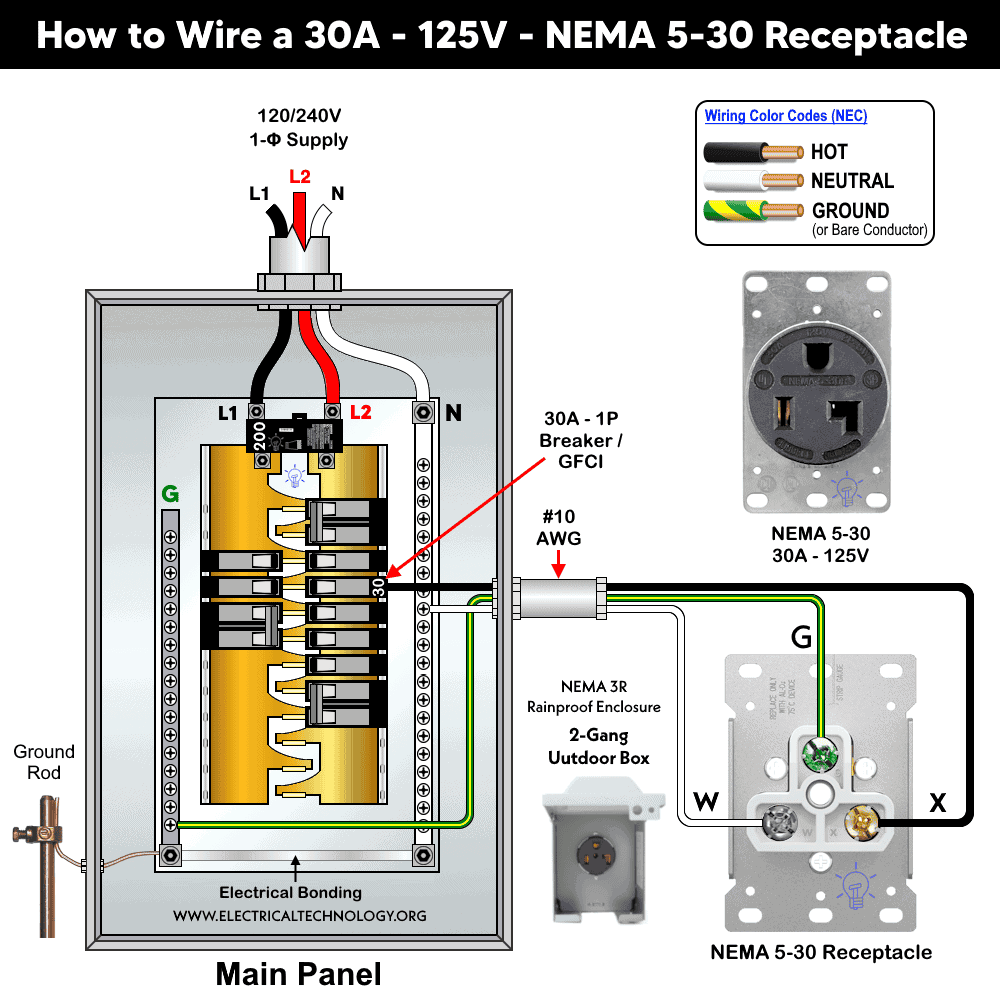
Wiring 30A-125V Outlet using 1-P, 30A GFCI Breaker
In the case of a 30A outlet used for RVs or outdoor installations where GFCI protection is required, simply replace the single-pole breaker with a single-pole, 30A-125V GFCI breaker. While replacing the standard breaker with GFCI, don’t forget to connect the built-in pigtail (white wire) from the GFCI to the neutral busbar in the main panel.
According to NEC 210.8, GFCI protection is required for receptacles installed in garages, basements, outdoors, laundry areas, and other wet or damp locations. Specifically, NEC 210.8(A)(1) through (A)(11) mandates that all outdoor receptacles must be installed downstream of GFCI protection, in accordance with Articles 426.28 and 427.22.
FAQs
How Many Amps Can a 30A – 125V Receptacle Handle Safely?
A 30-amp, 120-volt outlet can safely handle up to 30 amps of continuous load. However, according to the NEC 80% rule (NEC 210.19(A)(1) and 210.20(A)), the continuous load should not exceed 24 amps (80% of 30A) for safety and to prevent overheating.
How Many Watts Can a 30A – 125V Receptacle Hold?
You can calculate the wattage using P = V × I:
- Maximum: 120V × 30A = 3,600 watts
- Safe continuous: 120V × 24A = 2,880 watts
Which Breaker Size is Suitable for a 30A – 125V Receptacle?
A single-pole, 30-amp breaker is the correct choice for a 30A-120V circuit. This breaker protects both the outlet and wiring from overload or short circuits.
For outdoor or RV applications where GFCI protection is required (per NEC 210.8(A)), use a single-pole, 30A GFCI breaker.
What is the Correct Wire Size and Cable Type to Use with a 30A-120V Receptacle?
For a 30A circuit, the minimum required conductor size must safely handle 30 amps per NEC Table 310.16, Table 210.24(1) and NEC 240.4(D)(8). Similarly, use the same size i.e. #10AWG for EGC as per NEC Table 250.122.
Recommended wire sizes:
- Copper: 10 AWG (THHN, NM-B, or UF-B)
- Aluminum: 8 AWG (if aluminum wiring is used)
Typical cable types:
- Indoor: 10/2 NM-B (Black = Hot, White = Neutral, Bare = Ground)
- Outdoor or buried: 10/2 UF-B or THWN in conduit
Instructions, Precautions & Codes
- If your main purpose for installing the 5-30R outlet is for RVs, use an industrial-grade device with correct adapter.
- It is recommended to hardwire instead of plug-in a 30-amp receptacle for welding machines.
- The 5-30R should not be used with single-gang wall boxes. Use a 2-gang outdoor box and NEMA 3R rainproof enclosure, especially for outdoor applications.
- According to NEC Table – 310.16, Table 210.24(1), and NEC 240.4(D)(8), the correct wire size for a 30A circuit and outlet is #10 AWG copper. Likewise, the appropriate breaker size is a 30A, 120V single-pole breaker (or 30A 1-P, GFCI breaker) when wiring a NEMA 5-30R receptacle, using the same wire size (#10 AWG) copper conductors.
- A 30A outlet can supply up to a 24A continuous load and a maximum of 30A non-continuous load, as per NEC 210.19(A), 215.2, and 230.42(A).
- Use #10/2 cable (hot, neutral, and ground) for wiring a 30A-120V breaker and outlet.
- Use 30A, 120V outlet as a dedicated circuit for single unit especially for RV and welding machine.
Resources:
Related Wiring Tutorials
Related Wiring Tutorials
NEMA Family Outlets/Receptacle Wiring
NEMA 5 -Series
- How to Wire a 15A – 120V Outlet – NEMA 5-15 Receptacle
- How to Wire a 20A – 120V Outlet – NEMA 5-20 Receptacle
- How to Wire a 30A – 120V NEMA 5-30 Receptacle … (You are Here)
- How to Wire a 50A – 120V – NEMA 5-50 Receptacle
NEMA 6-Series
- How to Wire a 15A – 240V Outlet – NEMA 6-15 Receptacle
- How to Wire a 20A – 240V Outlet – NEMA 6-20 Receptacle
- How to Wire a 30A – 240V – NEMA 6-30 Receptacle
- How to Wire a 50A – 240V – NEMA 6-50 Receptacle
NEMA 10-Series
- How to Wire a 20A, NEMA 10-20 Non-Grounding Receptacle
- How to Wire a 30A, NEMA 10-30 Non-Grounding Receptacle
- How to Wire a 50A, NEMA 10-50 Non-Grounding Receptacle
NEMA 14-Series
- How to Wire a 20A – 125/250V NEMA 14-20 Receptacle
- How to Wire a 30A – 125/250V NEMA 14-30 Receptacle
- How to Wire a 50A – 125/250V NEMA 14-50 Receptacle
- How to Wire a 60A – 125/250V – NEMA 14-60 Receptacle
NEMA General Outlets/Receptacle
- How to Wire a 15A/125V, NEMA 1-15 Non-Grounding Outlet
- How to Wire a 20A/250V, NEMA 2-20 Non-Grounding Receptacle
- How to Wire a 30A – 125V, NEMA TT-30 Receptacle for RVs
- How to Wire a 3-Phase, 60A – 250V NEMA 15-60 Receptacle
- How to Wire a 3-Phase, 60A – 120/208V NEMA 18-60 Receptacle
Smart Devices Wiring Series
- How to Wire 120/240V Smart Load Center with Smart Breakers
- How to Wire a Smart Breaker in a Smart 120/240V Panel
- How to Wire a Smart GFCI Breaker in a 120/240V Smart Panel
- How to Wire Smart AFCI/GFCI Breaker in a Smart Load Center
- How to Wire a Smart Switch in a 120/240V Load Center
- How to Wire a 15A Wi-Fi Smart Outlet in a Smart Panel
- How to Wire 15A and 20A Wi-Fi Smart GFCI Outlets
General Wiring Installations:
- How to Size a Breaker and Wires in AWG with EGC for Load?
- How to Wire an Outlet Receptacle? Socket Outlet Wiring Diagrams
- How to a Wire 3-Way Combination Switch and Grounded Outlet?
- How to Wire Combo Switch and Outlet? – Switch/Outlet Combo Wiring Diagrams
- How to Wire 120V & 240V Main Panel? Breaker Box Installation
- How to Wire a Subpanel? Main Lug Installation for 120V/240V
- How to Wire 277V & 480V, 1-Phase & 3-Phase, Commercial Main Service Panel?
- How to Wire 240V Water Heater Thermostat – Non-Continuous?
- How to Wire 3-Phase Simultaneous Water Heater Thermostat?
- How to Wire Twin Timer for 120V/240V Circuits – ON/OFF Delay
- How to Wire ST01 Timer with Relay & Contactor for 120V/240V Motors?
- How to Wire Multifunction ON/OFF Delay Timer for 120V/240V Motors?
Switches Wiring
- How to Wire Single Pole, Single Throw (SPST) as 2-Way Switch?
- How to Wire Single Pole, Double Throw (SPDT) as 3-Way Switch?
- How to Wire Double Pole, Single Throw Switch? Wiring DPST
- How to Wire Double Pole, Double Throw Switch? Wiring DPDT
- How to Wire Double Switch? 2-Gang, 1-Way Switch – IEC & NEC
- How to Wire 4-Way Switch (NEC) or Intermediate Switch as 3-Way (IEC)?
GFCI/AFCI Breaker/Outlet Wiring
- How to Wire a GFCI Circuit Breaker?
- How to wire a GFCI Outlet?
- How to Wire GFCI Combo Switch and Outlet – GFCI Switch/Outlet
- How to Wire an AFCI Breaker?
- How to Wire an AFCI Outlet?
Related Posts:
- What is the Right Wire Size for 30A Breaker and Outlet?
- What is the Difference Between 15-Amp and 20-Amp Outlet?
- Difference Between Socket, Outlet and Receptacle
- Difference Between NEMA 14-50 Standard Vs EV Receptacle
- How to Find the Number of Outlets on a Single Circuit Breaker?
- How to Find Voltage & Ampere Rating of Switch, Plug, Outlet & Receptacle
- Can you use 15A Breaker on 20A Circuit and Vice Versa?
- Can You use a 15A Outlet on a 20A Circuit and Vice Versa?
- Ground Terminal Up or Down: Which Way Should Outlets Face?
- What Do the Green Dot or Orange Triangle Outlets Mean?
- What Do the Different Colors of Electrical Outlets Indicate?
- Why are Outlets and Receptacles in Hospitals Upside Down?
- How to Size a Load Center, Panelboards and Distribution Board?
- How to Determine the Number of Circuit Breakers in a Panelboard?
- How to Find the Proper Size of Circuit Breaker? Breaker Size Calculator & Examples
- How to Find The Suitable Size of Cable & Wire for Electrical Wiring Installation?
- Why is the Neutral Prong or Slot Wider on a Plug or Outlet?
- What Will Happen If You Connect a Male-to-Male Plug Between Outlets