How to Wire a 20A, NEMA 10-20 Non-Grounding Receptacle
How to Replace a 20A, 125/250V, NEMA 10-20 Receptacle with a 2P Breaker in Existing Installations
A NEMA 10-20R is a 20A, 125/250V dual voltage, straight-blade and non-grounding receptacle for high-power appliances. It is is no longer considered a safe or modern standard because it lacks a dedicated ground wire. The outdated 10-20 receptacle is unsafe for modern use, especially with high-consumption devices like dryers and ovens. It has 3 slots (for associated 3 pin pin/prongs) configuration, with the two tilted blade slots for Hot1 and Hot 2 and a center slot for the neutral wire.
It is a non-grounding receptacle, which means the third wire in 3-P is a neutral, not a ground, and can be replaced with a self-grounding feature.
The NEMA 10-20 (20A, 125/250V, 3-prong, non-grounding) receptacle is an old-style receptacle that was used before grounding was required in the NEC. It can only be used as a replacement in existing wiring systems where no equipment grounding conductor (EGC) is present.
It means, NEMA 10-20 is not for new installations. The NEC (since 1996) prohibits installing new NEMA 10-series receptacles and outlets (10-20, 10-30, 10-50) because they do not provide grounding protection. Safer alternatives today for new work are NEMA 6-20 for 240V-only appliances (with ground) or NEMA 14-20 for 120/240V appliances (with neutral and ground).
Since 2-wire non-grounding receptacles are no longer permitted for new installations, NEC 406.4(D)(2) and 250.130(C) allow their replacement only under the following conditions:
1. Replace with another 2-wire receptacle:
You may replace the existing non-grounding receptacle with a new one of the same type.
2. Replace with a GFCI receptacle:
A GFCI-type receptacle may be installed as a replacement. In this case, the receptacle must be clearly marked with the words “No Equipment Ground” and/or “GFCI Protected” to indicate that it is not connected to an equipment grounding conductor.
3. Replace with a grounding-type receptacle protected by a GFCI:
A grounding-type receptacle may be installed if it is protected by a GFCI device, such as a GFCI circuit breaker or a GFCI receptacle located at the first outlet on the circuit. In this configuration, the GFCI provides shock protection even though an equipment grounding conductor (EGC) is not present.
In the following wiring guide, we will show how to replace a damaged NEMA-10-20R in an existing installations with a 2-pole, 20A breaker or GFCI breaker.
The NEMA 10-20 Receptacle
The NEMA 10-20R is a 20-amp, 125/250V, non-grounding receptacle. It is wired with two hot conductors and one neutral conductor, and it is designed to be used with a matching NEMA 10-20P plug. The “20” in 10-20R indicates the maximum current rating in amperes, while “R” stands for Receptacle. Similarly, the “P” in NEMA 10-20P stands for Plug.
The NEMA 10-20 has a 3-pole, 3-wire configuration (Hot 1, Hot 2, and Neutral). It is a non-grounding, straight-blade device that does not include a dedicated equipment grounding conductor. Its distinctive “crow’s foot” design features two angled blade slots for the hot conductors and one vertical slot in the center for the neutral conductor.
Click image or open in a new tab to enlarge
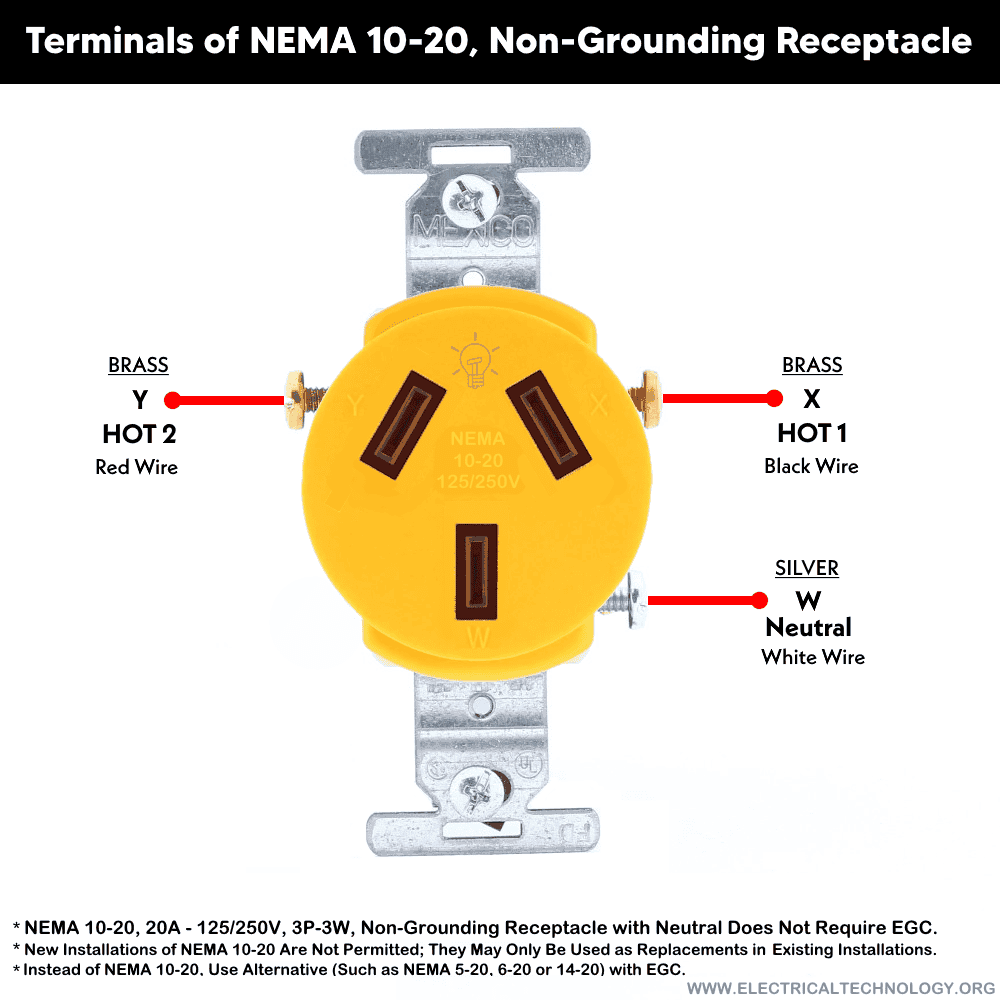
Terminals
There are three terminals in a NEMA 10-20 receptacle:
- X Terminal (Brass Screw): For HOT 1 (Line 1) – Black Wire
- Y Terminal (Brass Screw): For HOT 2 (Line 2) – Red Wire
- W Terminal (Silver Screw): For Natural – White Wire
Electrical Ratings & Specifications
- NEMA: NEMA 10-20R – Straight-Blade Receptacle
- Poles: 3-Pole, 3-Wire – Non-Grounding with Neutral
- Wires: Three Wires – Hot 1, Hot 2 & Neutral
- Voltage: 125/250V Single-Phase AC Supply – 60 Hz
- Breaker: 20A
- Current: 20A – 16A
- Wattage: 4,800 W
- Wire Size: #10 to #12 AWG (Copper Only)
- Temp. Rating: -40°C to 75°C (-40°F to 167°F)
- Dielectric-strength: Withstand 2kV Min.
- Options: Residential and Industrial Grade
- Mounting: Flush / Surface Mounting
- Outdoor Box: Single or 2-gang outdoor box – NEMA 3R rainproof enclosure
- Wiring: Hardwired / Dedicated Circuit
Wiring NEMA 10-20 Receptacle with a 2P Breaker
A NEMA 10-30 receptacle can be installed as a replacement for either a plug-in or hardwired connection in an existing electrical setup.
As shown in the wiring diagram, a 2-pole, 20A breaker in 120/240V main panel supply system can be used to re-wire the NEMA 10-20 receptacle as follow.
- Connect Hot 1 (black wire) to the “X” terminal screw.
- Connect Hot 2 (red wire) to the “Y” terminal screw.
- connect the neutral (white wire) to the centered “W” terminal of the receptacle
For this configuration, use #12 AWG copper conductors for the 20A circuit and the corresponding NEMA 10-20R receptacle.
During the installation process, strip each conductor 3/4″ (25mm) or refer to the stripe gage on mounting plate. Similarly, Tighten terminal screws to approximately 12-14 lb-in (1.3 – 1.5 N·m).
Click image or open in a new tab to enlarge
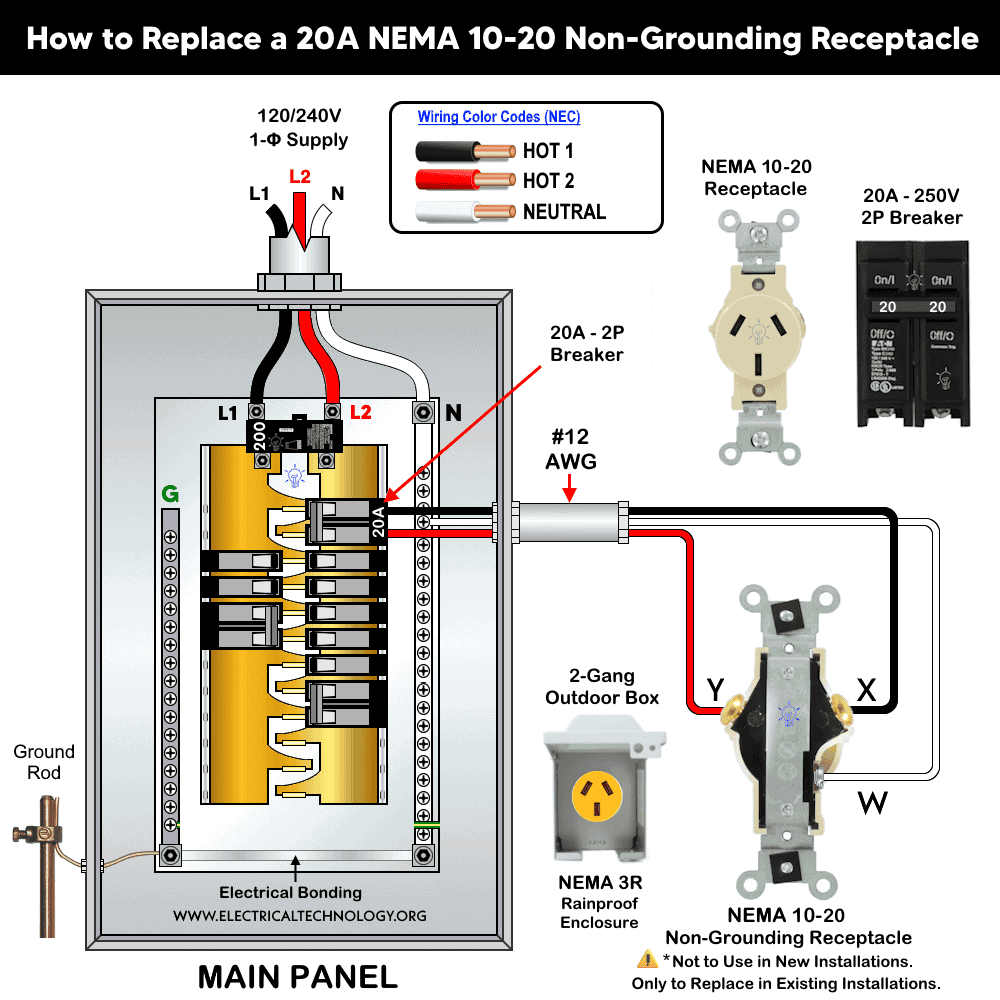
In indoor installations, the NEMA 10-20 are fixed in a single-gang box. For outdoor installations, a NEMA 3R weatherproof (rainproof) 2-gang enclosure should be used to protect the receptacle from moisture and environmental exposure.
FAQs:
How Many Amps Can a NEMA 10-20 Handle Safely?
A NEMA 10-20 receptacle is rated for 20 amps maximum. For continuous loads (lasting 3 hours or more), the NEC recommends using only 80% of the rating, which equals 16 amps continuous.
How Many Watts Can a NEMA 10-20 Receptacle Hold?
At 250 volts, a 20-amp NEMA 10-20 receptacle can supply up to 5,000 watts (20A × 250V). For continuous loads, the safe limit is 4,000 watts (16A × 250V).
Which Breaker Size is Suitable for a NEMA 10-20R?
The correct breaker size is 20 amps, double-pole (2P) to match the receptacle’s rating and protect the circuit wiring.
What is the Correct Wire Size and Cable Type to Use with NEMA 10-20?
- Based on NEC Table – 310.16, the correct wire size for NEMA 10-20 is #12 AWG – Copper or #10 AWG – Aluminum.
- Cable type should be NM-B, UF-B, or THHN/THWN in conduit, depending on the installation.
Can You Install NEMA 10-20 in New Installations?
No. NEMA 10 series (non-grounding) receptacles are no longer permitted in new installations under the NEC. They may only be replaced in existing installations. For new work, use a NEMA 6-20 (250V, grounding) or NEMA 14-20 (125/250V, grounding).
How Can I Replace a NEMA 10-20 with NEMA 6-20 Without Running an Additional Wire?
You cannot legally convert a NEMA 10-20 (2 hots + neutral, no ground) to a NEMA 6-20 (2 hots + ground, no neutral) without running a new grounding conductor. The NEC requires a dedicated equipment grounding conductor (EGC) for grounding-type receptacles.
Alternatively, you can remove the neutral wire from the NEMA 10-20 receptacle , re-identify it as a ground conductor, and connect it to the ground terminal of the 6-20 outlet. Since the neutral is bonded to the ground in the main service panel, this setup will function.
However, this is not considered good practice (and may only be legal in certain areas). If the neutral is repurposed as a ground, the conductor must be clearly marked with a permanent label or identifying note to avoid confusion and ensure safety.
Resources:
Related Wiring Tutorials
Related Wiring Tutorials
NEMA Family Outlets/Receptacle Wiring
NEMA 5 -Series
- How to Wire a 15A – 120V Outlet – NEMA 5-15 Receptacle
- How to Wire a 20A – 120V Outlet – NEMA 5-20 Receptacle
- How to Wire a 30A – 120V NEMA 5-30 Receptacle
- How to Wire a 50A – 120V – NEMA 5-50 Receptacle
NEMA 6-Series
- How to Wire a 15A – 240V Outlet – NEMA 6-15 Receptacle
- How to Wire a 20A – 240V Outlet – NEMA 6-20 Receptacle
- How to Wire a 30A – 240V – NEMA 6-30 Receptacle
- How to Wire a 50A – 240V – NEMA 6-50 Receptacle
NEMA 10-Series
- How to Wire a 20A, NEMA 10-20 Non-Grounding Receptacle … (You are Here)
- How to Wire a 30A, NEMA 10-30 Non-Grounding Receptacle
- How to Wire a 50A, NEMA 10-50 Non-Grounding Receptacle
NEMA 14-Series
- How to Wire a 20A – 125/250V NEMA 14-20 Receptacle
- How to Wire a 30A – 125/250V NEMA 14-30 Receptacle
- How to Wire a 50A – 125/250V NEMA 14-50 Receptacle
- How to Wire a 60A – 125/250V – NEMA 14-60 Receptacle
NEMA General Outlets/Receptacle
- How to Wire a 15A/125V, NEMA 1-15 Non-Grounding Outlet
- How to Wire a 20A/250V, NEMA 2-20 Non-Grounding Receptacle
- How to Wire a 30A – 125V, NEMA TT-30 Receptacle for RVs
- How to Wire a 3-Phase, 60A – 250V NEMA 15-60 Receptacle
- How to Wire a 3-Phase, 60A – 120/208V NEMA 18-60 Receptacle
Smart Devices Wiring Series
- How to Wire 120/240V Smart Load Center with Smart Breakers
- How to Wire a Smart Breaker in a Smart 120/240V Panel
- How to Wire a Smart GFCI Breaker in a 120/240V Smart Panel
- How to Wire Smart AFCI/GFCI Breaker in a Smart Load Center
- How to Wire a Smart Switch in a 120/240V Load Center
- How to Wire a 15A Wi-Fi Smart Outlet in a Smart Panel
- How to Wire 15A and 20A Wi-Fi Smart GFCI Outlets
General Wiring Installations:
- How to Size a Breaker and Wires in AWG with EGC for Load?
- How to Wire an Outlet Receptacle? Socket Outlet Wiring Diagrams
- How to a Wire 3-Way Combination Switch and Grounded Outlet?
- How to Wire Combo Switch and Outlet? – Switch/Outlet Combo Wiring Diagrams
- How to Wire 120V & 240V Main Panel? Breaker Box Installation
- How to Wire a Subpanel? Main Lug Installation for 120V/240V
- How to Wire 277V & 480V, 1-Phase & 3-Phase, Commercial Main Service Panel?
- How to Wire 240V Water Heater Thermostat – Non-Continuous?
- How to Wire 3-Phase Simultaneous Water Heater Thermostat?
- How to Wire Twin Timer for 120V/240V Circuits – ON/OFF Delay
- How to Wire ST01 Timer with Relay & Contactor for 120V/240V Motors?
- How to Wire Multifunction ON/OFF Delay Timer for 120V/240V Motors?
Switches Wiring
- How to Wire Single Pole, Single Throw (SPST) as 2-Way Switch?
- How to Wire Single Pole, Double Throw (SPDT) as 3-Way Switch?
- How to Wire Double Pole, Single Throw Switch? Wiring DPST
- How to Wire Double Pole, Double Throw Switch? Wiring DPDT
- How to Wire Double Switch? 2-Gang, 1-Way Switch – IEC & NEC
- How to Wire 4-Way Switch (NEC) or Intermediate Switch as 3-Way (IEC)?
GFCI/AFCI Breaker/Outlet Wiring
- How to Wire a GFCI Circuit Breaker?
- How to wire a GFCI Outlet?
- How to Wire GFCI Combo Switch and Outlet – GFCI Switch/Outlet
- How to Wire an AFCI Breaker?
- How to Wire an AFCI Outlet?
Related Posts:
- What is the Right Wire Size for 20A Breaker and Outlet?
- What is the Difference Between 15-Amp and 20-Amp Outlet?
- Difference Between Socket, Outlet and Receptacle
- Difference Between NEMA 14-50 Standard Vs EV Receptacle
- How to Find the Number of Outlets on a Single Circuit Breaker?
- How to Find Voltage & Ampere Rating of Switch, Plug, Outlet & Receptacle
- Can you use 15A Breaker on 20A Circuit and Vice Versa?
- Can You use a 15A Outlet on a 20A Circuit and Vice Versa?
- Ground Terminal Up or Down: Which Way Should Outlets Face?
- What Do the Green Dot or Orange Triangle Outlets Mean?
- What Do the Different Colors of Electrical Outlets Indicate?
- Why are Outlets and Receptacles in Hospitals Upside Down?
- How to Size a Load Center, Panelboards and Distribution Board?
- How to Determine the Number of Circuit Breakers in a Panelboard?
- How to Find the Proper Size of Circuit Breaker? Breaker Size Calculator & Examples
- How to Find The Suitable Size of Cable & Wire for Electrical Wiring Installation?
- Why is the Neutral Prong or Slot Wider on a Plug or Outlet?
- What Will Happen If You Connect a Male-to-Male Plug Between Outlets




Our old house has one of those in each bathroom, and there are 2 double pole breakers in the main panel marked “bath upstairs 240 volt” and “bath downstairs 240 volt”. The very thought gives me chills.
This was the old 20 amp 230 volt configuration used on many window ac units till the nema 6-20 style was developed in the late 60s. It was the little crows foot, identical to the 3 wire range outlet but smaller. I worked on many large window units from the 60s and this was a common plug.
In NZ, the top left is phase The top right is neutral, or negative The bottom middle is earth. WE USE the PNE system.
Encountered one of these after someone received a severe electric shock. It was installed by someone who assumed that it would be grounded by installing it flush to a metal box. The metal strap does not have grounding continuity with the neutral slot.