Can You Use a 2-Pole Breaker Instead of a 1-Pole Breaker
Is It OK to Connect a Load to a 2-Pole Breaker Instead of a 1-Pole Breaker?
In most residential 120/240V panels and 230V consumer units, you will find both 1-pole and 2-pole circuit breakers. Each type is designed for specific applications and is selected according to the circuit requirements to protect branch-circuit conductors, final circuits, and connected loads.
A common question is whether it is permissible to use a 2-pole breaker for a load that is normally protected by a 1-pole breaker, such as a lighting circuit.
The answer depends on the wiring system and applicable electrical code requirements. Moreover, it depends on compatibility with the panelboard / consumer unit and compliance with the applicable electrical code (NEC / IEC) and manufacturer’s specifications.
In IEC standards, the distribution voltages used in residential and commercial installations differ from those commonly used voltage systems in NEC and CEC standards. The United States and Canada primarily use a 120/240V single-phase system, whereas countries following IEC standards typically use 230V for single-phase and 400V for three-phase systems.
May I Install a 2-Pole Breaker Instead of a 1-Pole Breaker?
Yes, it can be acceptable to connect a load to a 2-pole breaker instead of a 1-pole breaker, provided the breaker is properly rated for the circuit voltage, current, and application.
However, using a 2-pole breaker for a circuit that only requires a 1-pole breaker may increase installation cost and occupy additional panel space. In addition, the rules and practical considerations differ between NEC (120/240V) and IEC (230V) installations, as discussed in the following sections.
IEC – 230V System
In 230V systems (followed by IEC/BS7671), a 2-pole breaker may be used in place of a 1-pole breaker, in case it is correctly rated and installed in accordance with the applicable electrical code.
For example, the following figure shows two wiring diagrams. In the first diagram, a light bulb is connected through a 1-pole circuit breaker, while in the second diagram, the same light bulb is connected through a 2-pole circuit breaker.
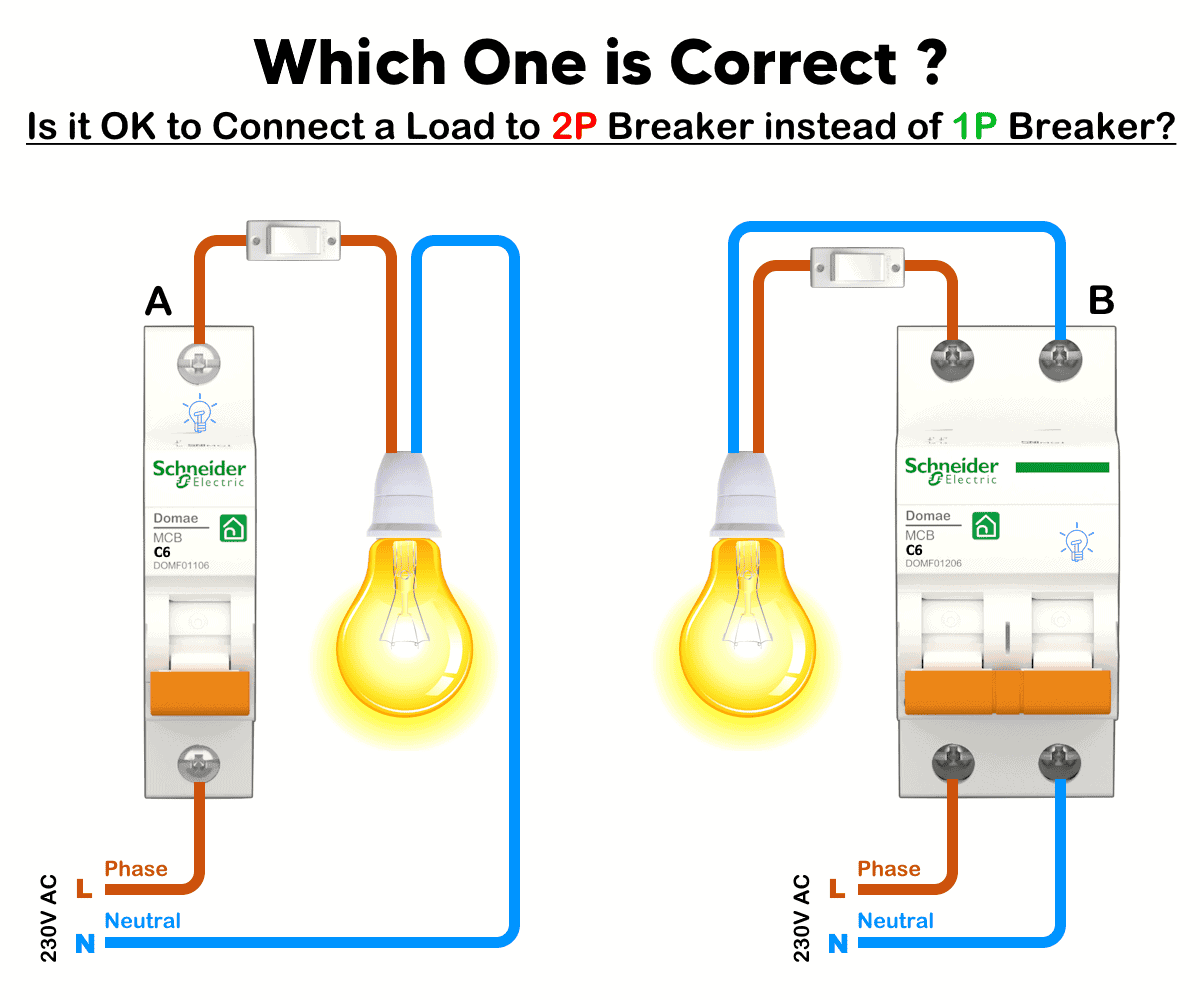
In a 230V single-phase AC system (L–N), both diagrams can work electrically, but they serve different purposes and are not always equally acceptable.
Wiring A:
In diagram A, only the phase (line/live) conductor passes through the breaker and the neutral is directly connected to the load. This is the standard arrangement used in most residential and commercial installations.
A 1-pole breaker is generally sufficient because the phase conductor is the dangerous conductor that must be protected and disconnected. Hence, the wiring configuration in fig A is the usual and preferred method in most residential and household installations.
Advantages:
- Lower cost
- Requires less panel space
- Complies with most wiring practices for ordinary 230V branch circuits
- Disconnects the live conductor, removing dangerous voltage from the load side when switched OFF.
Wiring B:
In diagram B, both the phase and neutral conductors pass through a common-trip 2P breaker. It means, both disconnect simultaneously in case of fault.
If the breaker is rated for the system and the neutral is not shared with other circuits, in that case, a 2-pole breaker does not harm the lamp and provides additional isolation.
Advantages:
- Provides complete isolation of the circuit.
- No conductor remains connected when the breaker is OFF.
- Useful where regulations require simultaneous disconnection of all current-carrying conductors.
They are commonly used for water heaters, air conditioners, motors, EV charging, main switch in garage units, generators and transfer systems, outdoor equipment, and industrial and commercial circuits.
Which one is Correct?
For a standard 230V lighting circuit, the wiring configuration shown in fig A is the normal and economical installation method.
However, wiring configuration shown in fig B is also technically correct if a properly rated common-trip 2-pole breaker is used and local codes allow or require simultaneous disconnection of both phase and neutral conductors.
In IEC-based 230V single-phase installations, both single-pole and double-pole circuit breakers may be used, depending on the application and local regulations.
- Single-pole breaker: The phase (live) conductor is connected through the breaker, which then supplies the load. The neutral conductor remains connected directly to the neutral bar.
- Double-pole breaker: One pole is connected to the phase (live) conductor and the other to the neutral conductor. This arrangement allows both conductors to be disconnected simultaneously when the breaker is switched OFF or trips, providing improved isolation and enhanced safety during maintenance and fault conditions.
- Related Post: Can You Install Breakers and Switches on Neutral Conductor
NEC – 120/240V System
While there are generally no code restrictions prohibiting the use of a 2-pole breaker on a 120/240V system, this practice is often unnecessary and may have certain limitations. This is because the voltage system and power distribution method used in the United States and Canada (120/240V split-phase) are fundamentally different from those used in many European countries and the United Kingdom (230V single-phase).
Let’s explain how it works in case of single-pole and two pole breakers.
Can I Use a 2-Pole Breaker Instead of a 1-Pole Breaker, and Vice Versa, in 120/240V Systems?
In a typical 120/240V split-phase system used in the United States and Canada, 1-pole and 2-pole circuit breakers are designed for different purposes. While there are situations where a 2-pole breaker may be used in place of a 1-pole breaker, the reverse is generally not permitted when both ungrounded conductors require simultaneous protection and disconnecting means.
Using a 2-Pole Breaker Instead of a 1-Pole Breaker
Yes, it is generally permissible to use a properly rated 2-pole breaker to supply a 120V load connected to only one pole of the breaker, provided that the breaker is listed and approved for the panelboard. Similarly, the breaker rating matches the conductor ampacity and load requirements. In addition, panel space and installation requirements are met.
For a 120V single-phase circuit, a 2-pole breaker may be used with only one pole connected to the hot conductor, while the neutral conductor is connected directly to the neutral busbar. In this arrangement, the second pole is left unused. As a result, the breaker disconnects only the energized (hot) conductor when switched OFF or when a fault causes it to trip.
However, this practice is usually unnecessary because:
- It occupies two panel spaces instead of one.
- It increases installation cost.
- The unused pole serves no practical purpose.
- Troubleshooting and maintenance may become less intuitive.
Therefore, although it is often technically acceptable, using a 2-pole breaker for a standard 120V branch circuit is generally not considered good design practice.
Using a 1-Pole Breaker Instead of a 2-Pole Breaker
No, a 1-pole breaker should not be used where a 2-pole breaker is required.
A 2-pole breaker is specifically designed to protect both ungrounded (hot) conductors. It provides a common trip mechanism which means, it simultaneously disconnects both conductors during a fault or manual operation.
Typical applications include:
- 240V loads (water heaters, air conditioners, electric ranges, welders, etc.).
- Multi-wire branch circuits (MWBCs).
- Circuits where code requires simultaneous disconnecting of all ungrounded conductors.
Using two independent 1-pole breakers instead of a listed 2-pole breaker can create safety hazards because one conductor may remain energized if only one breaker trips or is switched off.
Related Posts:
- Can you use 15A Breaker on 20A Circuit and Vice Versa?
- Can You use a 15A Outlet on a 20A Circuit and Vice Versa?
Precautions for 1P & 2P Breakers
- A 2-pole breaker can be used for both 120V and 240V circuits, provided it is rated for the system voltage. However, it is generally not suitable for commercial 277V circuits unless specifically listed and rated for that voltage.
- It is not permitted to use two independent single-pole breakers for a 208V or 240V circuit unless they are equipped with an approved common disconnecting means or common trip mechanism.
- When two single-pole breakers are used to supply a 240V circuit, their handles must be mechanically tied together or they must be part of a listed common-trip assembly so that both poles disconnect simultaneously during switching or fault conditions.
- Check the breaker’s nameplate and manufacturer’s documentation to determine whether it is a common-trip or non-common-trip breaker. If in doubt, consult the manufacturer’s specifications or a licensed electrician.
- A single-pole 120V breaker may be used on a 120V branch circuit when it is properly rated for the circuit’s voltage and current.
- A breaker rated for a higher voltage (for example, 120/277V) may generally be used on a lower-voltage circuit (e.g. 12V, 240V & 277V).
- A breaker must never be used on a circuit whose voltage exceeds the breaker’s voltage rating. For example, a 120V-rated breaker must not be installed on a 240V circuit.
- It is unsafe and generally prohibited to protect a 15-amp circuit wired with #14 AWG conductors using a 20-amp breaker.
- A 15-amp breaker should not be used on a 20-amp branch circuit that is wired with #12 AWG conductors and designed for a 20-amp load.
- For 240V circuits, use a properly rated 2-pole breaker designed for the circuit voltage and load requirements.
- Use #14 AWG copper conductors for 15-amp circuits protected by a 15-amp breaker.
- Use #12 AWG copper conductors for 20-amp circuits protected by a 20-amp breaker.
- The breaker’s voltage and ampere ratings must match the requirements of the circuit, conductors, and connected equipment.
- Refer to the applicable requirements of the NEC, particularly Articles 240 and 310, for proper overcurrent protection and conductor sizing.
- Always follow the breaker’s manufacturer specifications and any applicable local electrical codes (such as NEC, IEC, IEEEE, BS7671 or other adopted standards).
- For safety, consult a licensed electrician before modifying or upgrading any electrical installation.
Resources & Tutorials:
Related Posts:
- Can We Use AC Circuit Breaker for DC Circuit & Vice Versa?
- Can I Use a 1-Phase Breaker on a 3-Phase Supply & Vice Versa?
- What Happens if You Use a 120V Device on 240V & Vice Versa?
- Can an AC Device Operate on DC Supply, and Vice Versa?
- How Does a Standard Breaker Respond to Electrical Fault?
- Why Doesn’t a Standard Breaker Protract Against Ground Faults?
- How Do GFCI and Standard Breakers Respond to Ground Faults?
- Difference Between 1-Pole and 2-Pole Breakers – NEC & IEC
- Difference Between GFCI and AFCI
- Difference Between Circuit Breaker and GFCI
- Difference Between 15-Amp and 20-Amp Outlet?
- Main Difference between Fuse and Circuit Breaker
- What is the Right Wire Size for 15A Breaker and Outlet?
- What is the Suitable Wire Size for 20A Breaker and Outlet?
- How to Find the Number of Outlets on a Single Circuit Breaker?
- How to Toggle Electric Water Heater Between 120V and 240V?
NEC – Wiring Guides for Breakers Installations
- How to Wire a 1-Pole Breaker
- How to Wire a 2-Pole Breaker
- How to Wire a 3-Pole Breaker
- How to Wire a 1-Pole GFCI
- How to Wire a 2-Pole GFCI
- How to Wire a 3-Phase, 3-Pole GFCI
- How to Wire a Tandem Breaker
- How to Wire GFCI Circuit Breakers
- How to Wire an AFCI Breaker
- How to Find the Proper Size of Circuit Breaker? Breaker Calculator & Examples
- How to Install EV Charging Outlet using GFCI Breakers
- How to Determine the Number of Circuit Breakers in a Panel Board?
- Sizing Motors FLC, HP, Voltage, Breaker Size and Wire Size
- How to Find The Suitable Size of Cable & Wire for Electrical Wiring Installation?
- How to Wire 120/240V Smart Load Center with Smart Breakers
- How to Wire a Smart Breaker in a Smart 120/240V Panel
- How to Wire a Smart GFCI Breaker in a 120/240V Smart Panel
- How to Wire Smart AFCI/GFCI Breaker in a Smart Load Center
- How to Wire 120V & 240V Main Panel? Breaker Box Installation
- How to Wire a Smart Switch in a 120/240V Load Center
IEC – Wiring Guides for Breakers Installations
- How to Wire 1-P & 2-P, 1-Phase & 3-P, 3-Phase GFCI Breakers
- How to Wire Single-Phase, 230V Consumer Unit with RCD? IEC, UK & EU
- How to Wire 1-Phase Split Load Consumer Unit? – RCD+RCBO
- How to Wire 230V Dual Split Load Consumer Unit? – RCD+MCB
- Wiring of the Distribution Board with RCD
- Wiring of the Distribution Board without RCD
- How to Wire a Three Phase, 400V Distribution Board? IEC & UK
- How to Wire Combo of 3 & 1-Φ, 400V/230V Distribution Board?
- How to Wire a Garage Consumer Unit?
- How to Wire an RCBO? Residual Current Breaker with Overcurrent
- How to Wire Wi-Fi & RF Smart Wireless Remote Control Switch?



I’m interested in fields of electrical Installation.