Can I Run 1-Phase Load on 3-Phase Supply and Vice Versa?
What Happens If We Connect a Single-Phase Appliance to a Three-Phase Supply or a 3-Phase Device to a 1-Phase Supply?
Standard single-phase and three-phase voltage systems vary across the globe. For instance, the most common residential voltage in the US and Canada is 120V/240V single-phase and 240V, 277V and 480V three-phase for large loads and commercial applications. Similarly, the UK, EU, Australia, and many Asian countries use 230V single-phase and 415V three-phase for household and commercial applications. Interestingly, Japan uses 100V single-phase and 200V three-phase for distribution.
Following are the single-phase and three-phase voltage systems for both residential and commercial applications.
NEC Systems:
- 120/208V Wye (common in commercial buildings)
- 120/240V Delta/Split-phase (residential & light industrial)
- 277/480V Wye (large commercial/industrial)
IEC Systems:
- 230/415V Wye (most countries)
Apart from the differences in standard voltage systems around the world, a common question arises: Can a three-phase device operate on a single-phase supply? Similarly, is it possible to connect a single-phase appliance to a three-phase supply?
If you have been wondering the same, let’s explore the possibilities and consequences.

Connecting a Single-Phase Load to a Three-Phase Supply
A single-phase load (like a household appliance) typically requires two wires: one phase (hot) and a neutral, or sometimes two phases (for 240V systems in US/Canada). A three-phase supply has three phase wires (L1, L2, L3) and often a neutral.
Connecting a 1-phase device to a 3-phase supply has the following possible scenarios and outcomes:
Correct Connection (Line + Neutral):
It is OK if the single-phase load is connected to one phase and the neutral of a three-phase supply. For instance, a single phase load can be connected through one hot and a neutral in a three-phase 240V (high-leg delta) main panel. This way, it will operate normally, as it receives the correct rated voltage.
Similarly, a 230V in a 415/230V three-phase system can be used via a phase and neutral to run a single-phase load appliance e.g. single-phase induction motors, lighting points etc.
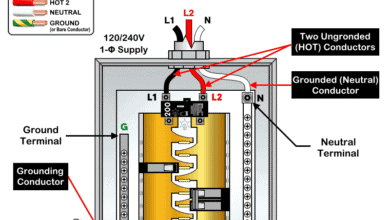
For example, In a 240V high leg delta three-phase system, the voltage between three hot lines are 240V three-phase while voltage between a two phases is 240V single-phase. Moreover, voltage between one hot and a neutral is 120V single-phase while voltage between High leg and neutral is 208V single-phase.
Similarly, in a 400-415V three-phase system, the voltage between one phase and neutral is approximately 230V, suitable for most single-phase loads.
This way, the load will only “see” the single-phase voltage (e.g., 230V in IEC countries, 120V/240 in the US). Hence, this is safe and common practice. Many buildings with a three-phase feeder still have single-phase lighting, outlets, and appliances connected this way.
Incorrect Connection (Line to Line):
If the single-phase load is accidentally connected across two phases (e.g., L1 and L2), it will be subjected to the line-to-line voltage, which is higher than the phase-to-neutral voltage.
For example, in a 240V high-leg delta system, the line-to-line voltage is 240V three-phase. The voltage between any two standard phases is 240V, while the voltage between a phase and neutral is 120V single-phase. This is except for the high leg (also called the wild leg), which measures about 208V to neutral.
Similarly. in a 400-415V three-phase system, the line-to-line voltage is 400V, while a single-phase load might be rated for 230V.
When you connect the load between two phases without neutral, the load will see the phase-to-phase voltage. This voltage is √3 times higher than phase-to-neutral voltage (e.g., 415V in IEC countries, 208V in the US). If the load is not rated for this higher voltage, it will burn out almost instantly.
Consequently, the load will likely be damaged or destroyed due to overvoltage. This could result in overheating, insulation breakdown, or immediate failure of the equipment.
Not Possible (Across All Three Lines)
A single-phase load cannot be directly connected across all three phases because the voltages are out of phase with each other. Moreover, most single-phase devices has only two terminals for phase and neutral. Therefore, it is impossible to connect all three phase wires to the single-phase device. If attempted incorrectly, this can cause short circuits, unbalanced currents, or damage.
Related Post: Can an AC Device Operate on DC Supply, and Vice Versa?
Connecting a Three-Phase Load to a Single-Phase Supply
A three-phase load (like a three-phase induction motor or industrial equipment) is designed to operate with three phase wires, each carrying an alternating current offset by 120 degrees. A single-phase supply provides only one phase, typically with a neutral.
Connecting a three-phase device to a single-phase supply has the following possible scenarios and consequences:
Three-Phase Motor Connected to Single-Phase Supply:
A three-phase motor requires all three phases to create a rotating magnetic field for operation. If a three-phase motor is connected to a single-phase supply, the motor will not start because it cannot generate the necessary rotating magnetic field.
Applying single-phase power to one or two windings may cause excessive current draw, overheating, or damage to the motor windings.
In the event of faults, the motor may “single-phase” (if motor is already running on three-phase and one phase is lost). This case leads to reduced torque, overheating, and eventual failure if not stopped.
Hence, directly connecting a three-phase motor to a single-phase supply will cause failure in operation. In this case, the load will not work properly. As a result, motors may not start at all or will draw excessive current in one winding, overheating rapidly.
Related Post: How to Run a Three-Phase Induction Motor on a Single-Phase Power Supply?
Other Three-Phase Loads (e.g., Heaters or Transformers):
If a three-phase load, such as a heater or transformer, is connected to a single-phase supply, only one section of the load will receive power. Since a three-phase device is designed to operate with three conductors carrying voltages that are 120° out of phase, supplying it with only a single phase will result in partial operation or complete failure to operate. Consequently, the equipment may not function as intended, and the uneven power distribution could lead to overheating or damage to the connected components.
Similarly, heaters wired in delta or star may work partially, but at reduced power and with potential imbalance damage.
Possibility Using a Phase Converter:
To run a three-phase load on single-phase power, you need a rotary phase converter, static phase converter, or variable frequency drive (VFD) to create the missing phases. This is common in workshops without three-phase service where a three-phase load runs safely on single-phase supply.
However, the single-phase to three-phase converter must be properly sized for the load. Improper use can lead to inefficient operation or equipment damage.
Precaution:
- Use appropriate circuit breakers or fuses to protect the load.
- Improper connections may lead to short circuits, ground faults, or tripped circuit breakers if protective devices are in place.
- If the neutral is not connected properly, it could cause floating voltages, posing a safety hazard.
- Always verify the voltage rating of the single-phase load matches the phase-to-neutral or phase-to-phase voltage of the supply.
- Ensure proper wiring and consult a licensed electrician to avoid unbalanced loading or incorrect connections.
Resources:
- Can We Use AC Circuit Breaker for DC Circuit & Vice Versa?
- What happens to the 3-Phase Motor When 1 Out of 3 Phases is Lost?
- What happens to the 3-Phase Motor When 2 Out of 3 Phases are Lost?
- Why are 1-Phase Motors Not Self-Starting Like 3-Phase Motors?
- Difference Between Single Phase and Three Phase Power Supply
- Advantages of Three Phase System Over Single Phase System
- If a 1-Phase Supply is 230V, Why is 3-Phase 400V & Not 690V?
- Why 3-Phase Power? Why Not 6, 12 or More for Power Transmission?
- How to Toggle Electric Water Heater Between 120V and 240V?
- Why Do Some Devices Have Dual Input Voltage Ratings?
- Why is AC Commonly Used in Households Instead of DC?
- Why are High-Power Devices Not Designed to Run on DC Voltage?
- Can you use 15A Breaker on 20A Circuit and Vice Versa?
- Can You use a 15A Outlet on a 20A Circuit and Vice Versa?
- Will a DC Shunt Motor Operate on an AC Supply?
- How Do Some Devices Operate on Both AC and DC Supplies?
- Difference Between Single Phase and Three Phase Transformer
- Difference Between Single Phase & Three Phase Induction Motor
- How to Size a Single Phase and Three Phase Transformer in kVA?
- Single Phase Electrical Wiring Installation in Home – NEC & IEC
- Three Phase Electrical Wiring Installation in Home – NEC & IEC