Why are 1-Phase Motors Not Self-Starting Like 3-Phase Motors?
Why a Single-Phase Induction Motor is Not Self-Starting, While a Three-Phase Induction Motor Can Start on Its Own?
Single-phase induction motors are not self-starting because they produce an evolving magnetic field instead of a rotating magnetic field. This phenomenon often surprises beginners in electrical engineering or individuals new to the subject. Let’s find out the exact reason why and how it happens.
Single-phase and three phase induction motors are widely used in household and commercial appliances e.g. fans, pumps, blowers and other low/high power applications due to their simplicity and cost-effectiveness. However, unlike their three-phase motors, single-phase induction motors are not self-starting.
It is one of the drawbacks of single-phase induction motors compared to three-phase induction motors. To overcome this issue, special techniques and starting methods are used to make a single-phase induction motor self-starting.
While three-phase induction motors are inherently self-starting, single-phase induction motors require special mechanisms to initiate rotation. To understand the logic behind the theory, let’s find how it works.
- Related Post: Why is a Capacitor Needed for a Single-Phase Motor?
Why is a Single-Phase Induction Motor Not Self-Starting?
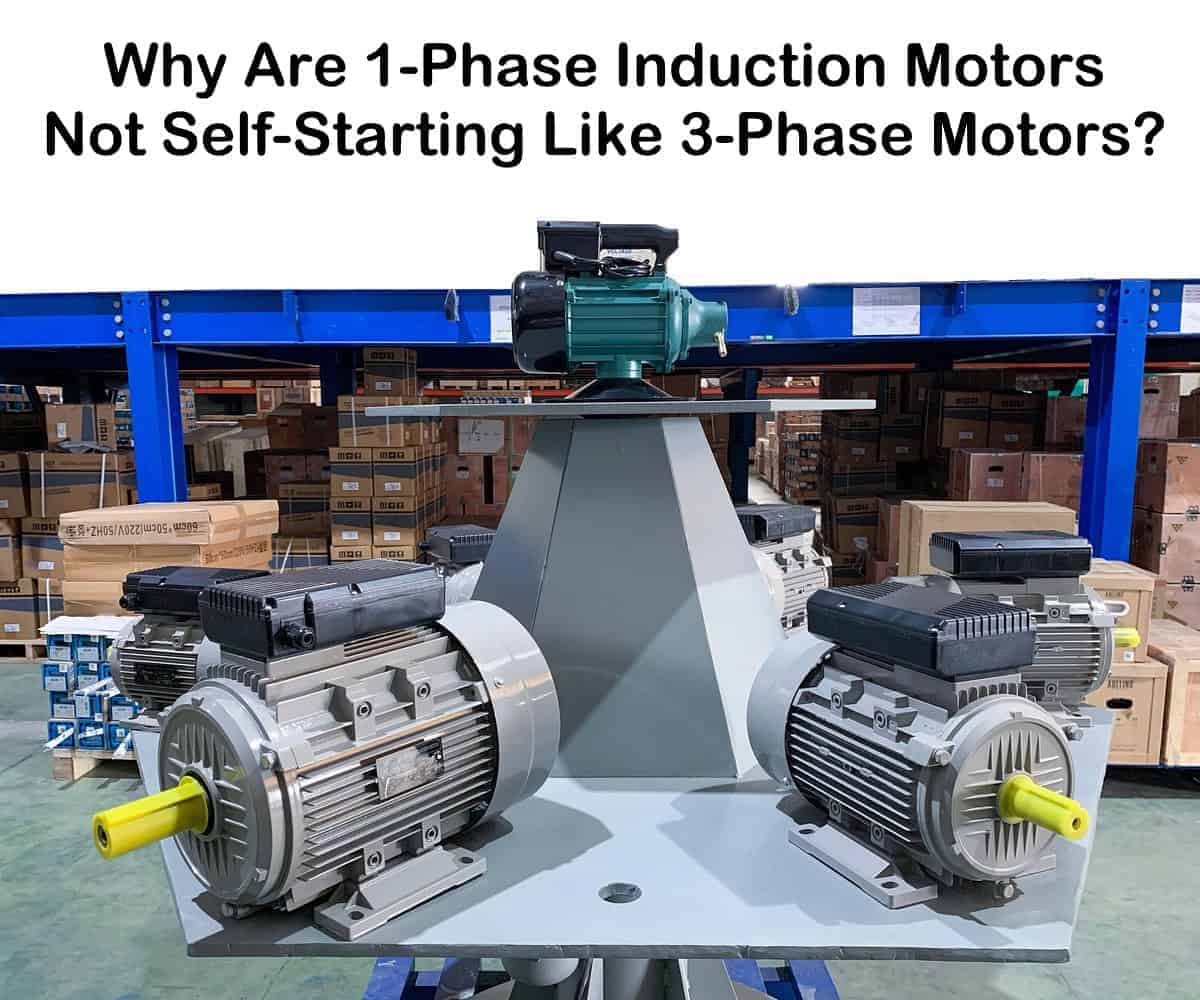
Single-phase induction motors rely on a single-phase AC supply, which produces a pulsating magnetic field rather than a rotating one. This pulsating field alternates in direction but does not rotate. As a result, it generates zero net torque at standstill. Without a rotating magnetic field, the rotor cannot initiate motion. Consequently, this effect makes single-phase induction motors inherently non-self-starting.
The core issue lies in the nature of the single-phase AC supply. When the stator winding is energized, it creates a magnetic field that oscillates along a single axis. This field can be thought of as two counter-rotating fields (as explained by the double-field revolving theory). At standstill, these fields produce equal and opposite torques, canceling each other out. As a result, the rotor remains stationary unless an external mechanism provides the initial push.
Double-Revolving Field Theory
The double-revolving field theory provides a theoretical framework to understand why single-phase induction motors fail to self-start. According to this theory, the pulsating magnetic field produced by a single-phase stator winding can be resolved into two equal and opposite rotating magnetic fields. These fields rotate at synchronous speed in opposite directions.
The single-phase AC supply creates a magnetic field that alternates along a fixed axis. This pulsating field can be mathematically decomposed into two rotating fields: one moving clockwise and the other counterclockwise.
At standstill, the rotor experiences equal and opposite torques from these two fields. The process of torque cancellation leads to net zero torque. Hence, it prevents the rotor from rotation and starting the motor.
For this reason, a single-phase induction motor requires an external push or a rotating field to start, which is usually not feasible due to the motor’s internal structure or because it may be loaded in some cases. For automatic operation, a special mechanism must be incorporated into the motor’s circuitry to provide this starting action internally.
Once the rotor is given an initial push by applied mechanism in one direction, the torque from the field rotating in the same direction dominates. Hence, it allows the motor to start and continue running.
- Related Post: Why is the Synchronous Motor Not Self Starting?
This scenario is not possible in a single-phase induction motor because the single-phase supply produces an alternating current that reverses every half cycle. The resultant starting torque is zero, which is why a single-phase motor is not self-starting.
Cross-Field Theory
The cross-field theory explains what happens inside a single-phase induction motor when it is connected to a single-phase supply. The theory also shows how it restricts motion during the initial phase, thereby preventing the motor from starting.
This theory focuses on the interaction between the stator’s main winding and the rotor’s induced currents.
- At standstill, the cross field is absent because no rotor motion exists to induce currents. Thus, the motor cannot self-start.
- The stator’s main winding produces a pulsating magnetic field (main field). As the rotor begins to rotate (after an external push), currents induced in the rotor create a secondary magnetic field, known as the cross field, perpendicular to the main field.
- The interaction between the main field and the cross field produces a resultant rotating magnetic field once external push is applied. As a result, it generates torque, sustains the rotor’s motion and allow the motor to accelerate at rated speed.
For instance, when a single-phase induction motor at a stand-still position is connected to a single-phase AC supply, an alternating magnetic flux is produced in the stator windings along its axis.
Due to mutual induction, similar to transformers, the produced magnetic field links with the rotor windings through the air gap. As a result, an EMF is generated in the rotor windings. Since the rotor circuit is closed, this induced EMF causes a current to flow through it.
According to Len’s Law, the induced EMF will cause a current to flow in such a direction that its magnetic effect opposes the change that produced it. Therefore, the induced current in the rotor flows in a way that opposes the air-gap field responsible for its generation. The direction of this induced current in the rotor can be determined using Fleming’s Left-Hand Rule.
This entire process is illustrated in the following figure. For example, when the air-gap magnetic field (Φs) is directed upward, the rotor conductors on the left side carry a current that produces a force causing the rotor to rotate from left to right. At the same time, the conductors on the right side experience a force in the opposite direction, from right to left.
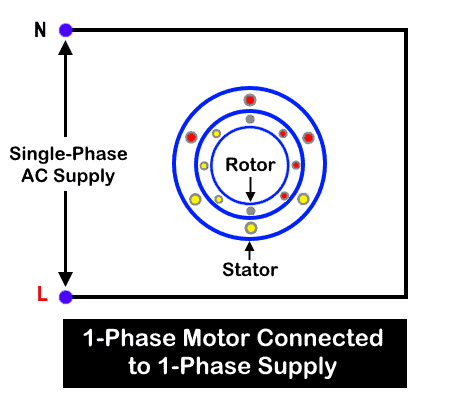
Since the forces generated in the rotor are equal in magnitude but opposite in direction, they cancel each other out. As a result, the net torque produced is zero, causing the rotor to remain stationary. Therefore, the motor is not self-starting.
To counter this issue and make a single-phase induction motor self-starting, an external force is required. This small push causes the rotor conductors to cut the stator’s air-gap magnetic field, thereby producing a rotational EMF. As a result, current is induced in the rotor conductors, which in turn generates its own magnetic flux. This breaks the balance of opposing forces which allows the motor to develop starting torque. Finally, the motor begins rotating in the given direction.
- Related Post: What is the Role of Capacitor in a Ceiling Fan?
How to Self-Start a Single-Phase Induction Motor?
To overcome the non-self-starting nature of single-phase induction motors, various starting mechanisms are employed to create a phase difference in the magnetic field, simulating a rotating field. Below are the most common methods:
1. Split-Phase Starting
In this method, an auxiliary winding (start winding) is placed in the stator alongside the main winding. The start winding has higher resistance and lower inductance which creates a phase difference between the currents in the two windings. This phase difference produces a rotating magnetic field, enabling the motor to start.
A centrifugal switch disconnects the start winding once the motor reaches a certain speed. These types of motors are mostly used in fans, blowers, and small appliances.
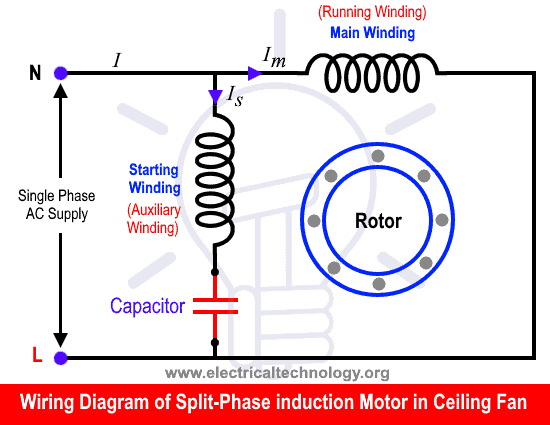
2. Capacitor-Start Motor
In this method, a capacitor is connected in series with the auxiliary winding to create a larger phase shift (typically 90 degrees), which is used to improve the starting torque. The capacitor enhances the phase difference and produces a stronger rotating magnetic field.

The auxiliary winding is disconnected after startup. These kinds of motors are considered ideal for compressors, pumps, and refrigeration units.
3. Capacitor-Start Capacitor-Run Motor
In this way of mechanism, two capacitors are used i.e. one for starting and another for running. The start capacitor provides a high phase shift for starting, while the run capacitor improves efficiency during operation.
The run capacitor remains in the circuit to improve the motor’s performance and power factor. They are used in air conditioners and heavy-duty equipment.

4. Shaded-Pole Motor
A shading coil (a copper ring or coil) is placed on a portion of the stator pole to create a phase shift in the magnetic field. The shading coil delays the magnetic flux in one part of the pole produces a weak rotating field. The amount of field is sufficient for starting low-power motors. These types of motors are commonly used in small fans, timers, and household appliances.

5. Repulsion-Start Motor
A repulsion motor uses brushes and a commutator to create a starting torque. Once running, it operates as a standard induction motor. The brushes are lifted, and the commutator is short-circuited after startup. They are less common but used in specific high-torque applications.

- Related Post: How to Replace a Ceiling Fan Capacitor – 3 Ways
Why are Three-Phase Induction Motors Self-Starting?
In a three-phase induction motor, the stator coils are placed 120° apart from each other. When a three-phase supply is connected to the motor, the stator draws current, which produces a magnetic field.
The magnitude of this magnetic field remains constant, however, the generated flux changes its direction throughout the cycle. As a result, a rotating magnetic field is produced in the air gap of the induction motor. The synchronous speed of this rotating field is given by the following formula:
NS = 120f ÷ P
Where:
- NS = Synchronoss Speed in RPM
- f = Frequency in c/s or Hertz (Hz)
- P = Number of poles
The rotating magnetic flux produced in the stator travels through the air gap and links with the rotor conductors of the induction motor. According to Faraday’s Law of Electromagnetic Induction, the flux linking with the rotor conductors induces an EMF (voltage) in the rotor circuit. Since the rotor conductors are short-circuited through the end rings, current begins to flow in the rotor.
As a result of the interaction between the rotating magnetic field flux and the rotor current, torque is generated in the rotor. Since the magnetic flux is rotational, the torque produced in the rotor also rotates. This is because the torque developed in the motor is directly proportional to the magnetic flux. The generated torque enables the rotor to begin rotating.
This is why a three-phase induction motor is self-starting and does not require any external means to initiate rotation.
Related Posts:
- How to Run a Three-Phase Motor on Single-Phase Supply Using VFD?
- How to Run a Three-Phase Induction Motor on a Single-Phase Power Supply?
- What happens if You Connect a 3-Φ Induction Motor to 1-Phase Supply?
- What Happens to the 3-Phase Motor When 2 Out of 3 Phases are Lost?
- What Happens to the 3-Phase Motor When 1 Out of 3 Phases is Lost?
- Why 3-Phase Power? Why Not 6, 12 or More for Power Transmission?
- If a 1-Phase Supply is 230V, Why is 3-Phase 400V & Not 690V?
- Why Do We Need to Install a Starter with a Motor?
- Why Do DC Motors Have Higher Starting Torque than AC Motors?
- How to Run a Three-Phase Induction Motor on a Single-Phase Power Supply?
- Why is a Motor Rated in kW instead of kVA?
- Why Does A Capacitor Block DC But Pass AC?
- What Happens if We Connect a Polar Capacitor the Wrong Way?
- Can I Run 1-Phase Load on 3-Phase Supply and Vice Versa?
- Can I Use a 1-Phase Breaker on a 3-Phase Supply & Vice Versa?
- Difference Between Single Phase & Three Phase Induction Motor
- Difference Between Single Phase and Three Phase Power Supply
- Advantages of Three Phase System Over Single Phase System
- Difference Between AC and DC Motors
- What Happens if You Use a 120V Device on 240V & Vice Versa?
- Can I Use a 240V Breaker on a 120V Circuit and Vice Versa?
- Can an AC Device Operate on DC Supply, and Vice Versa?