Why is the Rating of a Capacitor Expressed in Farad?
Why is a Capacitor Rated in Farads rather than W, VA or Ah
A capacitor stores electrical energy in the form of an electric field between its plates. The value of capacitance indicates how much electric charge the capacitor can store for a given voltage.
The capacitance of a capacitor is rated in Farads (F) because it measures the component’s capacitance in the form of electric charge. Farad is the SI unit of capacitance which defines the fundamental property of a capacitor, i.e. its ability to store electric charge per unit voltage.
Mathematically, capacitance (C) is the amount of electric charge (Q) stored for every unit of voltage (V) applied. The relationship between these quantities:
Q = C × V
Where:
- Q = Electric charge in Coulombs (C)
- C = Capacitance in Farads (F)
- V = Applied voltage across the capacitor in Volts (V)
It means, 1 Farad = 1 Coulomb per Volt. In other words, a capacitor has a capacitance of 1 Farad if it can store 1 Coulomb of charge when 1 Volt is applied across it.
- Related Post: Why is a Capacitor Bank Rated in kVAR, Not in Farad?
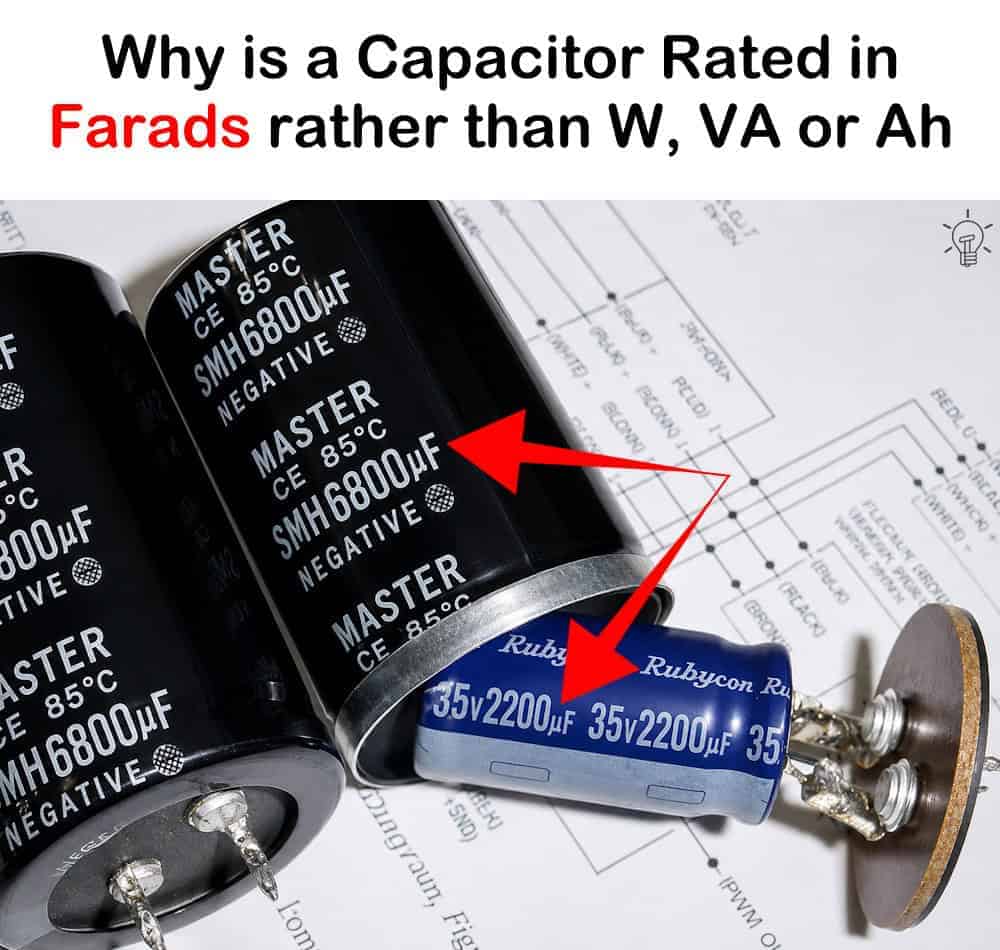
Why Farads Specifically? Why not kW, kVA or Ah?
Just like other electrical devices such as motors, generators, transformers, air conditioners, and batteries are rated in kW (or hp), kVA, tons, and ampere-hours (Ah) respectively, the rating of a capacitor is expressed in Farads (F) because it quantifies the “charge-storage capacity of the capacitor”.
For example, a bucket’s capacity is measured in liters. Similarly, a capacitor’s capacity to hold charge is measured in Farads. A larger Farad value means more charge can be stored at the same voltage.
In addition, the capacitance of a capacitor depends on physical parameters:
C = ε × (A / d)
Where:
- ε = permittivity of the dielectric material
- A = area of the plates
- d = distance between the plates
Farads naturally emerge from these physical quantities i.e. it’s derived from SI base units:
F = C2·s2/kg·m2).
The unit “Farad” is named after the English scientist and physicist Michael Faraday, who made major contributions to electromagnetism and electrochemistry in the 19th century. The unit “Farad” honors his pioneering research, which established the fundamental principles of capacitance.
A pure 1 Farad capacitance is enormously large in practice, which is why real-world capacitors are typically rated in smaller units.
| Unit | Value |
| Millifarad (mF) | 10-3 F |
| Microfarad (µF) | 10-6 F |
| Nanofarad (nF) | 10-9 F |
| Picofarad (pF) | 10-12 F |
Good to Know:
- A 1 µF (microfarad) capacitor stores less charge than a 1000 µF capacitor at the same voltage.
- Supercapacitors (used in energy storage) may be rated in hundreds or thousands of Farads because they can store a very large amount of charge.
Why is Capacitors Rated in kVAR in Power System where the Unit of Capacitance is Farad?
As we know, capacitors are normally rated in Farads, which indicate how much electric charge they can store for every volt applied across their plates. However, you may have noticed that the rating of capacitors sometimes is expressed in kVAR instead of Farads.
kVAR is the unit of reactive power by capacitors which stands for (Kilo-Volt-Amperes Reactive). When a capacitor is used in power system for power factor correction, the unit kVAR is used rather than farads.
This is because capacitor banks are used to absorb or supply reactive power in order to improve the power factor in a power system, not primarily to store electric charge like capacitors used in DC circuits for filtering, resonant networks, coupling, decoupling, or time-constant applications.
In an AC transmission and distribution system, reactive power “Q“ supplied by a capacitor is
Q = V2 × ωC
Where
- Q = Reactive power by capacitor in (VAR)
- V = RMS line voltage,
- ω = 2πf … (f is the frequency)
- C = capacitance
This clearly indicates how much reactive power (VAR) a capacitor can provide at a given voltage and frequency to reduce the reactive current drawn from the power source. This helps correct the power factor (P.F), active power (W), and apparent power (kVA), to enhance the overall efficiency of the power system.
Related Posts:
- Why is a Transformer Rated in kVA, but Not in kW?
- Why is a Motor rated in kW instead of kVA?
- Why is an Alternator and Generator rated in kVA, not in kW?
- Why is a Battery rated in Ah (Ampere hour) and not in VA?
- Why is an Air-condition (AC) Rated in Ton, not kW or kVA?
- Why is a Power Plant Capacity Rated in MW and not in MVA?
- Why was a Circuit Breaker Capacity Rated in MVA and Now in kA and kV?
Resources:
- General Capacitor Nameplate Rating (Electrolytic Capacitor)
- Why are Capacitors Connected in Series in Power Lines?
- Why is a Capacitor Bank Connected in Parallel and Not in Series for P.F?
- Difference Between Shunt Capacitors and Shunt Reactors
- Why is a Capacitor Needed for a Single-Phase Motor?
- Capacitor Color Codes – How To Read Capacitor Value? Calculator
- Capacitor Bank in kVAR & µF Calculator for Power Factor Correction
- How to Calculate the Suitable Capacitor Size in µ-Farads & kVAR for P.F Improvement
- How to Convert Capacitor μ-Farads to kVAR and Vice Versa? – For P.F Correction
- Power Factor Correction Calculator – How to Find P.F Capacitor in µF & kVAR?
- Formula and Equations For Capacitor and Capacitance
- What Happens if We Connect a Polar Capacitor the Wrong Way?
- What is the Role of Capacitor in a Ceiling Fan?
- What is the Role of Capacitor in AC and DC Circuit?
- Why Does A Capacitor Block DC But Pass AC?
- Difference Between a Battery and a Capacitor
- How to Test a Capacitor using Digital and Analog Multimeter