Wiring a 600/347V, Single & Three Phase Main Breaker Box for Commercial Applications
What is 347 & 600V Commercial Supply?
The 600/347V commercial supply is a common three-phase, four-wire (3-Φ, 4W) electrical power system commonly used in Canada and some older installations in the US for medium to large commercial and industrial applications.
It is a grounded system with three hot conductors and a neutral conductor, connected in a wye configuration from the secondary of a utility transformer.
The Star (Y or Wye) connected 600/347V main panel or load center for power distribution offers the following levels of voltages:
- 347V Single Phase, 3 Wires (One Hot wire + Neutral wire + Ground wire)
- 600V Single Phase, 2 Wires (Two out of phase Hot wires + Ground wire)
- 600V Three Phase, 4-5 Wires (Three out of phase Hot wires + Neutral wire (if needed) + Ground wire)
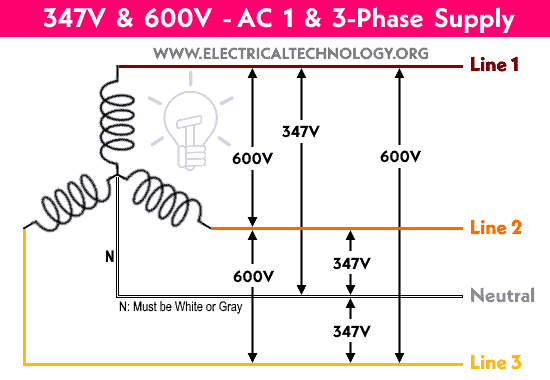
Good to Know: 600/347V system is similar to 480/277V systems used in the United States, but Canada uses 600/347V as its standard for many commercial installations.
This voltage system is mainly used in commercial, industrial, and large building applications in Canada for commercial buildings, industrial facilities. It is mainly used three-phase machinery rated for 600V such as, HVAC units, pumps, motors, elevators, and large commercial appliances rated for 600V. The 347V single phase supply is used for lighting circuits which is efficient for commercial fluorescent or LED lighting.
Good to Know:
Why 600/347V is Beneficial than 277/480?
Compared to the 277/480V system used in the United States, Canada uses a 600/347V system in industrial and large commercial facilities that require high-wattage applications. To keep the current (amps) low, higher distribution voltage is used. This approach reduces conductor size requirements and helps save costs on feeders and cables.
Voltage Levels in 347/600V Panel
In a 600/347V three-phase wye (Y) system, the voltage relationships are based on the following formulas
VL-L = √3 × VL-N
600V ≈ 1.732 × 347V
Hence:
- Line-to-Line (or Phase to Phase) voltage (VL-L) = 600V
- Line-to-Neutral (or Phase to Neutral) voltage (VL-N) = 347V
Based on this type of “wye” (or “star”) electrical service provides three different voltage levels, depending on how the circuit is connected:
- Voltage between Phase and Neutral = 600V / √3 = 347V (1-Φ).
- Voltage between two hots (Phases) = 600V (1-Φ).
- Voltage between three hots (Phases) = 347V × √3 = 600V (3-Φ).
347V Single Phase = It is the line-to-neutral voltage and measured between any one of the three hot phases and the neutral wire. This is commonly used for high-efficiency commercial lighting and smaller single-phase loads.
600V Single Phase: It is the line-to-line voltage, measured between any two of the three hot phases. This voltage system is rarely used in specific applications.
600V Three Phase: It is the line-to-line voltage, measured between three hot phases. This higher voltage is used to power larger three-phase equipment such as motors, pumps, and HVAC systems.
In simple words, the available voltage levels in a 347V and 600V, 1-Phase & 3-Phase main service panel are as follows:
- Voltage between three hot wires (hot 1, hot 2 & hot 3) = 600V, 3-Phase
- Voltage between any two hot wires = 600V, 1-Phase
- Voltage between any hot wire and Neutral = 347V, 1-Phase
Click image or open in a new tab to enlarge

Now, Let’s see how to wire 600V and 347V, single phase and three phase breakers and load circuits in the breaker box as follows.
Wiring 347V, 1-Phase Circuits using 1-P Breakers
The following tutorial explains how to wire a 347V single-phase circuit derived from a 600V three-phase commercial supply.
A 347V single-phase voltage is obtained between any one hot conductor (Hot 1, Hot 2, or Hot 3) and the Neutral. For example, in the figure below, a 347V-rated UFO LED parking-lot light is connected to a single-pole breaker. The 1-pole breaker and its associated 347V outlet are connected to Hot 2, Neutral, and Ground.
You may use a 347V single-phase NEMA locking receptacle, such as NEMA L24-20. This is a 2-pole, 3-wire grounded receptacle that requires three conductors e.g., one hot conductor from the breaker, plus the neutral and the equipment grounding conductor (EGC) from the neutral/ground busbar in the main panel.
Wiring 600V, 1-Phase Circuits using 2-P Breakers
The 600V single phase between any two HOT lines is rarely used. If 600V, 1-phase is needed, a double-pole breaker rated for 600V can be used between any two lines. As an example load, 600V, 1-Φ industrial heater is connected between Hot 1 and Hot 2 using 2-pole breaker rated for 600V.
The following NEMA locking outlets rated up to 600V can be wired between two hots for 600V – single phase.
- NEMA L9-20, L9-30, L9-50, L9-60 – (2-pole, 3-wire) grounding – No Neutral – rated for 600V
Similarly, 600V single phase loads such as resistive and reactive load banks, HV air heaters, transformers (to get 120/240V supply) are used in 347/600V panel via 2-pole breakers in commercial applications.
Wiring 600V, 3-Phase Circuits using 3-P Breakers
For 600V, three phase circuits, we need four or five wires (Three Hots + Neutral (if needed) + Ground. As shown in the following fig, three phase motor is connected through three hot wires + ground wire using the three-pole 600V breaker.
The three-phase NEMA locking outlets rated for 600V with gerund and neutral wires (if required), are also wired the same way using 3-pole breaker rated for 600V as follows:
- NEMA L13-30 for three phase (3-pole, 3 wire) non-grounding – No neutral
- NEMA L17-30, L17-50, L17-60 (3-pole, 4 wire) grounding – No neutral
- NEMA L20-20, NEMA L20-30 (4-pole, 4-wire) with neutral – non-grounding
- NEMA L23-20, L23-30, L23-50, L23-60 (4-pole, 5-wire) groaning with neutral
Click image or open in a new tab to enlarge

Wiring Color Codes for 347V & 600V
For 347V & 600V service, the following wiring color codes are used based on Canadian Electrical Code (CEC).
- Red = Hot 1 or Line 1
- Black = Hot 2 or Line 2
- Blue = Hot 3 or Line 3
- White = Neutral Wire
- Green or Green with Yellow stripes = Bare Conductor as Ground wire (EGC)
Good to Know:
- Green, green/yellow, or bare conductors must never be used for any wire that carries voltage. These colors are reserved exclusively for equipment grounding conductors (EGC).
- Only and only use copper wire to reduce the resistance and heat instead of aluminum wires in the main panel box wiring.
- The terms Hot, Phase, and Line all refer to the same thing i.e. conductors that carry live voltage
- Never touch the main lugs (terminal screws) located before the main breaker, as they remain continuously live and carry high voltage even when the main breaker is switched OFF.
Instructions & Precautions
- Always disconnect the power source (and confirm it is completely switched OFF) before servicing, repairing, or installing any electrical equipment. Turn off the main switch in the main panel before beginning any work.
- Follow all applicable CEC and NEC requirements for main panels, load centers, and electrical installations.
- Never stand on or touch wet surfaces or metallic parts while working on live electrical circuits.
- Read all cautions and instructions carefully, and follow them strictly when performing this tutorial or any practical electrical work.
- Always use properly sized service-entrance cables, feeder conductors, and branch-circuit conductors for service disconnects, main panels/load centers, and branch circuits.
- Use correctly sized Equipment Grounding Conductors (EGC) and Grounding Electrode Conductors (GEC) for the main panel and all load points.
- Use the correct wire and cable size (based on NEC Table 310.16 or CEC Table (1-4), as well as appropriate outlets, switches, and properly sized circuit breakers. A wire and cable size calculator may also be used to determine the proper gauge and associated ampacities.
Warning:
- Never attempt to work with electricity without proper knowledge, supervision, and safety precautions. Electrical work should be performed in the presence of experienced professionals who understand safe working practices.
- DIY electrical work can be dangerous and may also be illegal. Consult a licensed electrician or your local electrical power provider before making any changes or modifications to electrical wiring systems.
- Disclaimer: The author is not responsible for any losses, injuries, or damages resulting from the use or misuse of this information, or from improper implementation of any circuit. Please exercise extreme caution as electricity is hazardous and can be fatal.
Resources:
Related Main Panels Wiring Tutorials
- How to Wire 120V/240V Main Panel? Breaker Box Installation
- How to Wire 120V/208V, 1-Phase & 3-Phase Main Panel?
- How to Wire 120/208/240V High Leg Delta 1-Phase & 3-Phase Main Panel?
- How to Wire 277/480V, 1-Phase & 3-Phase Main Service Panel?
- How to Wire 347/600V, 1 and 3-Phase Main Service Panel … You are Here
- How to Wire a Subpanel? Main Lug Installation for 120V/240V
- Single Phase Electrical Wiring Installation in Home according to NEC & IEC
- Three Phase Electrical Wiring Installation in Home – NEC & IEC
- How To Wire a Single Phase kWh Meter – 120V/240V
- How to Wire a Three-Phase Meter? 120/208/240/277/347/480/600V
Sizing Breakers, Wires, and Panels
- How to Size a Load Center, Panelboards and Distribution Board?
- How to Determine the Right Size Capacity of a Subpanel?
- How to Find the Right Wire Size for 100A Service 120V/240V Panel?
- How to Size a Circuit Breaker?
- How to Find the Proper Size of Wire & Cable In Metric & Imperial Systems
- How to Size a Breaker and Wires in AWG with EGC for Load?
- How to Size Service-Entrance Conductors and Feeder Cables?
- How to Size Feeder Conductors with Overcurrent Protection
- How to Size a Branch Circuit Conductors with Protection?
- How to Size Equipment Grounding Conductor (EGC)?
- How to Size Grounding Electrode Conductor (GEC)?
- How to Size Motors FLC, HP, Voltage, Breaker Size and Wire Size
- What is the Correct Wire Size for 100A Breaker and Load?
- What is the Right Wire Size for 15A Breaker and Outlet?
- What is the Suitable Wire Size for 20A Breaker and Outlet?
Standard Breakers & GFCI Breakers Wiring Installations
- How to Wire 1-Pole Breaker
- How to Wire 2-Pole Breaker
- How to Wire 3-Pole Breaker
- How to Wire Tandem Breaker
- How to Wire a GFCI Circuit Breaker?
- How to Wire an AFCI Breaker?
General Outlets and GFCI/AFCI Receptacles Wiring
- How to Wire an Outlet Receptacle? Socket Outlet Wiring Diagrams
- How to wire a GFCI Outlet?
- How to Wire GFCI Combo Switch and Outlet
- How to Wire an AFCI Combo Switch
- How to Wire an AFCI Outlet?
- How to a Wire 3-Way Combination Switch and Grounded Outlet?
- How to Wire Combo Switch and Outlet? – Switch/Outlet Combo Wiring Diagrams
- How to Wire a 15A – 120V Outlet – NEMA 5-15 Receptacle
- How to Wire a 20A – 120V Outlet – NEMA 5-20 Receptacle
- How to Wire a 15A – 240V Outlet – NEMA 6-15 Receptacle
- How to Wire a 20A – 240V Outlet – NEMA 6-20 Receptacle
- How to Wire a 50A – 125/250V Outlet – NEMA 14-50 Receptacle
Switches Wiring
- How to Wire Single Pole, Single Throw (SPST) as 2-Way Switch?
- How to Wire Single Pole, Double Throw (SPDT) as 3-Way Switch?
- How to Wire Double Pole, Single Throw Switch? Wiring DPST
- How to Wire Double Pole, Double Throw Switch? Wiring DPDT
- How to Wire Double Switch? 2-Gang, 1-Way Switch – IEC & NEC
- How to Wire 4-Way Switch (NEC) or Intermediate Switch as 3-Way (IEC)?
- How to Wire Auto & Manual Changeover & Transfer Switch – (1 & 3 Phase)
Finding the Number of Breakers/Outlets in a Circuit
- How to Determine the Number of Circuit Breakers in a Panelboard?
- How to Find the Number of Outlets on a Single Circuit Breaker?
- How to Find Voltage & Ampere Rating of Switch, Plug, Outlet & Receptacle
- How to Calculate the Number of Fluorescent Lamps in a Final Sub Circuit?
- How to Calculate the Number of Incandescent Lamps in a Final Sub Circuit?
- How to Determine the Number of Lighting Branch Circuits?
- How to Determine the Number of Branch Circuits? – 3 Ways
- How to Find the Number of Lights on a Single Circuit Breaker?
General Wiring Installation Tutorials:
- How to Toggle Electric Water Heater Between 120V and 240V?
- How to Wire 120V Water Heater Thermostat – Non-Simultaneous?
- How to Wire 240V Water Heater Thermostat – Non-Continuous?
- How to Wire 3-Phase Simultaneous Water Heater Thermostat?
- How to Wire Twin Timer for 120V/240V Circuits – ON/OFF Delay
- How to Wire ST01 Timer with Relay & Contactor for 120V/240V Motors?
- How to Wire Multifunction ON/OFF Delay Timer for 120V/240V Motors?
- Even More Residential Wiring Installation Tutorials
-
 How to Wire and Use Tesla Gen 3 Mobile Connector Charger
-
 How to Wire 48A Level 2 Dual Port EV Charging Station
-
 How to Wire Smart Electric Vehicle Charging Station – 32A/80A
-
 How to Wire ChargePoint Home Flex Charger for Every EV
-
 How to Wire an EV Wall Charger – Hardwired and Plug-in
-
 How to Wire AC Level 2 EV Smart Breaker Charger – 40A/32A