How to Wire a 60A, 125V/250V – NEMA 14-60 Receptacle
How to Install a NEMA 14-60 Receptacle with Breaker/GFCI for Heavy-Duty EV Chargers and Connectors
A NEMA 14-60R is a type of electrical receptacle, or outlet, designed for high-power applications. They are typically found in industrial equipment, commercial settings and some electric vehicle (EV) chargers.
NEMA 14-60 is a 3P, 4W receptacle and capable to handle 60-amps at 125/250V, single phase power supply. The industrial grade 60-amp receptacle is also suitable for high-wattage residential equipment, industrial welding and large machinery.
In this wiring tutorial, we will show you how to wire a NEMA 14-60 receptacle using both ordinary and GFCI breakers, along with the correct breaker and wire size for high-wattage applications and EV charging.
The NEMA 14-60 Receptacle
The NEMA 14-60R is a 125/250V receptacle with grounded neutral, used with 14-60P plug. As the name suggests, the “60” in the 14-60R indicates the maximum amperes of current, while the “R” stands for “Receptacle, outlet, or socket”. Similarly, the “P” in the NEMA-14-60P indicates “Plug”, with “60” denoting the maximum current in amperes.
NEMA 14-60 comes in a 3-pole, 4-wire configuration which means it requires a neutral wire. It has two vertical slots slots (for Hot 1 and Hot 2), a horizontal slot for neutral, and a round ground (U-shaped) slot for EGC.
Terminals
There are four terminals in a 14-60R receptacle in accordance with UL 498 and CSA:
- G (U) Shaped Terminal – Green Screw: Connects to the Ground (G) for EGC (⏚) – Bare or Green Wire.
- X Terminal – Vertical Slot (I) – Brass Screw: Connects to HOT 1 (Line 1) – Black Wire
- Y Terminal – Vertical Slot (I) – Brass Screw: Connects to HOT 2 (Line 2) – Red Wire
- W Horizontal Slot (➖) – Silver Screw: Connects to the Neutral wire – White or Grey Wire.
Click image or open in a new tab to enlarge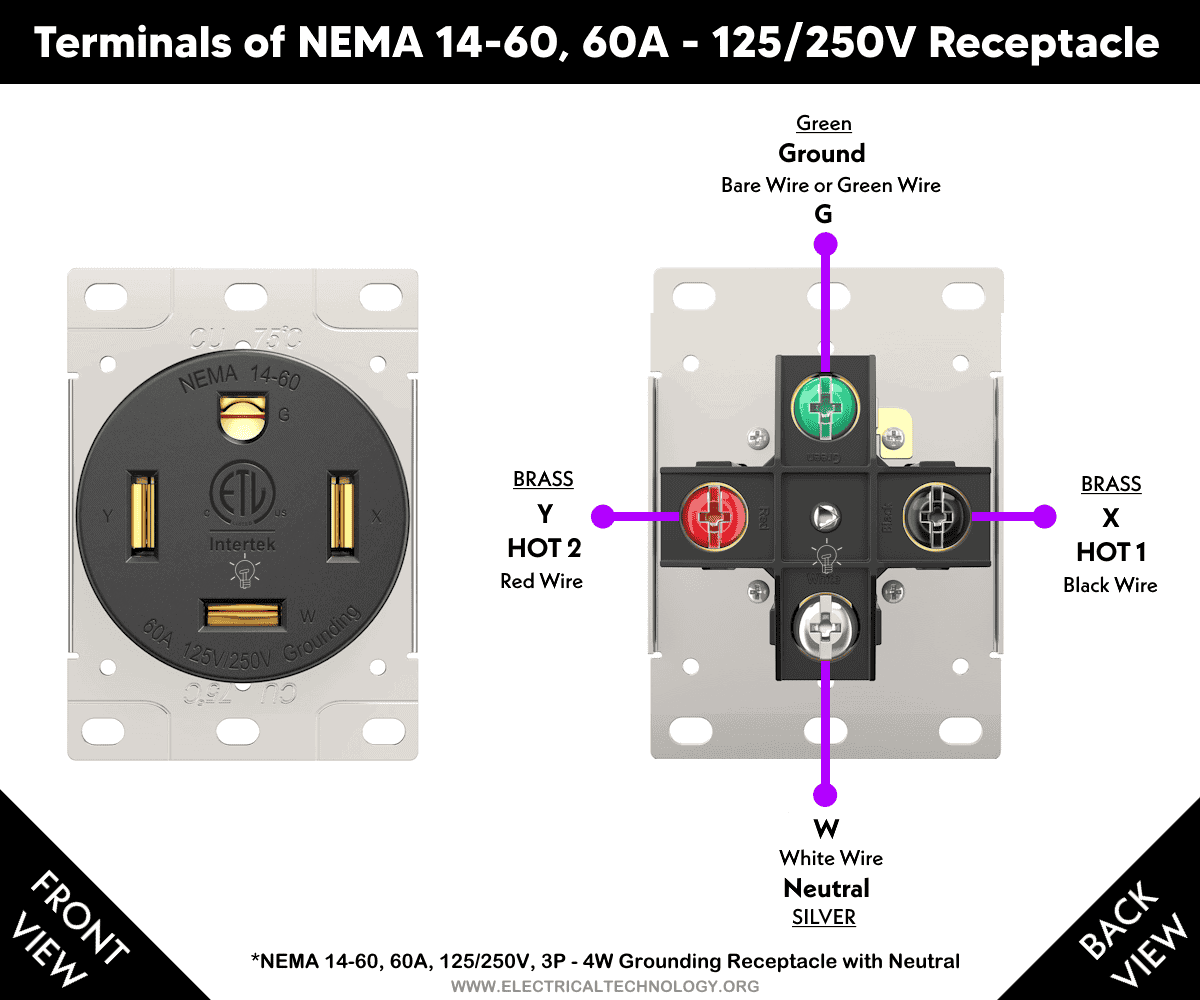
Electrical Ratings & Specifications
- NEMA: 14-60R – Straight-Blade Receptacle
- Poles: 3-Poles, 4 Wires – Grounding – with Neutral
- Wires: Four Wires – Hot 1 & Hot 2, Neutral and Ground
- Voltage: 125V – 250V Single-Phase AC Supply – 60 Hz
- Breaker / GFCI: 60A
- Current: 48A – 60A
- Wattage: 14,400 W
- Wire Size: #4 – #10 AWG (Copper Only)
- Temp. Rating: -40°C to 75°C (-40°F to 167°F)
- Dielectric-strength: Withstand 2kV Min.
- Grade & Material: Industrial Grade – Heavy Gauge Galvanized Steel with Thermoplastic/Composite)
- Mounting: Flush / Screw Mounting
- Outdoor Box: 2-gang outdoor box – NEMA 3R rainproof enclosure
- Wiring: Hardwired / Dedicated Circuit
- Service Disconnect: May or may not be required according to your local area codes.
Wiring NEMA 14-60 Receptacle with a GFCI
A NEMA 14-60R receptacle can be installed either as a plug-in or hardwired connection for EV charging applications. If ground-fault protection is not already built into the charger, the NEMA 14-60 must be protected by a GFCI breaker to prevent safety hazards.
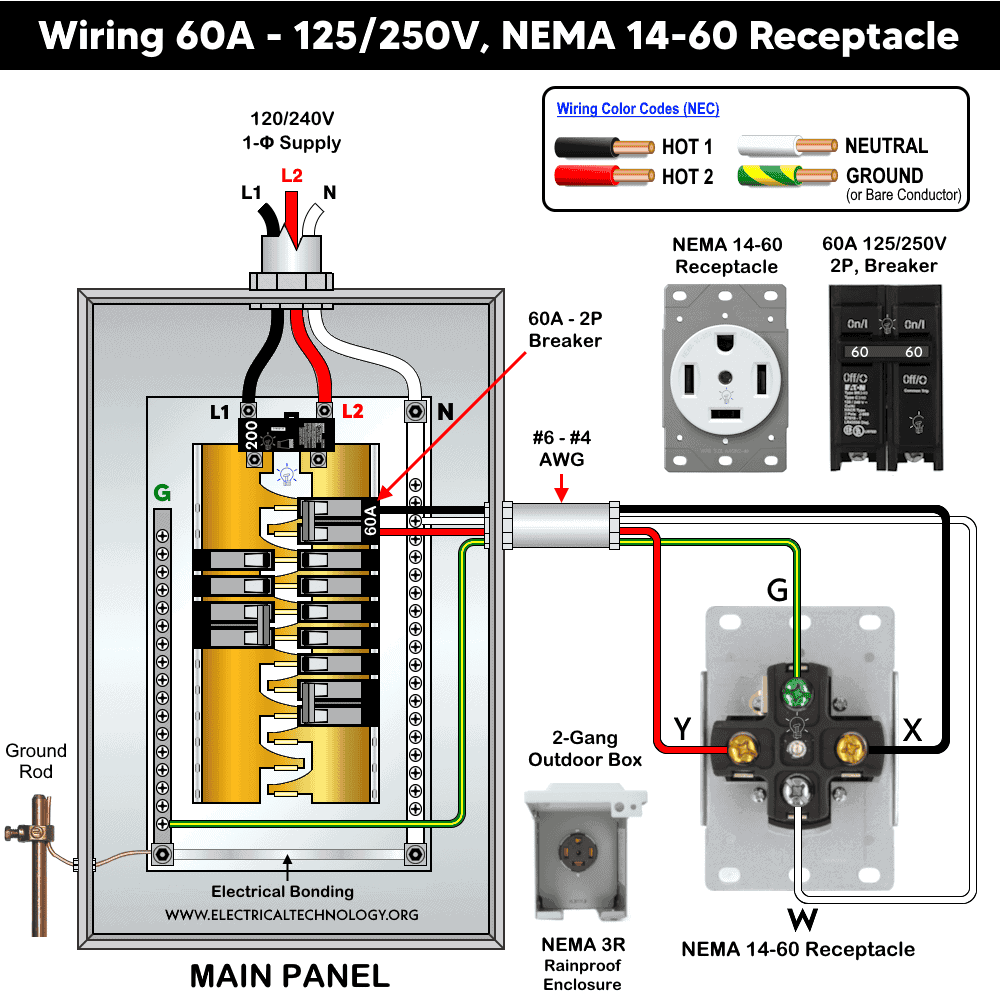
As shown in the figure, connect the two hot wires (Hot 1 (black) and Hot 2 (red)) from the 2-pole, 60A, 120/240V GFCI breaker to the X and Y terminals of the NEMA 14-60 receptacle. Next, connect the neutral wire (white) to the W terminal, and the ground wire (bare copper or green with yellow stripe) to the G terminal. For proper operation, don’t forget to connect the built-in white wire in the GFCI to the neutral busbar in the 120/240V main panel.
Although the NEMA 14-60 receptacle can accept wire sizes from #12 AWG to #4 AWG, the recommended conductors for this application are #4 AWG or #6 AWG, depending on the current requirement and installation conditions.
For outdoor installations, use a NEMA 3R weatherproof (rainproof) 2-gang enclosure to provide adequate protection against moisture and environmental exposure.
The following wiring diagram illustrates how to install a NEMA 14-60R, 60-amp heavy-duty receptacle using a 2-pole, 60A GFCI breaker.
Click image or open in a new tab to enlarge

Wiring NEMA 14-60 Receptacle with a Breaker
The wiring configuration of a NEMA 14-60 receptacle with a 60A, 120/240V, 2-pole standard breaker is the same as that used with a 2-pole GFCI breaker.
Using a standard breaker for this installation helps prevent unwanted tripping, especially when the EV charger already has built-in GFCI protection (as most modern chargers do).
The following wiring diagram shows how to connect a NEMA 14-60, 60-amp receptacle using a 2-pole, 60A standard breaker for RVs or other high-power appliances.
Click image or open in a new tab to enlarge
FAQs:
Should I Use a GFCI or Standard Breaker with NEMA 14-60 Receptacle ?
You should use a standard 2-pole 60A breaker unless your local electrical code requires GFCI protection. Many EV chargers already have built-in GFCI protection, and double protection can cause nuisance tripping. If GFCI is required by NEC (e.g., in garages or outdoors), use a 2-pole 60A GFCI breaker.
For instance, If you are in a state which adopted the NEC – 2020 or 2023, you have the following options:
- Install a GFCI prior the NEMA 14-60 receptacle to work with the mobile connector and plug adapters.
- Replace the existing socket outlet with a disconnect switch and hard wire the Electric Vehicle Supply Equipment “EVSE”.
How Many Amps Can NEMA 14-60 Receptacle Handle Safely?
A NEMA 14-60 receptacle is rated for 60 amps maximum. For continuous loads (3+ hours, such as EV charging), NEC requires derating to 80% of breaker rating (also known as 125% rule) specified in 210.19(A)(1) and 210.20(A), so it can handle up to 48 amps continuously.
- Continues Load: 60A × 80% = 48-Amp
- Non-continuous Load: 60-Amp
In the case of an industrial-grade 60-amp receptacle, it is designed to safely handle a continuous load of 60 amps for extended periods of time.
These ratings comply with NEC Sections 210.19(A)(1), 215.2, and 230.42(A) for continuous and non-continuous loads, and 110.14(C) for ambient temperature.
Which Breaker Size is Suitable for 14-60 Receptacle ?
For continuous load, we will use the 80% rule (which shows only 80% of the load should be connected to the rated circuit breaker). In addition, the size of the OCPD (fuse or circuit breaker) should handle 125% of the load circuit as per NEC 210.20(A) & 210.21.
- Continues Load of 48A × 125% = 60-Amp
- Non-continuous Load = 60-Amp
Based on NEC 210.19(A)(1), 210.20(A), and 210.23(E), the correct breaker size for 60-amp receptacle (NEMA 14-60) is a 2-pole 60A breaker or GFCI at 240V.
How Many Watts Can a 60A, 14-60 Receptacle Hold?
At 240V, a 60A receptacle can supply:
- Maximum: 60A × 240V = 14,400 watts
- Continuous load (80% rule): 48A × 240V = 11,520 Watts
What is the Correct Wire Size and Cable Type to Use with NEMA 14-60?
As mentioned before, the 60-amp receptacle can be used for 48A continuous and 60-amp non-continuous load, (industrial grade can be used for 60-amp continuous).
The suitable wire size for 60A circuit is determined using NEC tables. For this ampacity, the #6 AWG copper can carry 55A at 60°C (140°F), 65A at 75°C (167°F) and 75A at 90°C (194°F) which is suitable wire size for NEMA 14-60 receptacle according to NEC Table 310.16) and CEC Table 2.
Similarly, for a circuit of up to 60-amp protected by OCPDs, the ground conductor can be smaller than the non-grounded conductors. Hence, ground wire (EGC) can be #10 AWG as per NEC Table 250.122.
- Copper conductors: Minimum #6 AWG THHN/THWN in conduit
- EGC (Ground Wire): Min #10 AWG
- Aluminum conductors: Minimum #4 AWG (Not recommended)
- For indoor NM-B cable, #6/3 with ground is acceptable. Always follow NEC ampacity tables and adjust for distance, ambient temperature, or conduit fill.
Can I Use NEMA 14-60 Receptacle on a 50A Breaker?
NO/YES
No, a NEMA 14-60 receptacle must be protected by a 60-amp breaker. Using it on a 50A breaker is a code violation because the receptacle’s rating must match or exceed the breaker size.
Yes, if you need to draw a maximum of 48–50 amps of continuous current for charging purposes, you may use a NEMA 14-60 receptacle on a 50A breaker. However, the load must not exceed 48A for continuous use, in accordance with the 80% rule for continuous loads. This is because the breaker rating (not the receptacle rating) ultimately determines the maximum allowable load on the circuit. Exceeding this limit will cause the breaker to trip, leaving the vehicle uncharged.
For this reason, a NEMA 14-60 receptacle should be protected with a 60A breaker when the intended continuous load is above 48A.
Can You Install NEMA 14-60R in 120V AC Circuit?
No, a NEMA 14-60 is designed for 240V, 4-wire circuits (2 hots, 1 neutral, 1 ground). This configuration is not feasible in single phase 120V supply (1 Hot + Neutral + Ground).
While technically, it can be installed on a 120V where only 120V will be available between one hot leg and Neutral, but Installing it on a 120V circuit is unsafe and non-compliant. This is because someone may connect 240V device in this 120V circuit which may damage the device. Therefore, Use a properly rated 120V receptacle instead.
Instructions, Precautions & Codes
- If your main purpose for installing the 14-60R receptacle is for EV charging, use an industrial-grade, EV rated device.
- It is recommended to hardwire instead of plug-in a 60-amp receptacle especially for EV charging.
- Install the 14-60R near the vehicle charging port, a maximum of 15 feet (4.5 meters) away.
- The recommended height of the outlet is 4 ft (1.2 meters) above the floor.
- If the installation location is near the main panel and you want to install it in the lower portion, a minimum height of 18 inches (45 cm) above the ground is suitable.
- The 14-60R should not be used with single-gang wall boxes. Use a 2-gang outdoor box and NEMA 3R rainproof enclosure, especially for outdoor applications.
- According to the NEC Table – 310.16 and 210.24.(1), the correct Breaker and Wire size for a 60-Amp, 14-60 outlet is #6 AWG copper.
- Use #6-3 wires (including 2-hot, 1 neutral and 1 ground) for 240V, 60-Amp breaker and outlet/receptacle.
- Longer runs (when the distance is more than 50 ft (15.25 meters) require an upgrade and larger wire gauge size to compensate for voltage drop.
- A standard 60-amp outlet can be used for a 48-amp continuous load and a maximum 60-amp non-continuous load (210.19(A)), 215.2, and 230.42(A). However, the industrial grade can be used for 60-amp continuous load.
- It is against the code to use a 60-amp outlet to draw 60-amp on a 50-amp breaker.
- It is against the code to use smaller gauge wire sizes (e.g., using 10, 12 AWG) instead of 6 AWG wire with a 60-amp breaker and outlet.
- According to the NEC – 310.16, add 20% of additional ampacity for every 100 feet (30.50 meters) of distance (for example between main panel and subpanel) to counter the voltage drop. For distance and ambient temperature rating (Refer to 110.14(C), 310.15(B)(2)), 310.16 and 240.4(A).
- 60A, 240V outlet can be installed on 60 amp breaker/GFCI only.
- 60A, 240V outlet can only be used as dedicated circuit for single unit.
Resources:
Related Wiring Tutorials
Related Wiring Tutorials
NEMA Family Outlets/Receptacle Wiring
NEMA 5 -Series
- How to Wire a 15A – 120V Outlet – NEMA 5-15 Receptacle
- How to Wire a 20A – 120V Outlet – NEMA 5-20 Receptacle
- How to Wire a 30A – 120V NEMA 5-30 Receptacle
- How to Wire a 50A – 120V – NEMA 5-50 Receptacle
NEMA 6-Series
- How to Wire a 15A – 240V Outlet – NEMA 6-15 Receptacle
- How to Wire a 20A – 240V Outlet – NEMA 6-20 Receptacle
- How to Wire a 30A – 240V – NEMA 6-30 Receptacle
- How to Wire a 50A – 240V – NEMA 6-50 Receptacle
NEMA 10-Series
- How to Wire a 20A, NEMA 10-20 Non-Grounding Receptacle
- How to Wire a 30A, NEMA 10-30 Non-Grounding Receptacle
- How to Wire a 50A, NEMA 10-50 Non-Grounding Receptacle
NEMA 14-Series
- How to Wire a 20A – 125/250V NEMA 14-20 Receptacle
- How to Wire a 30A – 125/250V NEMA 14-30 Receptacle
- How to Wire a 50A – 125/250V NEMA 14-50 Receptacle
- How to Wire a 60A – 125/250V – NEMA 14-60 Receptacle … (You are Here)
NEMA General Outlets/Receptacle
- How to Wire a 15A/125V, NEMA 1-15 Non-Grounding Outlet
- How to Wire a 20A/250V, NEMA 2-20 Non-Grounding Receptacle
- How to Wire a 30A – 125V, NEMA TT-30 Receptacle for RVs
- How to Wire a 3-Phase, 60A – 250V NEMA 15-60 Receptacle
- How to Wire a 3-Phase, 60A – 120/208V NEMA 18-60 Receptacle
Smart Devices Wiring Series
- How to Wire 120/240V Smart Load Center with Smart Breakers
- How to Wire a Smart Breaker in a Smart 120/240V Panel
- How to Wire a Smart GFCI Breaker in a 120/240V Smart Panel
- How to Wire Smart AFCI/GFCI Breaker in a Smart Load Center
- How to Wire a Smart Switch in a 120/240V Load Center
- How to Wire a 15A Wi-Fi Smart Outlet in a Smart Panel
- How to Wire 15A and 20A Wi-Fi Smart GFCI Outlets
General Wiring Installations:
- How to Size a Breaker and Wires in AWG with EGC for Load?
- How to Wire an Outlet Receptacle? Socket Outlet Wiring Diagrams
- How to a Wire 3-Way Combination Switch and Grounded Outlet?
- How to Wire Combo Switch and Outlet? – Switch/Outlet Combo Wiring Diagrams
- How to Wire 120V & 240V Main Panel? Breaker Box Installation
- How to Wire a Subpanel? Main Lug Installation for 120V/240V
- How to Wire 277V & 480V, 1-Phase & 3-Phase, Commercial Main Service Panel?
- How to Wire 240V Water Heater Thermostat – Non-Continuous?
- How to Wire 3-Phase Simultaneous Water Heater Thermostat?
- How to Wire Twin Timer for 120V/240V Circuits – ON/OFF Delay
- How to Wire ST01 Timer with Relay & Contactor for 120V/240V Motors?
- How to Wire Multifunction ON/OFF Delay Timer for 120V/240V Motors?
Switches Wiring
- How to Wire Single Pole, Single Throw (SPST) as 2-Way Switch?
- How to Wire Single Pole, Double Throw (SPDT) as 3-Way Switch?
- How to Wire Double Pole, Single Throw Switch? Wiring DPST
- How to Wire Double Pole, Double Throw Switch? Wiring DPDT
- How to Wire Double Switch? 2-Gang, 1-Way Switch – IEC & NEC
- How to Wire 4-Way Switch (NEC) or Intermediate Switch as 3-Way (IEC)?
GFCI/AFCI Breaker/Outlet Wiring
- How to Wire a GFCI Circuit Breaker?
- How to wire a GFCI Outlet?
- How to Wire GFCI Combo Switch and Outlet – GFCI Switch/Outlet
- How to Wire an AFCI Breaker?
- How to Wire an AFCI Outlet?
Related Posts:
- What is the Right Wire Size for 60A Breaker and Outlet?
- What is the Difference Between 15-Amp and 20-Amp Outlet?
- Difference Between Socket, Outlet and Receptacle
- Difference Between NEMA 14-50 Standard Vs EV Receptacle
- How to Find the Number of Outlets on a Single Circuit Breaker?
- How to Find Voltage & Ampere Rating of Switch, Plug, Outlet & Receptacle
- Can you use 15A Breaker on 20A Circuit and Vice Versa?
- Can You use a 15A Outlet on a 20A Circuit and Vice Versa?
- Ground Terminal Up or Down: Which Way Should Outlets Face?
- What Do the Green Dot or Orange Triangle Outlets Mean?
- What Do the Different Colors of Electrical Outlets Indicate?
- Why are Outlets and Receptacles in Hospitals Upside Down?
- How to Size a Load Center, Panelboards and Distribution Board?
- How to Determine the Number of Circuit Breakers in a Panelboard?
- How to Find the Proper Size of Circuit Breaker? Breaker Size Calculator & Examples
- How to Find The Suitable Size of Cable & Wire for Electrical Wiring Installation?
- Why is the Neutral Prong or Slot Wider on a Plug or Outlet?
- What Will Happen If You Connect a Male-to-Male Plug Between Outlets