How to Wire a 50A, NEMA 10-50 Non-Grounding Receptacle
How to Replace a 50A, 125/250V, NEMA 10-50 Receptacle with a 2-P Breaker in Existing Installations
The NEMA 10-family (10-20, 10-30, and 10-50) has been obsolete since 1965. These receptacles were commonly used for ranges and dryers until 1996. in 1997, NEC switched from NEMA 10 to 14-series. Some in the welding community still use NEMA 10-series outlets and receptacles, but doing so is now against code.
NEMA 10 devices can only be replaced when an existing receptacle is broken. In other words, NEMA 10 receptacles cannot be installed in new buildings or installations. If a replacement is required, it is safer to upgrade to a modern alternative, such as NEMA 6-50 or NEMA 14-50, which include proper grounding and (for 14-50) a neutral connection.
When replacing a damaged NEMA 10-50 receptacle in an existing installation, ensure you use a 50A, 2-pole breaker or GFCI breaker if required by local code. Be aware that using a GFCI breaker with a 10-50R may lead to nuisance tripping (when neutral is bonded to the frame). This is because the receptacle lacks a separate ground wire to be properly compatible with GFCI.
The NEMA 10-50 Outlets & Receptacles
The NEMA 10-50R is a 50-amp, 125/250V, non-grounding receptacle. It is wired with two hot wires and a neutral wire and is designed to be used with a matching NEMA 10-50P plug. The “50” in 10-50R indicates the maximum current rating in amperes, while the “R” stands for “Receptacle.” Similarly, the “P” in NEMA 10-50P stands for “Plug.”
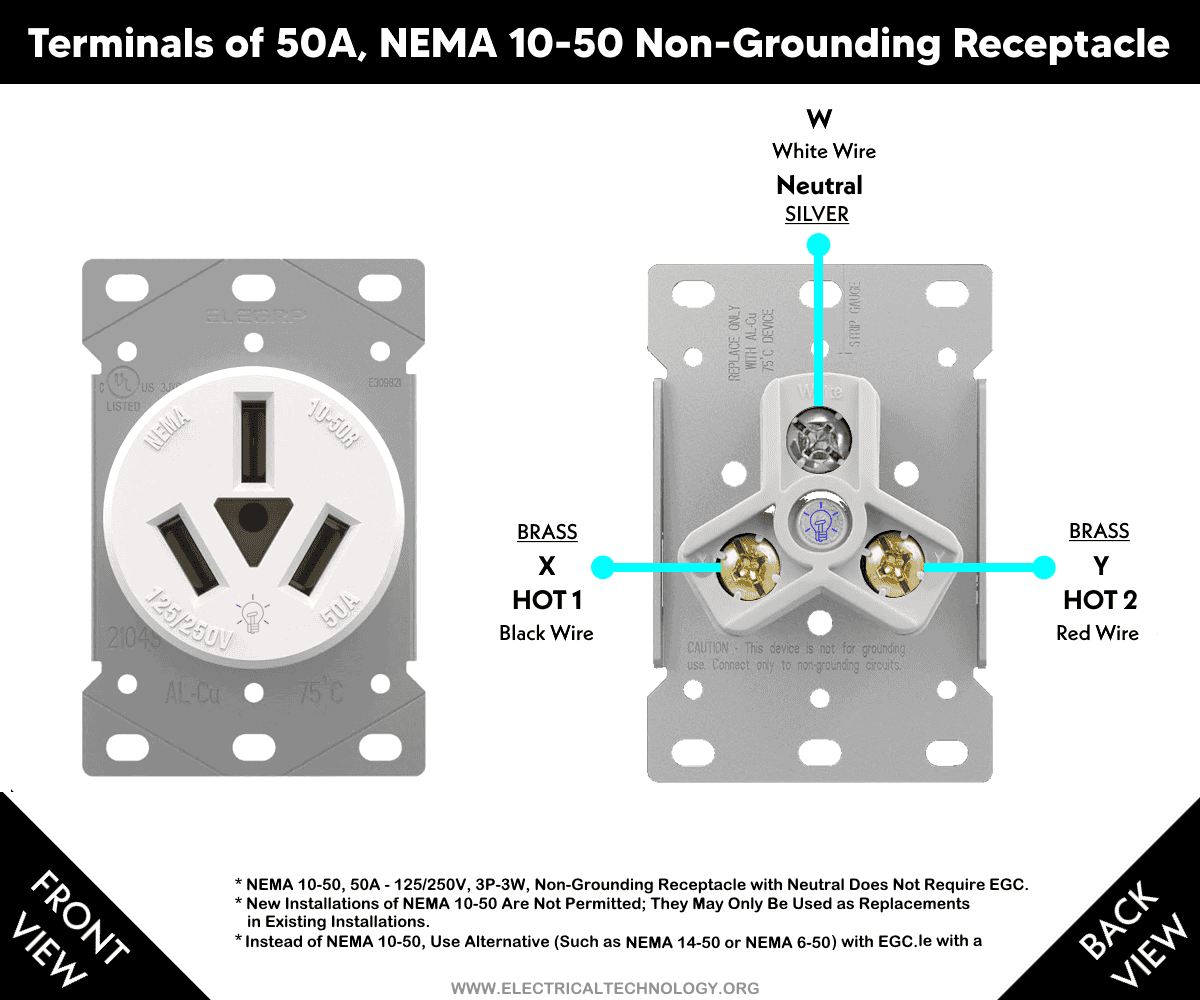
The NEMA 10-50 has a 3-pole, 3-wire configuration (Hot 1, Hot 2, and Neutral). It is a non-grounding, straight-blade device that does not include a dedicated grounding conductor. It has two angled hot slots (for Hot 1 and Hot 2) and one straight vertical slot for the neutral wire.
Click image or open in a new tab to enlarge
Terminals
There are Three (3) terminals in a NEMA 10-50 receptacle:
- X Terminal (Brass Screw): Connects to Black Wire – HOT 1 (Line 1)
- Y Terminal (Brass Screw): Connects to Red Wire – HOT 2 (Line 2)
- W Terminal (Silver Screw): Connects to the White Wire – Neutral Wire
Electrical Ratings & Specifications
- NEMA: NEMA 10-50R – Straight-Blade Receptacle
- Poles: 3-Pole, 3-Wire, Non-Grounding with Neutral
- Wires: 3 Wires – Hot 1, Hot 2 and Neutral
- Voltage: 125/250V Single-Phase AC Supply – 60 Hz
- Breaker: 50A
- Current: 40A – 50A
- Wattage: 12,000 W
- Wire Size: #6 AWG (Copper Only)
- Temp. Rating: -40°C to 75°C (-40°F to 167°F)
- Dielectric-strength: Withstand 2,000V Min.
- Grade & Material: Industrial Grade – Thermoplastic
- Mounting: Flush / Screw Mounting
- Outdoor Box: 2-gang outdoor box – NEMA 3R rainproof enclosure
- Wiring: Hardwired / Dedicated Circuit
Wiring NEMA 10-50R Outlet with 2P Breaker
A NEMA 10-50 can be installed as a replacement in an existing installation, either as a plug-in connection or as a hardwired connection.
As shown in the wiring diagram, connect Hot 1 (black) and Hot 2 (red) from the 2-pole, 50A breaker to the X and Y terminals of the NEMA 10-50 receptacle. Then, connect the neutral wire (white) to the W terminal in the 120/240V or 208/240V main panel.
Although the NEMA 10-50 receptacle can accept wire sizes ranging from #10 AWG to #4 AWG, #6 AWG copper conductors are recommended for a 50A circuit and associated 10-50R outlet.
Click image or open in a new tab to enlarge
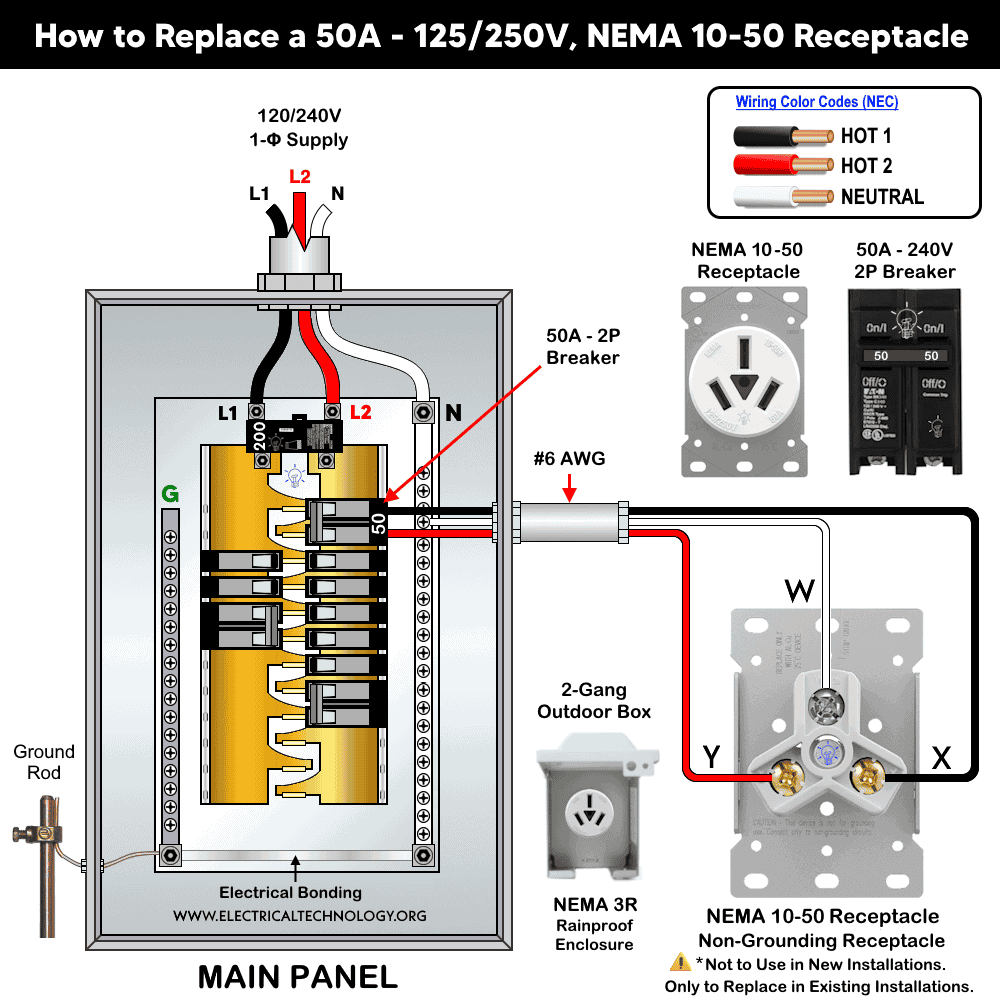
While available in two variants, use an industrial grade instead of residential grade receptacles. For outdoor installations, use a NEMA 3R weatherproof (rainproof) 2-gang enclosure to protect the receptacle from moisture and environmental exposure.
FAQs:
How Many Amps Can a NEMA 10-50 Handle Safely?
A NEMA 10-50 receptacle is rated for 50 amps maximum, but per NEC guidelines, it can safely handle up to 40A continuous load (80% rule) and 50A non-continuous load.
If it is an industrial grade, you may use it for 50A continuously without overloading.
How Many Watts Can a NEMA 10-50 Receptacle Hold?
On a 240V circuit, a 10-50 receptacle can deliver up to 12,000 watts (12 kW) (50A × 240V). For continuous loads, limit to 9,600 watts (9.6 kW).
Which Breaker Size is Suitable for a NEMA 10-50 Receptacle?
A 50A, double-pole breaker is the correct choice for a NEMA 10-50 receptacle. Always use a breaker that matches the receptacle rating and wire capacity.
What is the Correct Wire Size and Cable Type to use with NEMA 10-50?
Based on NEC Table – 310.16, the correct wire size is #6 AWG copper (THHN/THWN in conduit) or 6/3 NM-B cable (if allowed) for a 50A circuit. Since NEMA 10-50 does not have a grounding conductor, follow local codes carefully as modern installations often require a 4-wire grounded receptacles such as NEMA 14-50 or 6-50.
Can You Use 10-50R for EV Charging?
No, you should not use a NEMA 10-50R receptacle for EV charging because it lacks a safety ground connection. Equipment grounding conductor is required by modern electric vehicle chargers (EVSEs) and current electrical codes.
The recommended and safe solution is to have a licensed electrician install a NEMA 14-50R or 6-50R receptacle, which includes the required ground wire.
Can you Install NEMA 10-50 In New Installations?
NO! The NEC no longer allows NEMA 10-50 receptacles for new installations because they lack a grounding conductor. They are only permitted for replacement in existing installations. For new installations, use a NEMA 14-50 or 6-50 or other grounded receptacle type for improved safety.
How Can I Replace a NEMA 10-50 with NEMA 6-50 without Running an additional Wire?
If you can’t run an additional wire, it is safely to remove the NEMA 10-50R and install a NEMA 6-50R. Simply, mark the Neutral wire with “Ground” (where ground is bonded to the neutral in the main panel) and connect to the Grounding terminal in 6-50.
This will work with EV chargers or ranges which do not need a neutral connection in 240V circuits.
Resources:
Related Wiring Tutorials
Related Wiring Tutorials
NEMA Family Outlets/Receptacle Wiring
NEMA 5 -Series
- How to Wire a 15A – 120V Outlet – NEMA 5-15 Receptacle
- How to Wire a 20A – 120V Outlet – NEMA 5-20 Receptacle
- How to Wire a 30A – 120V NEMA 5-30 Receptacle
- How to Wire a 50A – 120V – NEMA 5-50 Receptacle
NEMA 6-Series
- How to Wire a 15A – 240V Outlet – NEMA 6-15 Receptacle
- How to Wire a 20A – 240V Outlet – NEMA 6-20 Receptacle
- How to Wire a 30A – 240V – NEMA 6-30 Receptacle
- How to Wire a 50A – 240V – NEMA 6-50 Receptacle
NEMA 10-Series
- How to Wire a 20A, NEMA 10-20 Non-Grounding Receptacle
- How to Wire a 30A, NEMA 10-30 Non-Grounding Receptacle
- How to Wire a 50A, NEMA 10-50 Non-Grounding Receptacle … (You are Here)
NEMA 14-Series
- How to Wire a 20A – 125/250V NEMA 14-20 Receptacle
- How to Wire a 30A – 125/250V NEMA 14-30 Receptacle
- How to Wire a 50A – 125/250V NEMA 14-50 Receptacle
- How to Wire a 60A – 125/250V – NEMA 14-60 Receptacle
NEMA General Outlets/Receptacle
- How to Wire a 15A/125V, NEMA 1-15 Non-Grounding Outlet
- How to Wire a 20A/250V, NEMA 2-20 Non-Grounding Receptacle
- How to Wire a 30A – 125V, NEMA TT-30 Receptacle for RVs
- How to Wire a 3-Phase, 60A – 250V NEMA 15-60 Receptacle
- How to Wire a 3-Phase, 60A – 120/208V NEMA 18-60 Receptacle
Smart Devices Wiring Series
- How to Wire 120/240V Smart Load Center with Smart Breakers
- How to Wire a Smart Breaker in a Smart 120/240V Panel
- How to Wire a Smart GFCI Breaker in a 120/240V Smart Panel
- How to Wire Smart AFCI/GFCI Breaker in a Smart Load Center
- How to Wire a Smart Switch in a 120/240V Load Center
- How to Wire a 15A Wi-Fi Smart Outlet in a Smart Panel
- How to Wire 15A and 20A Wi-Fi Smart GFCI Outlets
General Wiring Installations:
- How to Size a Breaker and Wires in AWG with EGC for Load?
- How to Wire an Outlet Receptacle? Socket Outlet Wiring Diagrams
- How to a Wire 3-Way Combination Switch and Grounded Outlet?
- How to Wire Combo Switch and Outlet? – Switch/Outlet Combo Wiring Diagrams
- How to Wire 120V & 240V Main Panel? Breaker Box Installation
- How to Wire a Subpanel? Main Lug Installation for 120V/240V
- How to Wire 277V & 480V, 1-Phase & 3-Phase, Commercial Main Service Panel?
- How to Wire 240V Water Heater Thermostat – Non-Continuous?
- How to Wire 3-Phase Simultaneous Water Heater Thermostat?
- How to Wire Twin Timer for 120V/240V Circuits – ON/OFF Delay
- How to Wire ST01 Timer with Relay & Contactor for 120V/240V Motors?
- How to Wire Multifunction ON/OFF Delay Timer for 120V/240V Motors?
Switches Wiring
- How to Wire Single Pole, Single Throw (SPST) as 2-Way Switch?
- How to Wire Single Pole, Double Throw (SPDT) as 3-Way Switch?
- How to Wire Double Pole, Single Throw Switch? Wiring DPST
- How to Wire Double Pole, Double Throw Switch? Wiring DPDT
- How to Wire Double Switch? 2-Gang, 1-Way Switch – IEC & NEC
- How to Wire 4-Way Switch (NEC) or Intermediate Switch as 3-Way (IEC)?
GFCI/AFCI Breaker/Outlet Wiring
- How to Wire a GFCI Circuit Breaker?
- How to wire a GFCI Outlet?
- How to Wire GFCI Combo Switch and Outlet – GFCI Switch/Outlet
- How to Wire an AFCI Breaker?
- How to Wire an AFCI Outlet?
Related Posts:
- What is the Right Wire Size for 20A Breaker and Outlet?
- What is the Difference Between 15-Amp and 20-Amp Outlet?
- Difference Between Socket, Outlet and Receptacle
- Difference Between NEMA 14-50 Standard Vs EV Receptacle
- How to Find the Number of Outlets on a Single Circuit Breaker?
- How to Find Voltage & Ampere Rating of Switch, Plug, Outlet & Receptacle
- Can you use 15A Breaker on 20A Circuit and Vice Versa?
- Can You use a 15A Outlet on a 20A Circuit and Vice Versa?
- Ground Terminal Up or Down: Which Way Should Outlets Face?
- What Do the Green Dot or Orange Triangle Outlets Mean?
- What Do the Different Colors of Electrical Outlets Indicate?
- Why are Outlets and Receptacles in Hospitals Upside Down?
- How to Size a Load Center, Panelboards and Distribution Board?
- How to Determine the Number of Circuit Breakers in a Panelboard?
- How to Find the Proper Size of Circuit Breaker? Breaker Size Calculator & Examples
- How to Find The Suitable Size of Cable & Wire for Electrical Wiring Installation?
- Why is the Neutral Prong or Slot Wider on a Plug or Outlet?
- What Will Happen If You Connect a Male-to-Male Plug Between Outlets